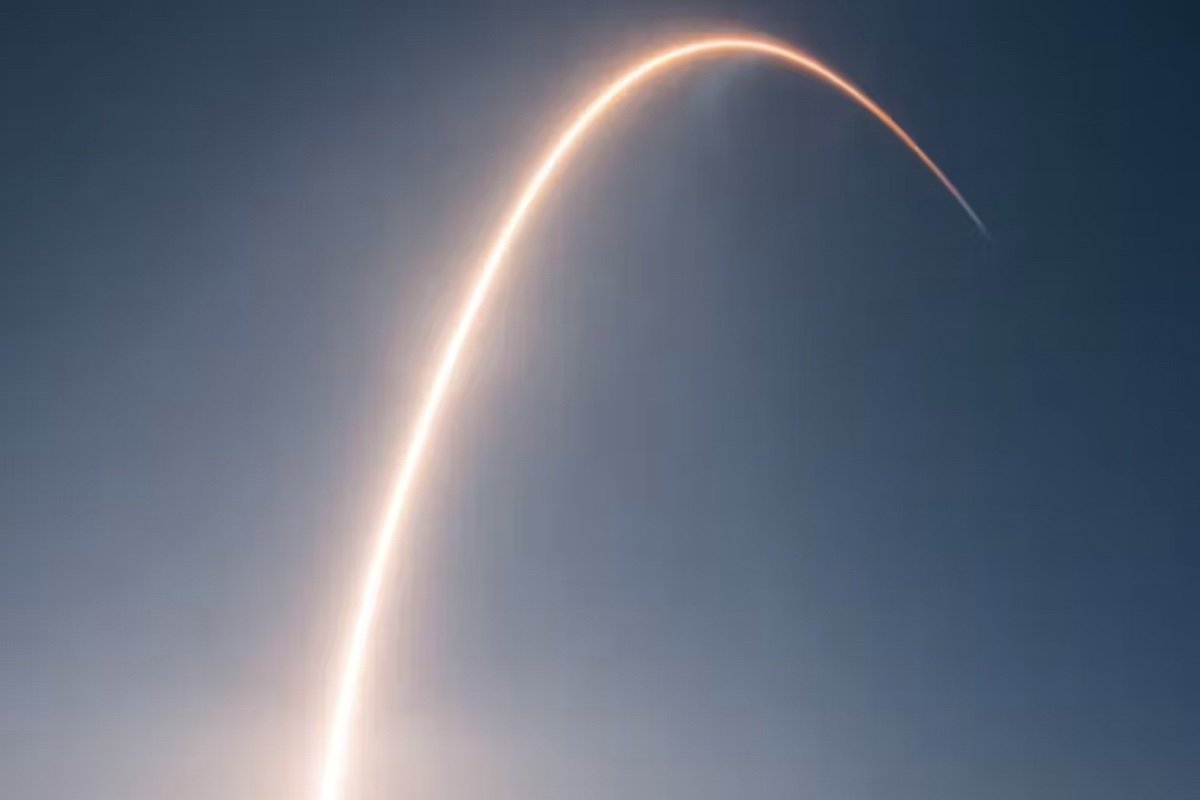
In the early hours of August 5 (UTC), a discarded SpaceX rocket stage is set to strike the lunar surface at roughly 8,700 kilometers per hour. Launched in January 2025, the rocket had delivered two commercial landers to the Moon before running out of fuel. Unable to return to Earth or enter a stable deep-space orbit, it drifted until lunar gravity pulled it onto a collision path.
The impact itself poses no immediate danger. But it spotlights a growing regulatory vacuum. As governments and private companies rush to establish a permanent presence on the Moon, there is virtually no framework for coordinating activities that permanently alter the lunar environment.
A rare scientific opportunity
For astronomers, the accident is a chance to gather data. Because scientists know the rocket's size, speed, and approximate impact zone, the crash offers a unique opportunity to study what happens when an object hits the Moon. Researchers expect the collision to carve a crater 20 to 30 meters across and eject a plume of lunar dust, or regolith, several kilometers high.
The data will help refine computer models of crater formation and dust behavior. But the dust cloud also raises a thorny question: who decides when humanity permanently changes the Moon? Unlike Earth, the Moon has no atmosphere and no weather. Any marks left behind will endure for millennia. Footprints from the Apollo missions, now more than 50 years old, remain visible and could last for thousands of years if undisturbed. The same applies to crash sites.
Sharing the moon
Space agencies, private firms, and researchers are all operating on the Moon simultaneously. Several countries, including China, India, Japan, and the United States, have announced plans for long-term lunar scientific stations. Commercial companies aim to deliver cargo, prospect for resources, operate communication satellites, and eventually support a sustained human presence.
As activity increases, so does the risk of one mission unintentionally harming another. A cloud of high-speed lunar dust kicked up by a landing could damage equipment—such as nuclear-powered bases or satellites—contaminate experiments, destroy a culturally significant site, or even endanger astronauts on the surface. If a poorly planned mission swept away humanity's first footprints or damaged the Apollo lander, it would represent a loss of heritage for all humankind.
By luck rather than design, the upcoming collision is expected to occur near the isolated Einstein Crater, away from most significant lunar landmarks.
Nobody owns the Moon, but some can still change it
SpaceX has unintentionally gained the power to permanently alter the Moon. Yet there is almost no international process for deciding whether, when, or where that should happen. The 1967 Outer Space Treaty, signed by 138 states, is the foundation of international space law. It prohibits any country from claiming sovereignty over the lunar surface and declares the Moon a realm to be explored for the benefit of all humanity. But the treaty says remarkably little about practical governance or environmental regulation.
To date, humans have left more than 187,000 kilograms of material on the Moon. Unlike Earth, the Moon has no equivalent of UNESCO World Heritage protection, domestic heritage laws, or environmental rules. Each country is responsible for supervising its own space companies to ensure compliance with national and international law. That means the U.S. government is, in theory, liable for SpaceX's mistakes.
Lunar accidents could also expose companies to financial liability. Damages to equipment or bases could run into millions of dollars. Accidental deaths could create criminal liability. Damage to a cultural or scientific site could trigger international diplomatic incidents.
More transparency and coordination needed
The United Nations Office for Outer Space Affairs (UNOOSA) and the UN Committee on the Peaceful Uses of Outer Space are already exploring solutions. Working groups are examining how to regulate space resources and better coordinate activities on and around the Moon. But these institutions face severe constraints. UNOOSA has only about 40 staff with a global mandate, and the committee meets for just a few weeks each year. Meanwhile, commercial enterprises are pouring vast sums into the lunar race, leaving the law struggling to keep pace.
The international community does not necessarily need new treaties. It needs to implement the ones it already has. Article XI of the 1967 Outer Space Treaty already calls on states to share information about their space activities. That voluntary measure is fast becoming an operational necessity.
A simple starting point would be a lunar registry where states voluntarily identify planned activities, surface infrastructure, and sites they consider culturally significant. A similar satellite registry is managed by UNOOSA. This complementary lunar registry would capture the operational details the satellite registry was never designed to handle. Aviation has a system of Notices to Airmen to advise pilots of hazards; a lunar equivalent could serve a similar purpose.
As the Moon becomes a crowded arena, the need for clear rules is urgent. The SpaceX crash is a reminder that without coordination, humanity risks turning the lunar surface into a chaotic junkyard—and losing irreplaceable heritage in the process.