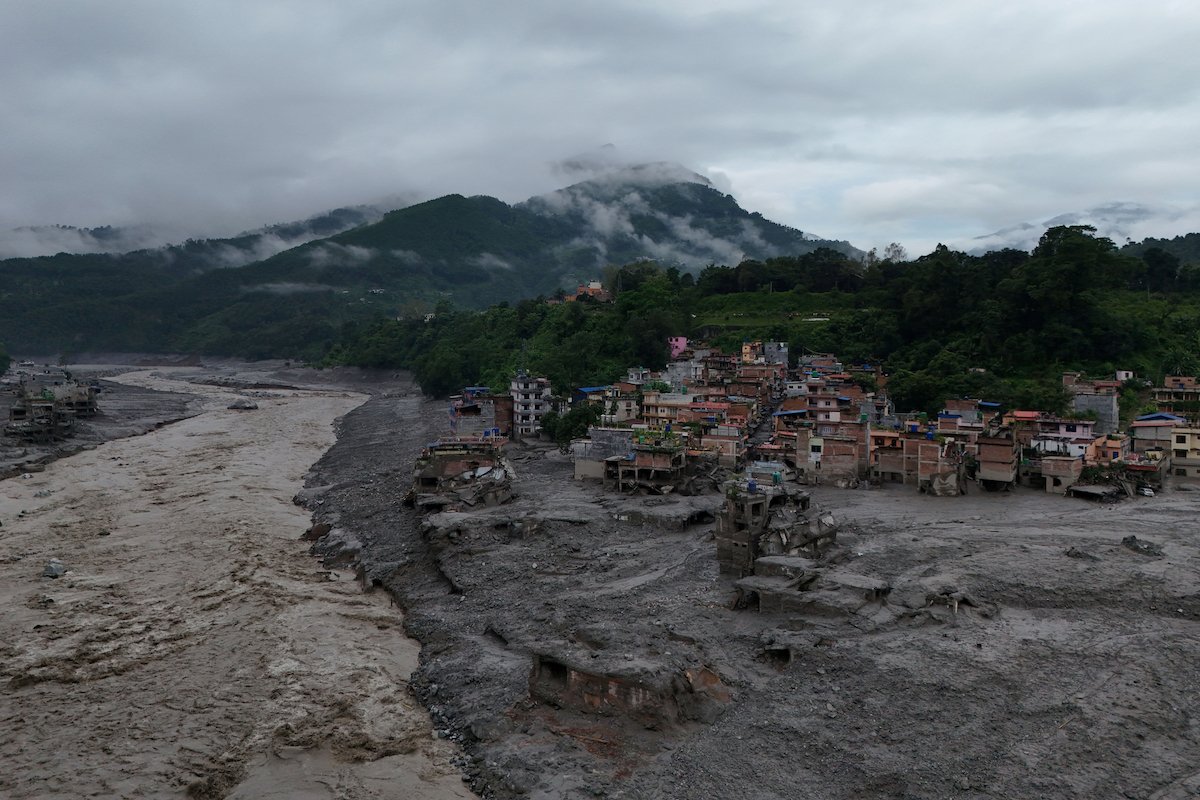
On August 26, the Himalayas seemed to move. An enormous mass of ice and rock broke loose near the Nepal-Tibet border, plunging into the Lhende Khola River and unleashing a wall of water, mud, boulders and debris down the mountain valleys.
What followed was not merely a flood but a cascading geological event: glacier collapse, debris flow, river surge and infrastructure failure compressed into minutes. The torrent swept away homes, bridges, roads and hydropower installations along Nepal’s Bhote Koshi and Trishuli river systems.
By Thursday, 353 were declared dead across Nepal and Tibet, with more than 1,300 missing. Reportedly, these include 517 citizens of more than 33 countries, including 178 from India, 65 Americans, 55 Malaysians, 53 Ukrainians, 25 Canadians and others from Germany, France, UK, Italy and so on.
It may be tempting to see this as another distant natural disaster. But what has happened is a warning about a rapidly changing geography of climate risk. Mountains around the world are becoming less predictable, infrastructure more vulnerable and environmental hazards increasingly transnational.
Glaciers becoming geopolitical actors
The most unsettling was its speed. The US Geological Survey and satellite imagery reveal an ice-rock mass broke away at high altitude, “collapsed about 1.2km vertically” before entering the river system. The resulting surge pushed river levels dramatically upward, in places reportedly by as much as nine meters in 30 minutes.
A glacier did what diplomats and armies do; it crossed a political boundary with dangerous consequences. The collapse occurred on the Tibetan side of the Himalayas; the devastation raced into Nepal; downstream rivers carried the consequences farther downstream, with India placing its neighboring under high alert.
This is the beginning of the new geopolitics of the cryospheres. Climate change is turning ice into an instrument — not of political intention, but of geopolitical consequence. Of course, the question is no longer whether Nepal should develop its hydropower, roads and tourism. The question is whether 20th-century infrastructure can survive 21st-century mountain physics.
Much of Himalayan development remains conceived around a relatively stable understanding of mountain hazards. Roads are carved into unstable slopes—Hydropower projects constructed in narrow valleys. Towns expanded along rivers. Tourism and pilgrimage routes multiplied. Bridges and transmission lines followed the logic of accessibility rather than the increasingly complex logic of cascading risks.
But the climate has changed faster than these engineering assumptions. The 2021 Melamchi flood demonstrated how a single catchment can threaten both urban settlements as well as Kathmandu’s critical water-supply infrastructure. An Asian Development Bank assessment subsequently argued for catchment-wide hazard mapping, early warning and a fundamentally new design basis for infrastructure.
These underlying assumptions must also move from national to regional level. A road should not merely be designed against yesterday’s landslide. A hydropower plant can not be assessed against a historical flood record that assumes the climate is stationary.
Urban expansion cannot treat riverbanks and floodplains as empty real estate. The central engineering question must become: What happens when several hazards occur sequentially — or simultaneously?
Himalayas feed two billion people
The Hindu Kush Himalaya contains more than 63,000 glaciers that provide water and ecosystem services to nearly two billion people, roughly one-quarter of humanity. Agriculture, drinking water, hydropower and major Asian river systems depend upon the mountains’ snow and ice.
The Himalayan cryosphere is changing at extraordinary speed. ICIMOD reported in 2023 that glaciers in the Hindu Kush Himalaya disappeared 65% faster during 2011-2020 than during the preceding decade. Its 2026 assessment found that glaciers have lost up to 27 meters of ice thickness since 1975, with ice loss accelerating markedly since 2000.
For centuries, societies learned to live with monsoon floods, landslides and avalanches as recurring features of Himalayan life. But the Anthropocene is changing those parameters. Warmer temperatures accelerate melting; thawing permafrost weakens mountain slopes; expanding glacial lakes create unstable reservoirs; intense precipitation can mobilize enormous quantities of sediment and rock.
With rampant urbanization downstream, the mountains are becoming more important as water towers but also more dangerous as hazard systems. The result is not simply more floods. It is more complex floods.
Cascade disasters to come
Scientific research now describes Himalayan disasters as compound or cascading events. A 2025 analysis of 1,015 floods across High Mountain Asia found a significant increase in flood frequency since 2000 and, crucially, greater unpredictability in when floods occur. Climate change is interacting with snowmelt, rainfall, glaciers, landslides and topography to create hazards that no longer fit neatly into one category.
The June 2021 Melamchi disaster had combined extreme rainfall with landslides, glacial-lake outburst and temporary river damming. In October 2023, the South Lhonak glacial lake outburst in India’s Sikkim destroyed 13 bridges and a major hydropower plant and affected more than 60,000 people. The 2021 Chamoli disaster in Uttarakhand killed or left missing more than 200 people after a massive rock-and-ice collapse generated a destructive flood.
These are not identical events, and scientists rightly caution against attributing every individual glacier collapse directly to climate change. But the larger physical system is unmistakably changing.
The danger lies precisely in the cascade: a warming climate destabilizes ice and slopes; human settlement increases exposure; infrastructure channels the consequences; and one failure triggers another. No longer can any single nation or sector plan in isolation. The Himalayas demand a new, regional approach to risk — one that matches the scale and speed of the changes already underway. As trans-Himalayan cities face existential climate threats, the need for coordinated adaptation has never been more urgent.