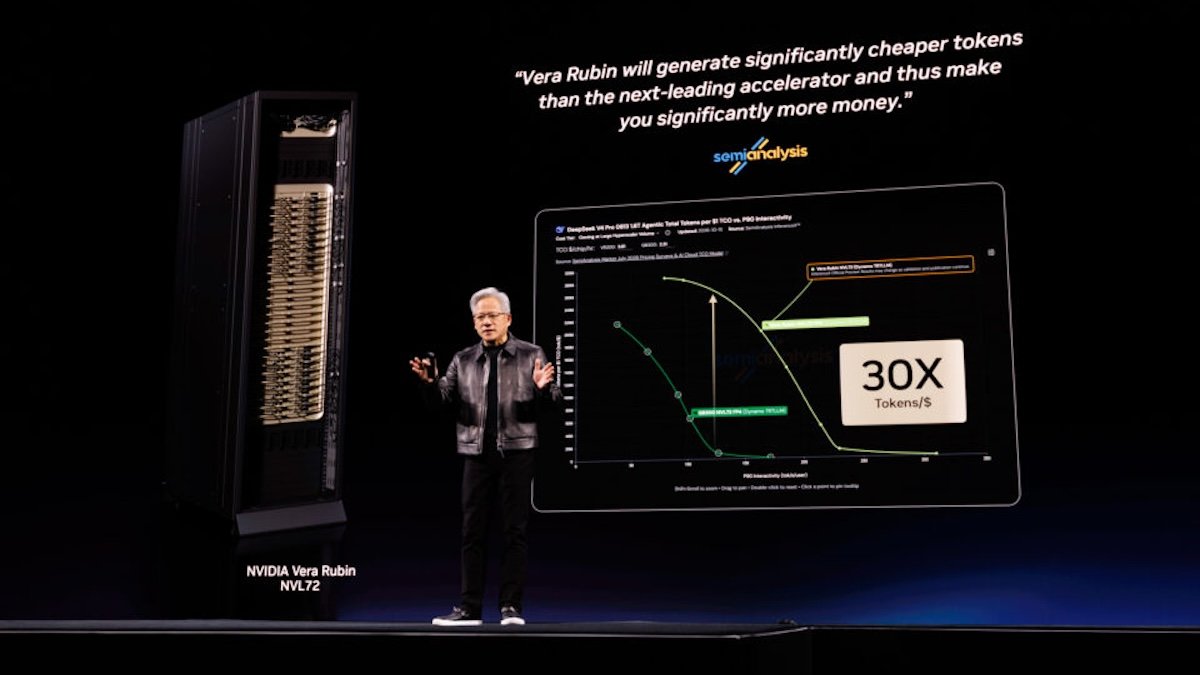
Nvidia shares and broader US equities staged a sharp rebound on Monday, driven by two developments: the return of Jensen Huang to the chipmaker's helm and President Donald Trump's pledge to keep artificial intelligence data centers on American soil. The moves signal a renewed US push to maintain dominance in AI, with direct implications for China's technological trajectory.
Nvidia's stock closed 31.5% higher after the company announced before the market open that its board had reinstated Huang as president and chief executive, effective immediately. The decision came just 11 days after his resignation, which followed his admission of an extramarital affair. The shares had fallen nearly 33% between November 8 and last Friday's close of $125.50.
The broader market also rallied strongly. The Dow Jones Industrial Average climbed 1,556 points, or 3.2%, while the S&P 500 gained 5% and the Nasdaq Composite rose 6.9%. The rebound came after a bruising week that saw the Dow lose 8%, its worst weekly performance since March 2020, as AI-related stocks dragged the index and the S&P 500 into correction territory.
Board's about-face and government input
Nvidia said its board voted unanimously to reinstate Huang after a series of discussions, citing satisfaction with his candor and leadership capabilities. The company added that the decision was informed by input from senior US government officials, who saw no national security risk in Huang's return. A committee of independent directors will continue investigating reports that Huang was the target of a foreign intelligence operation, and the board has established a new National Security and Export Control Committee while searching for a chief compliance officer.
The reversal marks a stark contrast with the board's earlier stance. Just last week, board chair Harvey Jones said during an earnings call that the board did not intend to reinstate Huang. However, after Trump returned from an Asia trip that included a stop in China, Treasury Secretary Scott Bessent signaled on Sunday that Huang's return could not be ruled out. Trump welcomed the decision on Truth Social, calling Huang "a great patriot and national treasure" and asserting that the Attorney General had found no evidence of unlawful conduct.
Huang, in a statement, expressed humility and renewed commitment, saying he was honored to lead "one of the most consequential technology companies in the world at the beginning of a new industrial revolution." His tone contrasted with reports from Bloomberg that he had appeared broken when he agreed to resign, reportedly calling himself a "piece of sh*t" in the days before.
Trump's data center tax threat
Monday's rally also reflected Trump's announcement, made three days earlier, that US companies would be barred from building data centers abroad, with violators facing heavy taxes and penalties. Trump admitted he had not discussed the plan with his staff and provided no specifics on tax rates, timelines, or legal basis. The threat extends beyond new Commerce Department rules requiring licenses for advanced chips shipped to data centers serving Chinese firms at scale, including those in Singapore and Malaysia, though US-headquartered operators are exempt if they report monthly.
The move could affect existing deals, such as Microsoft's $15.2 billion investment in the United Arab Emirates and Amazon Web Services' $5.3 billion cloud region in Saudi Arabia, though Trump did not clarify whether those would be retroactively taxed.
Chinese commentators see the twin pressures—export controls and the data center tax—as a deliberate strategy to constrain China's AI development. A columnist using the pen name "World Coordinate System" wrote that the data center ban is only a surface move; the real impact comes from escalating chip curbs. He noted that Chinese AI models will face short-term computing power shortages, forcing down performance ceilings and stalling capacity expansions. Maintenance services for ASML lithography machines purchased by Chinese firms are also now restricted, adding to supply chain pressures.
However, the columnist argued that in the long run, these restrictions will push Chinese companies to close gaps across the supply chain, nurturing local players in chips, computing power, and electronic design automation (EDA) tools. A technology columnist at Eastmoney.com observed that DeepSeek has tightened limits for free users since mid-November, with longer conversation expirations and reduced input caps, reflecting the strain on computing resources.
The developments underscore the deepening entanglement of AI, corporate governance, and geopolitics. As Huang's return ties Nvidia tighter to US statecraft, the company's fate is increasingly intertwined with Washington's strategic priorities. For China, the message is clear: the road to AI self-sufficiency will be arduous, but the pressure may accelerate its push for technological independence.