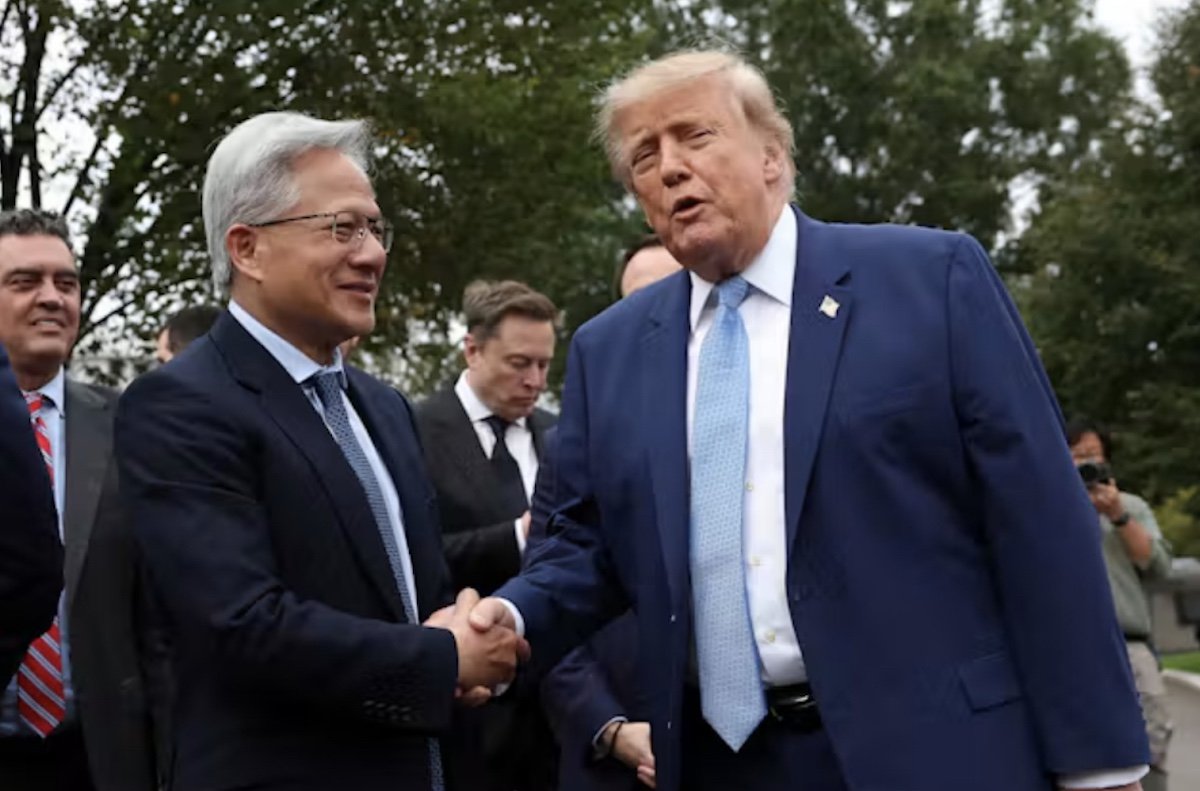
Just 11 days after stepping down as Nvidia's chief executive, Jensen Huang is back at the helm of the company he co-founded, promising to be "a better CEO the second time around." The board's unanimous decision came after what it described as "input from senior levels of the United States government," and President Donald Trump has openly claimed credit, saying he "convinced them" to reverse course. The about-face is remarkable, especially since the company had flatly ruled out Huang's return only days earlier.
Why would a US president intervene so directly in the affairs of the world's second-most-valuable company? And why does the leadership of Nvidia matter far beyond Silicon Valley—including the pace at which data centers rise across Asia and the Indo-Pacific?
A trillion-dollar swing
Nvidia's stock cratered after Huang resigned on November 12, following reports of extramarital affairs—one with a woman identified by US intelligence as having contacts with China's top spy agency, and another with an Nvidia employee. Both raised questions about his judgment. The Wall Street Journal and New York Times also reported allegations that Huang had belittled staff, including a senior executive who briefly succeeded him as CEO.
The numbers tell the story: Nvidia shares closed at $174 on November 11, the day before Huang quit. Within eight days, they had fallen to about $126, erasing roughly $1.2 trillion in market value and dragging down the broader US market. On the day of his reinstatement, shares surged 31% to $165, adding nearly $1 trillion back to the company's valuation.
Trump's four incentives
As an economist, I look at incentives. Trump had at least four reasons to push for Huang's return.
First, the economic impact. The AI selloff that followed Huang's resignation threatened to undermine the perception that markets thrive under Trump—a claim he has long made. Asked whether the market wobble was a factor, Trump said: "Probably so, but the bigger impact was the long term." He added that he "made the deal" and that his intervention was "very important."
Second, the political incentive. With growing talk of an "AI bubble," a prolonged Nvidia slump would have been a political liability. Trump's administration has already taken a 10% stake in Intel and bought 10–15% stakes in other tech-related companies, especially miners of critical minerals needed for AI. The success of AI and tech-related mining has become tied to this administration.
Third, the personal incentive. The Financial Times reported that the surge in Nvidia's share price on the day of Huang's return could have made Trump between $1.3 million and $15 million, based on his most recent financial disclosures showing he may have owned up to 370,000 shares as of September 30.
Fourth, the personal relationship. Trump reportedly takes Huang's advice on AI to a significant extent, both privately and publicly. Huang recently took a phone call from Trump while on stage. Huang is one of the few AI leaders who rarely mentions potential downsides of AI, and Trump has shunned doomsday scenarios or calls for greater safety.
Global implications
Under Huang, Nvidia has become the central bank of AI, fueling the boom with both its advanced chips and its funding of tech firms that need those chips. Nvidia is cash-rich with enormous profit margins, while many of its customers—such as Anthropic and OpenAI—are comparatively cash-poor, with huge spending commitments. Nvidia often invests in these companies, which then use that money to buy Nvidia chips. The better they do, the more chips they buy, and the better Nvidia does.
Nvidia has also been a crucial investor in data centers, providing $228 billion in guarantees, leases, and investments for data center providers. But this "circular financing" leaves Nvidia highly exposed to the AI industry overall. If investor confidence in AI falters, the fallout could be severe.
After Huang resigned, CFO Colette Kress was appointed interim CEO. Kress, who remains CFO, has reportedly been a counterweight to Huang on risky financing deals. According to several media outlets, she renegotiated a proposal for Nvidia to provide $250 billion in guarantees for an OpenAI data center in Ohio, cutting that commitment in half. However, Kress is not universally opposed to circular financing. In August, she publicly defended the approach, saying, "we know some will call this circular financing. We see it differently."
The episode underscores how deeply the US government and tech giants are now intertwined. For Asia, where data center construction is booming from Singapore to Mumbai, the stability of Nvidia's leadership matters directly. Southeast Asia's data center crunch won't be solved by Huang's return alone, but a prolonged leadership vacuum would have slowed chip deliveries and investment decisions. Asian markets have steadied after the initial shock, but the long-term implications of Trump's intervention—and the precedent it sets—remain uncertain.