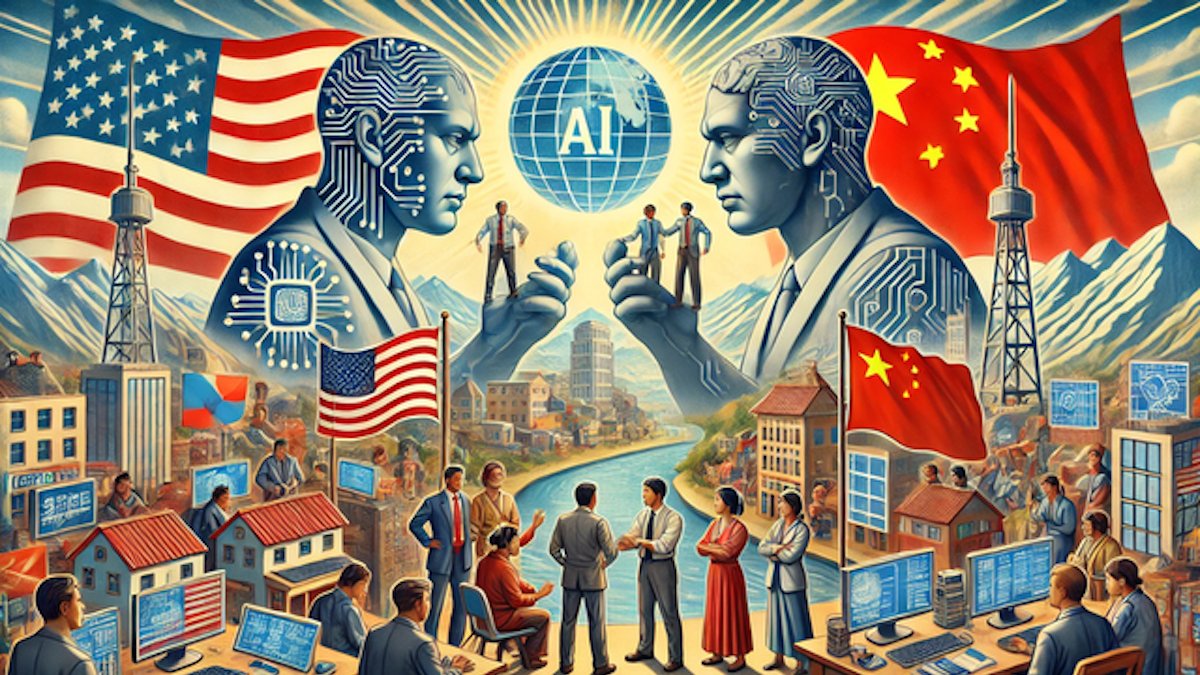
For nearly three years, the global conversation about artificial intelligence has centered on a horse race: who builds the biggest models, the largest data centers, and the fastest chips. By those metrics, the United States is clearly ahead. American hyperscalers—Alphabet, Amazon, Meta, and Microsoft—are on track to spend roughly US$650 billion on AI capital expenditures this year alone. In contrast, Alibaba, China's most ambitious AI investor, has committed about $53 billion over three years.
Yet a quieter story is unfolding alongside the headline race, one that may matter more than the leaderboard suggests: America is building AI; China is deploying it. That distinction—between invention and diffusion—is becoming the defining axis of the next AI era, and it deserves to be understood on its own terms rather than through the familiar binary of who is “winning.”
Two Industrial Logics
The contrast is not a values contest but rather two different industrial logics responding to different constraints. The American logic is frontier-maximizing. With abundant private capital, deep semiconductor partnerships, and a venture ecosystem that rewards moonshots, US firms have organized themselves around ever-larger, ever-more-capable foundation models—many explicitly oriented toward artificial general intelligence (AGI). The payoff structure favors closed, proprietary systems monetized through APIs and subscriptions, making American labs commercially dominant in direct revenue terms.
The Chinese logic is constraint-driven. Cut off from the most advanced Nvidia chips and operating with a fraction of American compute capital, Chinese labs have had little choice but to optimize. The result is a portfolio of architectural innovations—mixture-of-experts designs, sparse attention mechanisms, aggressive 4-bit quantization—that squeeze more performance out of less silicon. Where Americans buy their way to scale, Chinese engineers compress their way to efficiency. National programs like “AI Plus” then push those models into manufacturing, health care, drug discovery, and government services.
Neither approach is inherently superior. Rather, they are answers to different questions. The deeper insight is that frontier capability and societal benefit are not the same thing. A model that scores higher on a math benchmark does not automatically lower the cost of a clinic visit, improve a factory line, or make a small business more productive. Translating capability into utility is the last-mile problem of AI—and it is where China’s diffusion-first posture is paying unexpected dividends.
Consider the open-source channel. Many Chinese labs release model weights freely, along with detailed technical reports, allowing developers anywhere to download, fine-tune, and deploy them on their own infrastructure. On Hugging Face, Chinese models now lead in total downloads, and derivative models built on Chinese foundations have surpassed those built on American ones. Airbnb’s chief executive has publicly described relying on Alibaba’s Qwen for customer service because it is fast, capable, and inexpensive. Adoption, not benchmark supremacy, is what builds the rails on which an AI economy actually runs.
The same pattern shows up in the physical world. China is integrating AI into vehicles, drones, wearables, and especially robotics, leaning on its existing electronics and electric-vehicle supply chains. Unitree has already manufactured more than 5,000 humanoid robots, and major Chinese automakers are piloting them on assembly lines. American firms such as Waymo and Physical Intelligence remain best-in-class technically but may face greater scaling challenges without a comparable industrial base.
There is a feedback loop here that deserves more attention. Export controls, designed to slow China’s frontier progress, have indeed done so in the near term. But they have also catalyzed a whole-of-nation push toward semiconductor self-sufficiency, with domestic chips capturing roughly 41% of China’s AI chip market in 2025—up from a market once dominated 90% or more by Nvidia. Slowing a competitor at the frontier and hardening that competitor’s domestic stack are, in this case, the same policy. Acknowledging that trade-off honestly is not pro- or anti-China; it is simply good strategic accounting.
The most original lesson from this contrast may be that each system is partially blind to its own weakness. The American ecosystem under-invests in the connective tissue—open weights, energy infrastructure, academic compute, and adoption pathways for small and mid-sized firms—that turns brilliant models into broad prosperity. US data center power demand is projected to roughly double by 2030, to about 9% of national electricity, while China added 540 gigawatts of new capacity in 2025 alone. Capability without kilowatts is a brittle advantage.
The Chinese ecosystem, conversely, risks settling for a permanent second-best on the frontier. Distillation and clever engineering can close gaps, but they cannot, on their own, produce the next paradigm. Adoption matters enormously, but it is adoption of something—and the something still has to be invented.
For much of Asia, the smartest response to this divide is to refuse the binary altogether. Most economies in the region have little interest in pledging allegiance to an American or a Chinese AI ecosystem. They want affordable tools, reliable infrastructure, local-language capability, and protection against lock-in. That argues for building national capacity to use, audit, and adapt both. Chinese open-weight models are inexpensive and widely available, while American frontier models offer cutting-edge performance. Countries like Japan, South Korea, and Singapore are already pursuing dual-track strategies, investing in domestic AI research while maintaining access to both ecosystems. As the US and China intensify their quantum race, the broader Indo-Pacific region is watching closely, aware that the real prize is not just who leads the frontier, but who builds the infrastructure that powers the future.