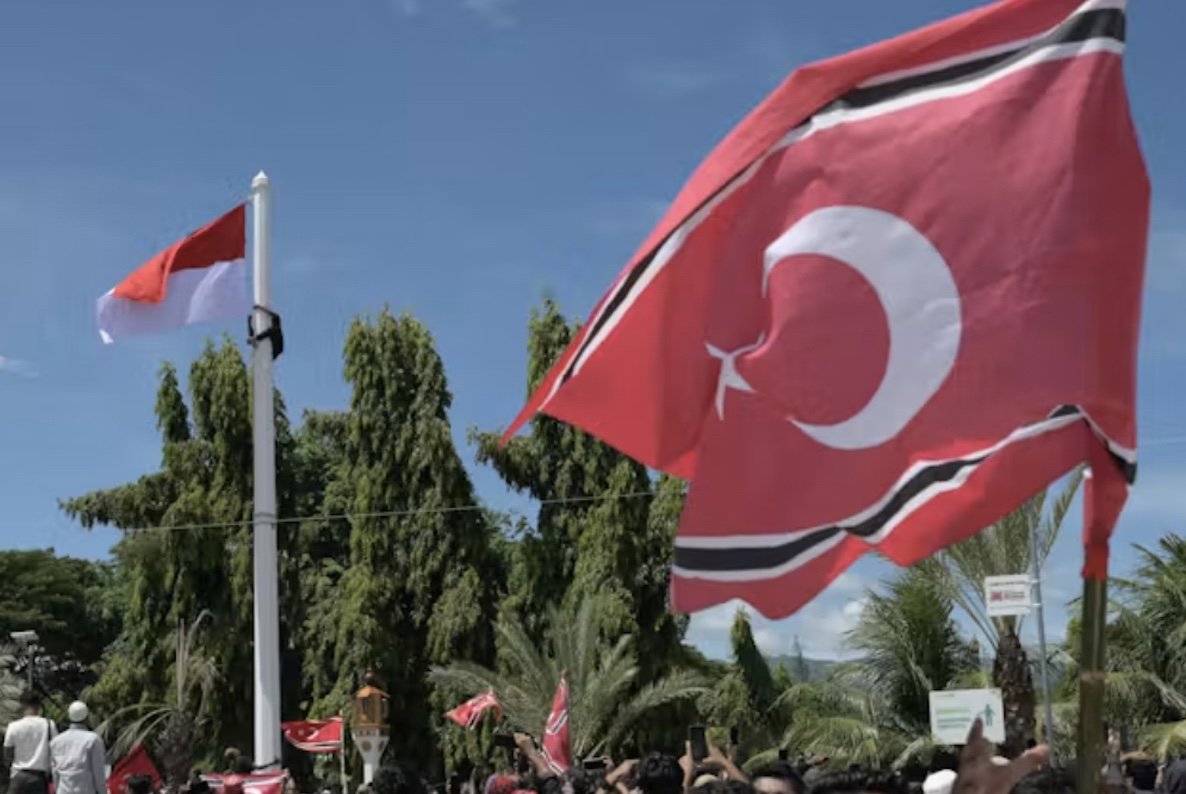
On August 15, 2026, thousands gathered at the Baiturrahman Grand Mosque in Banda Aceh to mark 21 years since the peace deal that ended a three-decade separatist conflict. But the commemoration was far from a simple celebration. Some participants raised the red, black, and white crescent-star flag of the Free Aceh Movement (GAM), chanted “Free Aceh,” and even replaced Indonesia’s national flag with the separatist banner.
These acts carry deep political weight in a province where GAM fought a bloody insurgency for independence until the 2005 Helsinki agreement. The display was not an isolated incident. In December 2024, former GAM members raised the flag during the movement’s anniversary, with one veteran expressing hope it would one day fly across Aceh. The flag reappeared in December 2025, prompting Indonesian soldiers to disperse the crowds.
The revival of these symbols comes as Aceh struggles to recover from severe floods and landslides that struck in late November 2025, killing more than 1,000 people and displacing over a million. The 2004 tsunami had helped accelerate the peace process, but two decades later, it is criticism of Jakarta’s response to the latest disaster that is intensifying pro-independence sentiment.
As a scholar of nationalism and political geography, I see this resurgence not simply as a return of separatism, but as a reminder that national belonging is continually negotiated. Perceived neglect in times of need can erode the bonds that hold a state together.
Peace ended the war, not the nationalism
GAM’s struggle was rooted in a distinct Acehnese identity. Founded in 1976, the movement portrayed Aceh—on the western tip of Sumatra—as a nation that had enjoyed sovereignty as an independent sultanate before being subsumed into Indonesia. The conflict killed thousands, with civilians bearing the brunt of abuses by both Indonesian security forces and GAM, including torture, arbitrary arrests, and forced displacement.
The 2004 tsunami acted as a catalyst for peace, drawing international attention and aid. The Helsinki agreement ended the armed conflict but did not erase Acehnese nationalism. Instead, it accommodated it within Indonesia’s framework, granting Aceh extensive self-governing powers, local political parties, and control over natural resources—though disputes over gas revenue-sharing persist.
GAM disarmed, and many former leaders entered electoral politics. But pro-independence ideas and symbols never fully disappeared. The peace held because it changed the terms of Aceh’s relationship with Jakarta, not because Acehnese abandoned their identity.
From disaster to independence talk
The November 2025 floods and landslides brought citizens into direct contact with the central government, making them dependent on state assistance. Calls to declare the disaster a national emergency were rejected by President Prabowo Subianto, who insisted Indonesia could manage the crisis alone. His refusal of foreign aid sparked anger, contrasting sharply with the international support that followed the 2004 tsunami.
Nearly a year later, recovery remains painfully slow. As of September 7, 2026, only 649 of the 34,777 permanent homes needed for the displaced had been completed. Dozens of road segments remain nonfunctional, and most bridges are still unrepaired. On August 14, a civil-society coalition raised white flags again, urging Jakarta to declare a national disaster.
Why do such grievances translate into pro-independence talk? History offers part of the answer. Acehnese identity has not always meant wanting to leave Indonesia—leaders have supported autonomy within the republic. But when the state appears absent in times of crisis, the appeal of independence grows.
The stakes extend beyond Aceh. The Helsinki accord is often cited as one of Southeast Asia’s most successful post-conflict settlements. Renewed tensions would not only strain Aceh’s relationship with Jakarta but also raise doubts about the durability of a peace that has held for over two decades. As Indonesia navigates its own political transitions, the lessons from Aceh—about the importance of responsive governance and the fragility of national unity—resonate across the region. For more on how disasters can test state legitimacy, see China's silence on Tibet-Nepal floods and Indonesia's largest Muslim group faces a test.