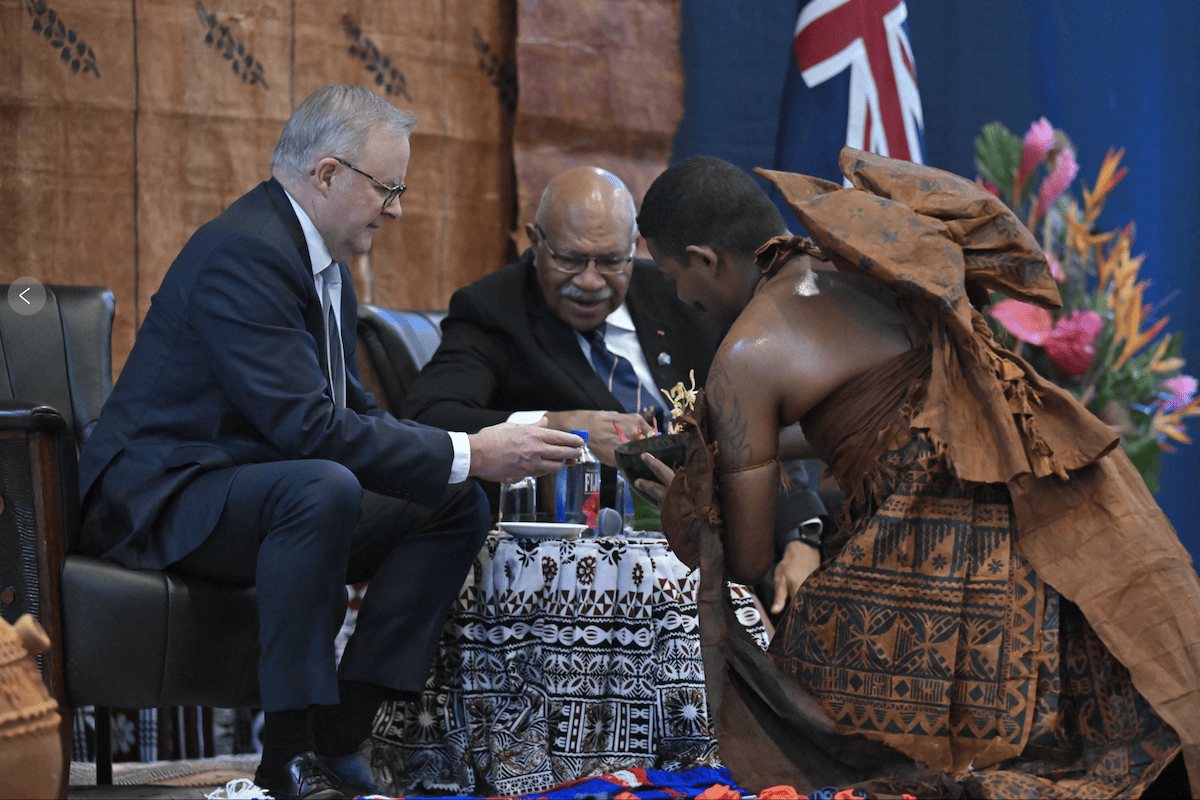
For decades, the South Pacific was a geopolitical afterthought. That era is over. On July 6, 2026, Australian Prime Minister Anthony Albanese and Fijian Prime Minister Sitiveni Rabuka signed a defense treaty in Suva that redefines the region's security architecture. The pact is a direct response to China's expanding influence, particularly after Beijing's clandestine security agreement with the Solomon Islands in 2022.
The agreement consists of two instruments: the Ocean of Peace Alliance, a mutual defense treaty, and the Vuvale Union, a broader cooperation framework covering domestic security, economic development, and people-to-people ties. Under the Ocean of Peace Alliance, any armed attack against either party in the Pacific is considered a threat to both, with provisions for other nations like New Zealand, Papua New Guinea, and Tonga to join. This open-ended structure aims to build a collective Pacific security network anchored by Australia.
Canberra's strategy reflects a shift from being a tactical adjunct to U.S. interests toward a more independent defense posture. The 2026 Australian National Defense Strategy outlines plans to increase defense spending to 3% of GDP by 2033–2034, focusing on resilient military infrastructure in northern Australia and enhanced power-projection capabilities in the Southwest Pacific. This is not merely about countering China; it is about establishing Australia as the region's primary security partner.
Beyond Military Hard Power
The Vuvale Union extends well beyond military cooperation. Australia is bolstering Fiji's law enforcement through police training, legislative reform, maritime interdiction, intelligence sharing, and prosecution of transnational crime. It also supports Fiji's Guardian-class patrol vessels, upgrades the RFNS Stanley Brown wharf, and optimizes the Maritime Essential Services Centre in Suva, operational since October 2025.
Economic interdependence is a key pillar. The Vuvale Skills Hub aims to modernize vocational education, while expanded visa access under the Pacific Australia Labour Mobility (PALM) program deepens ties. This approach contrasts sharply with China's Belt and Road Initiative, which often relies on state-owned enterprises and carries debt-trap risks. Australia's model emphasizes human capital and institutional resilience over physical infrastructure.
Yet a fundamental tension persists. Pacific island leaders, through the Declaration on the Blue Pacific Ocean of Peace endorsed at the Honiara Leaders' meeting in September 2025, consistently argue that their most pressing threats are not military aggression but climate change, rising sea levels, illegal fishing, and transnational crime. They define the Pacific as a zone of peace that rejects militarization and geopolitical coercion from external powers.
Critics of Western initiatives argue that the Partners in the Blue Pacific (PBP) mechanism, announced in June 2022, has co-opted the "Blue Pacific" narrative to advance a hard-security agenda. This perception risks alienating Pacific nations that prioritize climate action over military alliances. Australia's challenge is to balance its strategic objectives with the genuine concerns of island states.
The pact also sends a clear signal to Beijing. As recent developments show, Australia is prepared to respond to Chinese military activities in the region. The treaty formalizes a security guarantee that makes it harder for China to establish a permanent military presence in the Pacific.
For Fiji, the deal offers a robust security guarantee without requiring it to sever ties with China. Prime Minister Rabuka has maintained a balanced foreign policy, engaging both Canberra and Beijing. The Vuvale Union's emphasis on economic and social cooperation provides Fiji with tangible benefits that China's infrastructure loans cannot match.
Ultimately, the Australia-Fiji pact represents a strategic recalibration. It acknowledges that the Pacific is no longer a passive arena but a contested space where island nations assert their agency. Whether this agreement can reconcile hard security with climate resilience remains an open question. But for now, Canberra has made its move, and the region is watching.