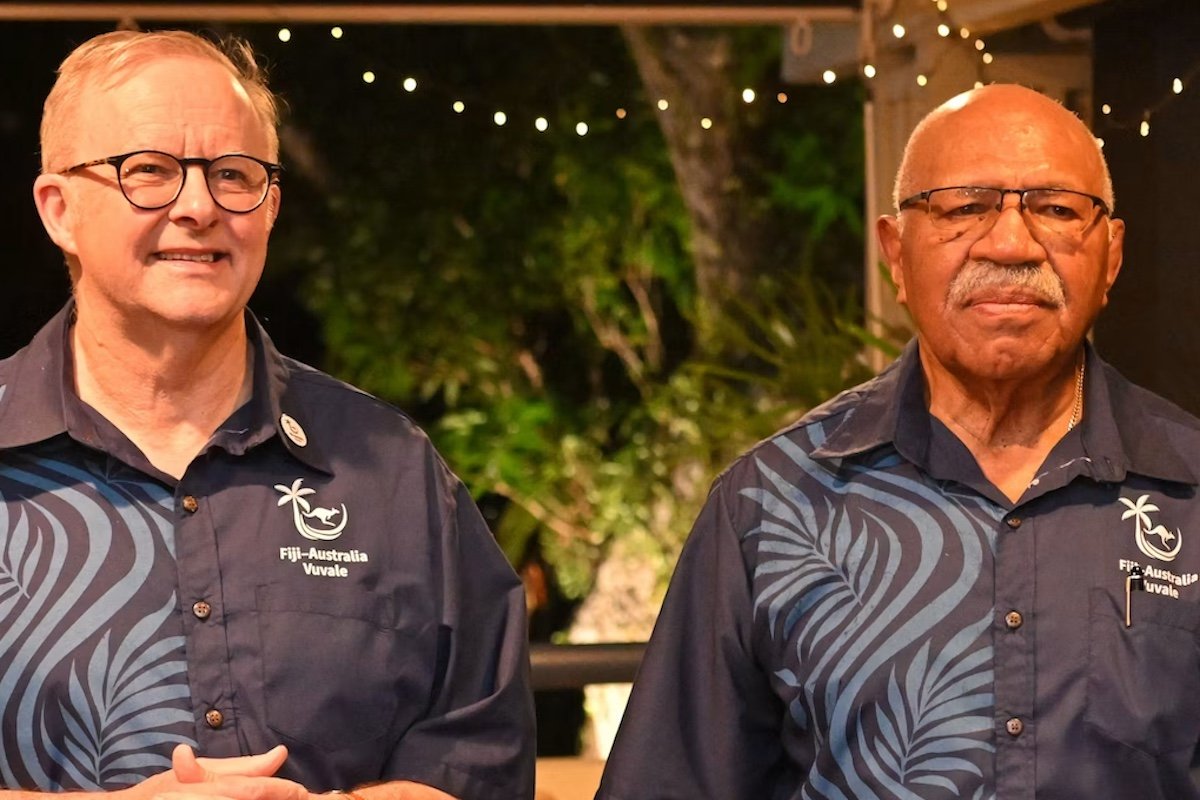
Australian Prime Minister Anthony Albanese and Fijian Prime Minister Sitiveni Rabuka have formalized a new defense treaty, the Ocean of Peace Alliance, also known as the Veitacini Treaty, during Albanese's Pacific tour. The pact is the latest in a series of bilateral security agreements Australia has pursued with Pacific Island nations, following similar treaties with Tuvalu (2023), Nauru (2024), Papua New Guinea (2025), and Vanuatu (2026). New Solomon Islands Prime Minister Matthew Wale has also requested negotiations for a bilateral treaty, and talks with Tonga are underway.
Shortly after the signing, China conducted a long-range missile test in the Pacific Ocean, drawing criticism from regional leaders. The timing underscores the strategic tensions in the region and the need for Pacific Island countries to carefully consider their defense arrangements. For more on China's military posturing, see our analysis on China's Submarine Missile Test: Routine Drill or Pacific Provocation?
Symbolism Over Substance
Like the 1951 ANZUS Treaty, the Veitacini Treaty's security guarantee is largely unenforceable. Article 6 commits each party to “act to meet the common danger” of an armed attack in the Pacific, but with the caveat that action will be taken “in accordance with its domestic processes.” This is weaker than NATO's collective defense clause. Even if enforceable, Australia relies on the United States for its own defense and would struggle to defend Fiji independently.
The treaty's primary purpose is symbolic. Rabuka's remarks at the signing ceremony were telling: he stressed he did not expect “severe pushback” from China and that the alliance threatens neither country's relationship with Beijing. A leader does not repeatedly reassure a country that a treaty is not aimed at it unless everyone understands it is, at least partly, a signal to that country—and to a region watching whether Fiji has chosen sides.
Regional Questions
First, does the Veitacini Treaty encourage militarization of the Pacific? Article 12 allows other Pacific Island countries to accede if they are “in a position to further its purposes and principles,” implying they would need militaries. Only Papua New Guinea, Fiji, Tonga, and New Zealand currently have armed forces. This could create a two-tier security relationship: deeper integration for countries with militaries, and lesser cooperation for those without. It may push nations like Solomon Islands, which has foreshadowed developing a military, to do so—potentially entrenching dependence on Australian defense assistance. Militaries can be useful for disaster response but also risk internal instability, as Fiji's 1987 and 2006 coups demonstrate.
Second, how does this alliance fit with regional architecture? The Blue Pacific Ocean of Peace Declaration, endorsed by Pacific Islands Forum leaders in 2025, is a regional vision. Borrowing its name for a bilateral military alliance raises the question of who speaks for the Ocean of Peace: the Forum, or Fiji and Australia? With the Forum Secretariat headquartered in Suva, and Fiji positioning itself to host an Ocean of Peace Centre under the accompanying Vuvale Union, there is a risk of reinforcing perceptions that Pacific regionalism is too Suva-centric—a longstanding grievance among Micronesian members.
Third, has Fiji abandoned its commitment to “remain friends to all and enemies to none,” as reiterated in its 2025 National Security Strategy? Pacific leaders have repeatedly rejected a choice between China and traditional partners. A mutual defense treaty is an unfriendly choice; it implies defending against threats from at least one other country.
Questions for Fiji
What are the costs of implementation? Alliance obligations require interoperability, sustained exercises, and equipping forces able to “act to meet the common danger.” These costs are high, as Australia knows from its efforts to keep up with the US. Will Fiji's budget stretch, or will it depend on Australian assistance? The cost of mutual defense is particularly high; even a qualified commitment can entrap a country into following its ally into wars it wouldn't choose, potentially entangling the region.
How does the Veitacini Treaty interact with ANZUS? Both treaties relate to armed attacks in the Pacific, with Australia as the linking ally. This could create complex obligations, especially if a conflict involves both a Pacific Island nation and a US ally. For broader context on China's strategic behavior, see China's Flawed Arms Sales Still Forge Strategic Dependencies Across Asia.
The Veitacini Treaty may be largely symbolic, but its signal is clear: the Pacific is becoming a theater of great-power competition, and small island nations must navigate carefully between traditional allies and an assertive Beijing.



