China's weapons may be plagued by quality concerns, spare-parts shortages, and operational failures, but its arms trade continues to serve a deeper strategic purpose: locking recipient states into long-term military, economic, and political dependence on Beijing. That paradox is the central finding of a June 2026 report by The Takshashila Institution, an Indian think tank, which argues that China's rise as a major global arms exporter has outpaced its ability to guarantee battlefield performance and life-cycle support.
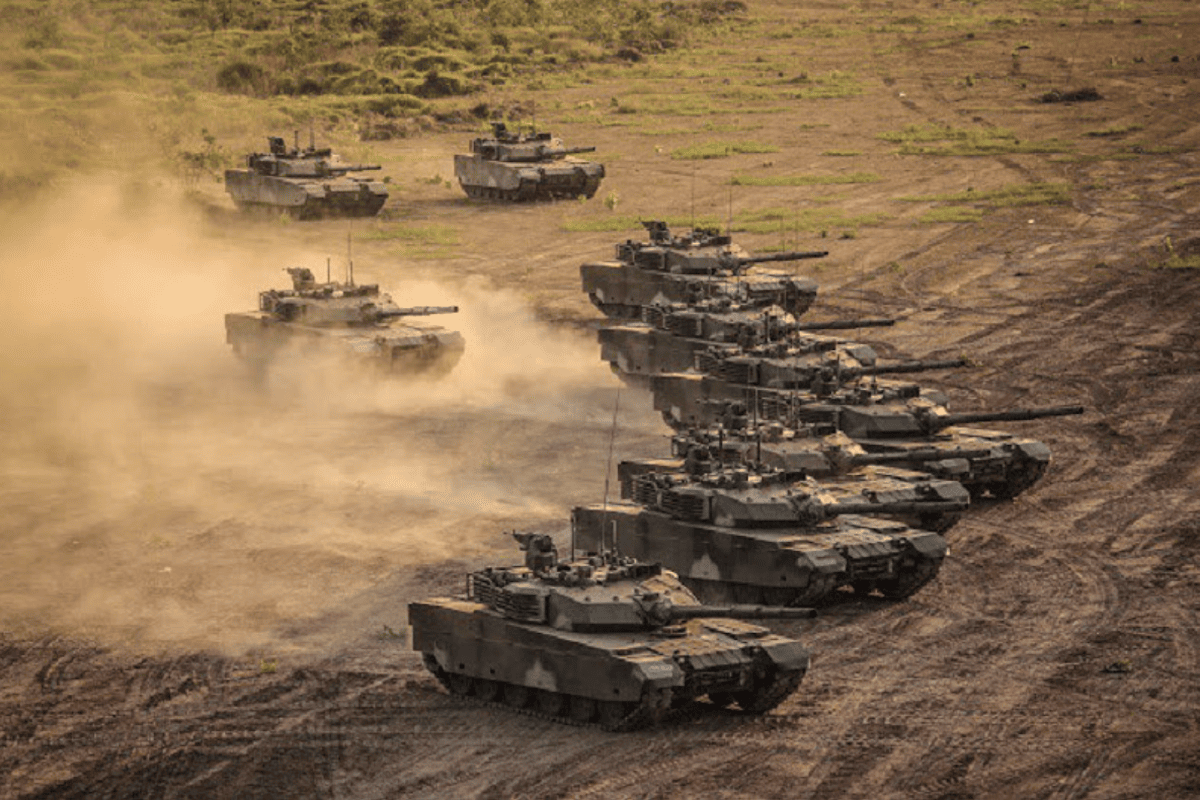
The report details how China's state-led military-industrial complex has supplied a growing number of tanks, drones, ships, missiles, and aircraft to buyers including Pakistan, Thailand, Saudi Arabia, Iraq, Algeria, Nigeria, Kenya, and Myanmar. It highlights repeated problems in widely exported systems, such as thermal and metallurgical issues in VT-4 tanks used by Thailand and Nigeria, and crashes, offloading incidents, or groundings involving CH-4B drones operated by Jordan, Iraq, and Algeria.
By 2025, China had become one of the world's top arms exporters while reducing its own reliance on imports. Pakistan, Serbia, Thailand, and Algeria now depend heavily on Chinese weapons systems. Yet the report warns that operational failures, spare-parts shortages, sanctions pressure, corruption probes, and renewed competition from the United States and Russia may limit deeper defense ties beyond close partners like Pakistan.
Affordability and Fewer Strings Attached
Despite these flaws, China's offer remains attractive because its weapons are relatively affordable, come with fewer political conditions than Western arms, and can complement wider Chinese infrastructure, finance, and diplomatic relationships. For Beijing, such sales provide more than revenue: they offer combat feedback, increase political leverage, and strengthen ties with states that often have few Western alternatives.
The deeper value lies in the ecosystem surrounding these sales. Frigates, jets, drones, tanks, and armored vehicles require spare parts, maintenance, software updates, training, and ongoing access to the supplier over years. Those dependencies give China channels of influence long after the initial sale, helping bind clients' foreign policy, defense, and economic interests more closely to its own.
Pakistan is the clearest example of how this dependence works. According to data from the Stockholm International Peace Research Institute (SIPRI), China was the world's fifth-largest arms exporter from 2021 to 2025, accounting for 5.6% of global arms exports. Pakistan was by far China's biggest customer, taking 61% of its arms exports over that period. Pakistan's reliance on Chinese systems has deepened as US sanctions linked to its nuclear and missile programs have blocked access to American and Western weapons.
For China, arming Pakistan also serves to keep rival India strategically stretched. A crisis involving Pakistan in Kashmir and China along the Himalayan frontier would force India to divide strategic attention, military assets, and political bandwidth between two nuclear-armed adversaries. The military relationship is reinforced by economics. Pakistan is a central node in China's Belt and Road Initiative (BRI), with the China-Pakistan Economic Corridor (CPEC) linking western China to the Arabian Sea through Pakistan's Gwadar port. That route gives China a partial hedge against the Strait of Malacca, through which an estimated 75% to 80% of China's crude oil supply passes and could be blocked in any conflict with the United States. For Pakistan, CPEC has been an economic lifeline, bringing as much as $25.9 billion in Chinese direct investment and generating up to 260,000 jobs.
That has given China rich leverage over Pakistan. The deeper Pakistan's dependence on Chinese arms, finance, and infrastructure becomes, the harder it is for Pakistan to resist China's geopolitical preferences. Any attempt to scale back CPEC projects or limit Chinese influence could expose Pakistan to financial penalties, diplomatic pressure, or reduced military cooperation.
Myanmar is in a similar situation. Chinese arms sales to the coup-installed junta suggest Beijing sees the military regime, despite its brutality and lack of Western recognition, as the most viable force for holding the country together and protecting Chinese interests. The China-Myanmar Economic Corridor (CMEC) is central to those interests. Like CPEC, it offers China another hedge to its Malacca dilemma through roads, pipelines, and a key port on the Indian Ocean. Between the February 2021 coup and 2023, Myanmar reportedly received $3 billion in Chinese foreign direct investment, much of it tied to CMEC and mining.
Chinese weapons have kept the junta in the fight against a panoply of rebel groups. Fighter jets, helicopters, artillery, and armored vehicles supplied by China have boosted the military's conventional advantage, even as the coup regime has lost significant ground across the country, including in western Rakhine state where much of China's commercial interests lie. But dependence has costs. Writing for Mizzima in January 2026, Maung Maung Myint argued that the junta's overriding focus on regime survival has trapped Myanmar in dependence on China, contradicting the sovereignty Myanmar's military claims to defend. He described Myanmar as a “zombie client state” that claims sovereignty while lacking real decision-making power and relying on external support to sustain an unpopular war machine.
China's support for Myanmar also weakens ASEAN's already limited ability to respond to the civil war. Several Southeast Asian governments are reluctant to confront the junta directly, whether because of their own histories of military rule or dependence on Chinese economic and defense ties. That reluctance gives China another leverage point in the region and risks carrying over into other disputes, including the South China Sea, where China benefits from a divided regional bloc.
The key question, then, is not whether Chinese weapons are uniformly reliable. The Takshashila Institution report shows clearly that they are not. But reliability is not the point. China's arms trade is a tool for building long-term influence, and in that respect, it is working.