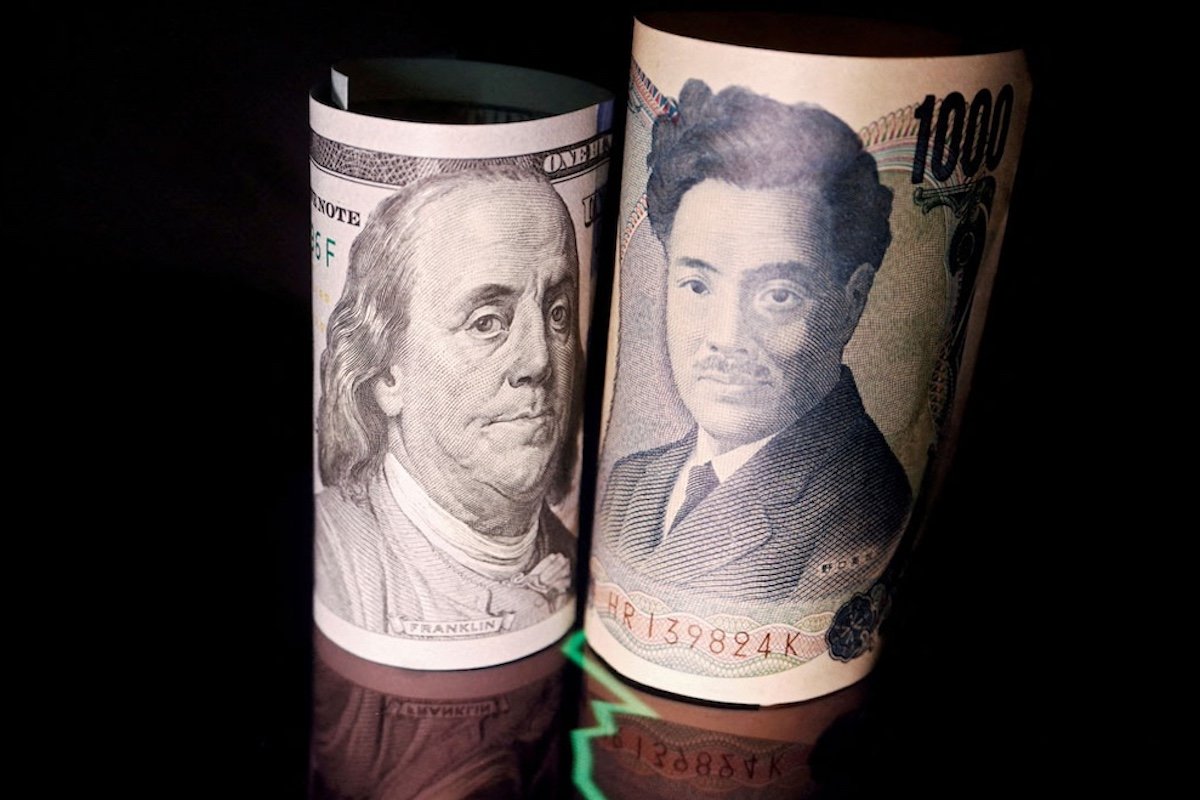
For decades, the global financial system rested on a tacit bargain: the United States would borrow freely, and Japan would buy the debt. That arrangement allowed Washington to finance its deficits at low cost while Tokyo built massive dollar reserves and fueled its export machine. But that bargain is now fracturing, and the consequences could ripple from Tokyo to Washington.
The Japanese yen has plunged to around 160 per dollar, its weakest level since the mid-1980s. The immediate cause is clear: the Bank of Japan has kept interest rates near zero while the Federal Reserve raised them aggressively to combat inflation. That gap has made the yen a cheap funding currency for global investors, who borrow yen and invest in higher-yielding dollar assets—a strategy known as the carry trade. This has created relentless selling pressure on the yen, which is compounded by Japan's heavy reliance on imported energy. Higher oil and LNG prices, exacerbated by the Iran war and the Hormuz blockade, force Japanese importers to sell yen for dollars, further weakening the currency.
Yet the yen's slide is not merely a Japanese problem. It is a symptom of a deeper structural imbalance that threatens to destabilize US Treasury markets. Japan remains the largest foreign holder of US government debt, with over $1 trillion in Treasury securities. When Tokyo intervenes to support the yen, it must sell dollars—often by liquidating its Treasury holdings. Recent reports indicate Japan has already reduced its foreign securities holdings by tens of billions of dollars, fueling speculation that a sustained sell-off is underway.
America's Debt Addiction Meets Japan's Dilemma
Washington's fiscal trajectory makes this a dangerous moment for a major creditor to step back. The US is issuing enormous volumes of new debt while refinancing trillions in existing obligations. Publicly held debt has surpassed 100% of GDP and is projected to climb steadily, according to the Congressional Budget Office. If Japan transforms from a reliable buyer into a persistent seller, Treasury yields could spike, raising borrowing costs across the American economy. Mortgage rates would stay elevated, corporate borrowing would become more expensive, and commercial real estate—already under pressure—could deteriorate further. The federal government's own interest payments would consume an ever-larger share of national expenditure.
This is not a hypothetical scenario. As the Bank of Japan's decades-old monetary experiment now threatens the yen, Tokyo faces an unenviable choice: continue selling Treasuries to defend the currency, or let the yen fall further and risk importing inflation. Raising interest rates aggressively is difficult given Japan's government debt exceeds 250% of GDP—the highest among advanced economies. The Bank of Japan's recent policy tweaks have already triggered volatility in Japanese government bonds, with yields hitting 30-year highs and a new term—'Honebuto Shock'—emerging to describe the market turmoil.
Washington's predicament is largely self-inflicted. Years of bipartisan fiscal excess—Republican tax cuts without spending reductions, Democratic expansion of social programs—have reduced America's policy room for maneuver. The dollar's reserve-currency status has long provided extraordinary advantages, but it is not a substitute for fiscal discipline. As global conditions become less forgiving, the US may find that its financial strength depends on the continued willingness of foreign creditors like Japan to finance its deficits.
The implications extend beyond the bilateral relationship. A sustained sell-off of Treasuries by Japan could trigger a broader reassessment of US sovereign risk, potentially undermining the dollar's role as the world's reserve currency. The Federal Reserve would face pressure to intervene in bond markets to stabilize yields, risking renewed inflation and questions about central bank credibility. For the Indo-Pacific region, a US financial crisis would have severe knock-on effects, disrupting trade finance and investment flows that underpin growth from Seoul to Singapore.
Japan's yen crisis is therefore a warning for the entire global financial order. The era of cheap US borrowing, financed by Asian savings, may be drawing to a close. How Tokyo and Washington navigate this dilemma will shape the stability of markets for years to come.