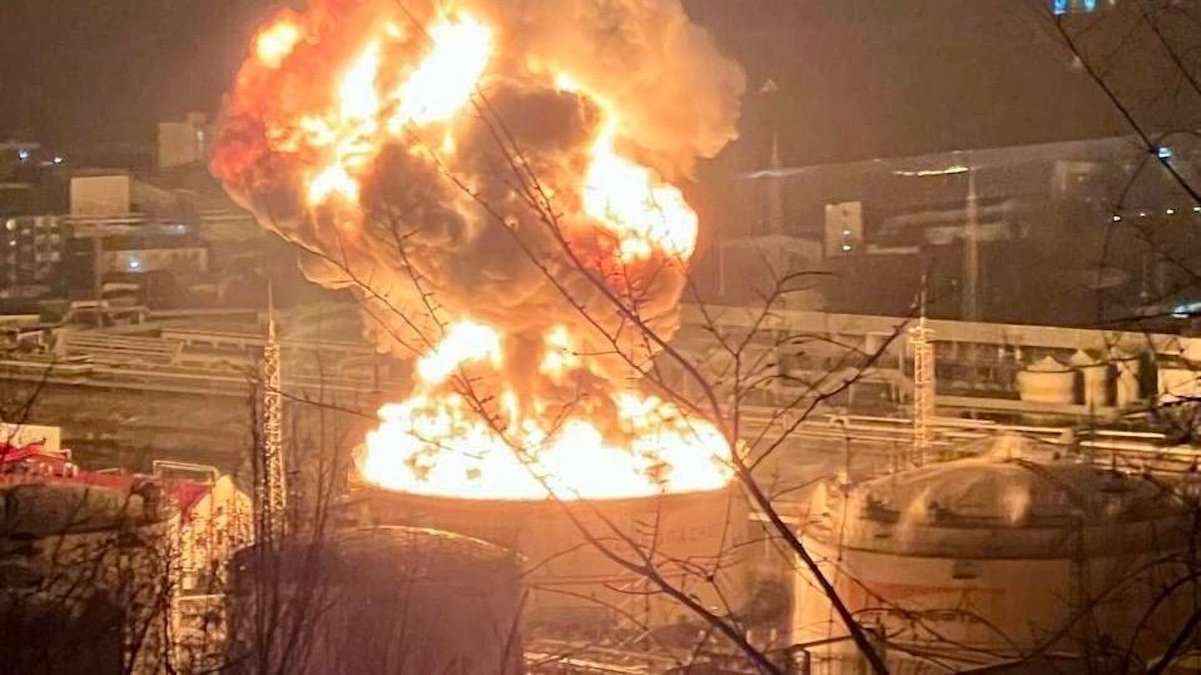
For decades, oil has been the foundation of Russian power—the resource that funded its military, propped up its economy, and gave it leverage over Europe. But Ukraine's escalating drone campaign is systematically dismantling that advantage, turning what was once Russia's greatest strength into a glaring weakness. The lesson extends far beyond the Black Sea: in the age of cheap, long-range drones, any country that depends on oil infrastructure is exposed.
Ukraine's drone operators have now struck all ten of Russia's largest refineries, some multiple times, according to reports from the front. The most dramatic recent attack hit the refinery at Omsk, a city in southwestern Siberia more than 2,500 kilometers from the Ukrainian border. That strike destroyed the ELOU-AVT-11 unit—the initial distillation and desalination system that is the heart of any refinery. Without it, the entire plant cannot produce gasoline or jet fuel. Western sanctions mean replacement parts will take six months to a year to arrive, if they arrive at all.
Oil Infrastructure: A Floating Target
The vulnerability is not limited to refineries. Supertankers, the massive vessels that carry crude across oceans, are essentially floating pools of flammable liquid. Ukrainian drones crippled one tanker in the Sea of Azov on Monday, while another was set ablaze in the Persian Gulf after straying from an approved shipping lane. There is no effective defense for a slow-moving tanker against a swarm of cheap drones—a fact that should alarm every nation that relies on seaborne oil imports.
Terminals are equally exposed. Ukraine struck a major logistics hub in occupied Crimea on Monday, a facility that handles the receipt, storage, and transfer of oil between rail lines, storage tanks, and tankers. The attack is part of a broader campaign that has forced Russia to declare a state of emergency in Crimea, as reported by Asian Examiner.
The cost asymmetry is staggering. A single drone can cost as little as $20,000, while the refinery it destroys may be worth billions. As we have noted, this imbalance is reshaping warfare globally. For Asian economies that import most of their oil—Japan, South Korea, India, and China among them—the implications are profound. A handful of drones could disrupt fuel supplies for weeks or months, with no quick fix available.
From Gas Station to Gas Lines
The consequences are already visible inside Russia. In occupied Crimea, gasoline prices have surged above $10 per gallon. Police have drawn weapons to control crowds at gas stations where lines stretch for kilometers. So-called "fuel tourists" are crossing into China and Kazakhstan to fill their tanks. Political analyst Andrei Kolesnikov told reporters that "mass fatigue with the war is turning into mass irritation," though he doubted the shortages would trigger widespread protests—yet.
President Volodymyr Zelenskyy framed the campaign as a strategic shift. "The very idea of Russia having a strategic rear is gone," he said on Tuesday. "For a long time, Russia believed it had territorial advantage no one else possessed, a deep rear, where it could safely keep everything its war depends on, believing no one could reach them. We have reached them."
Russia began this energy war by targeting Ukrainian heating plants and power stations, hoping to freeze the population into submission. Those attacks hardened Ukrainian resolve. Now, with far more attention to avoiding civilian casualties, Ukraine is returning the favor—hitting defense plants and refineries that fuel the Russian war machine.
What Asia Should Learn
The lesson for Asia is clear. Countries like India, which imports more than 80 percent of its oil, and Japan, which imports nearly all of it, must reconsider the vulnerability of their energy infrastructure. A single drone strike on a refinery in Gujarat or a tanker in the Malacca Strait could cause cascading economic damage. The same logic applies to China's massive refining capacity and its reliance on tanker routes through the South China Sea.
To replicate Ukraine's success, Asian militaries would need to change their culture and doctrine, as we have argued. But the defensive side is equally urgent: counter-drone technology is surging as a priority for defense ministries from Tokyo to New Delhi, as reported here.
Oil was supposed to be a source of strength. Ukraine's drone campaign is proving that in the modern era, it can just as easily become a liability—one that burns, quite literally, from the sky.



