Unmanned aerial systems have transformed modern battlefields, offering both tactical flexibility and deep-strike capabilities. From Ukraine's sustained campaign against Russian infrastructure to Iran's swarms targeting US naval assets, drones are now a central feature of conflict. In response, counter-drone technology is gaining major traction, with nations and non-state actors alike racing to develop effective defenses.
Ukraine has demonstrated the most innovative use of drones, employing them to strike strategic targets deep inside Russian territory. Ukrainian forces have destroyed Tu-95MS bombers at Belaya airbase, damaged long-range radars integral to Russia's nuclear defense network, and crippled portions of the Black Sea Fleet at Sevastopol. These operations often involve waves of lethal drones mixed with cheap decoys made from plywood and plastic, designed to overwhelm air defenses. Russia employs similar tactics, supplementing its drone salvos with ballistic and cruise missiles.
The drone threat extends far beyond Eastern Europe. Between February and March 2026, Iran launched an estimated 1,000 to 1,500 drones at US and allied facilities in the Gulf region, including political targets and naval vessels. Tehran claimed to have struck the USS Abraham Lincoln (CVN-72), a claim firmly denied by CENTCOM. Meanwhile, the Houthis in Yemen have repeatedly targeted the USS Harry S. Truman in the Red Sea using long-range kamikaze drones, and have attacked commercial shipping with uncrewed surface vessels (USVs) in the Red Sea and Gulf of Aden.
Hezbollah has also escalated its drone operations, particularly along the northern Israel-southern Lebanon border. The group employs sophisticated tactics, heavily supported by Iran, and increasingly uses fiber optic drones that are resistant to electronic jamming. Hezbollah's supply chain is a decentralized, multi-tiered network: Iran provides strategic direction, while parts are acquired through global dual-use procurement pipelines, front companies, and domestic workshops inside Lebanon.
Counter-Drone Systems: The New Arms Race
Interception rates remain insufficient to neutralize the threat entirely. Russia claims to stop 70% to 85% of incoming drones, yet still faces 150 to 300 drones over its territory each night. The US and Israel likely achieve higher success rates, but the drones that penetrate defenses cause significant damage and, in Israel's case, erode civilian and soldier morale. The US has largely failed to disrupt the supply networks of Russia, Iran, and their proxies, with many Russian and Iranian weapons containing US components alongside parts from Asia, particularly China.
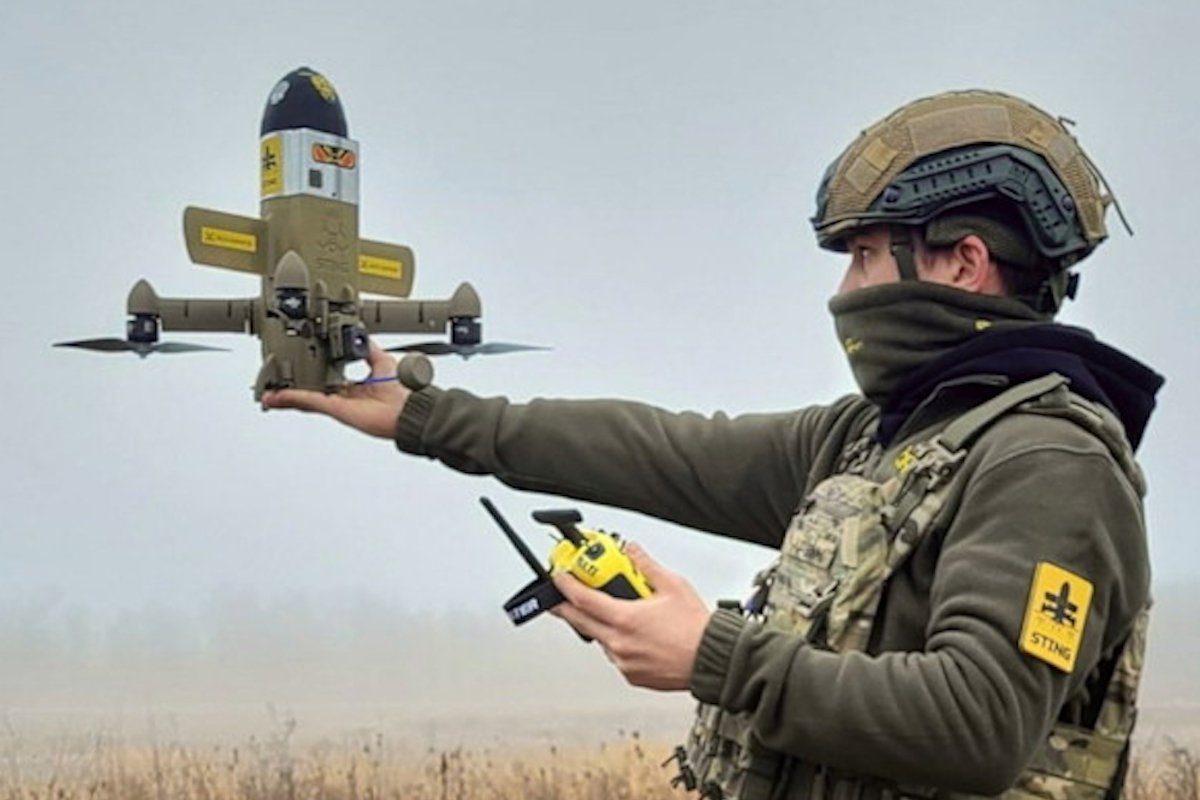
Instead of targeting supply chains, the US and its allies are investing heavily in counter-drone technologies. One of the most notable developments is Ukraine's Sting interceptor, built by the volunteer engineering group Wild Hornets. Sting is a 3D-printed, bullet-shaped drone with a pursuit speed of 213 mph (343 km/h), a service ceiling of 10,000 feet (3,000 meters), and an operational radius of 20 kilometers (12.4 miles). It carries a home-built thermal imaging camera for night operations and costs just $2,100 per unit.
Ukraine has formed specialized interceptor brigades, such as the 412th Nemesis Brigade, which claims a 95% success rate. The latest Sting versions feature autonomous interception using AI computer vision, allowing the drone to lock onto enemy silhouettes—such as the Russian Geran 2—and navigate without pilot input. Operators use the Hornet Vision remote control architecture, enabling them to stay far from the front line, reducing their vulnerability to Russian targeting.
Ukraine's advantages include skilled remote operators, local sourcing of critical components like thermal imagers, talented software engineers, and extensive battlefield experience. However, Sting is an explosive drone, posing handling risks; it includes a kill switch that detonates the drone if it misses its target. It is most effective against large, long-range threats like the Geran 2, but may struggle against short-range systems or jet-powered variants due to speed limitations.
Russia has developed its own kinetic interceptor, called Yolka (Fir Tree), a man-portable system. The broader trend is clear: as drone warfare becomes cheaper and more accessible, counter-drone technology is evolving rapidly to keep pace. This dynamic is reshaping military strategies across the Indo-Pacific, where nations like Japan are closely watching developments. Japan's Terra Drone has been testing combat drones in Ukraine, seeking lessons for potential deployment in the Indo-Pacific theater.
The cost asymmetry of drone warfare is a critical factor. A $20,000 drone can threaten a multi-million-dollar warship, as highlighted in our analysis of cost asymmetry. This economic imbalance is driving investment in electronic warfare, directed energy weapons, and kinetic interceptors. Meanwhile, the US and its allies continue to grapple with the challenge of shutting down supply networks, a task that remains largely unaddressed.
As the conflict in Ukraine and tensions in the Middle East demonstrate, the drone era is here to stay. Counter-drone technology is no longer a niche field but a central pillar of modern defense. For the Indo-Pacific, where maritime and aerial threats are paramount, the lessons from these battlefields are increasingly urgent.