Japanese Prime Minister Sanae Takaichi has framed the debate over Japan's rearmament around the potential threat from China over Taiwan. But the first real-world test of that military buildup may be unfolding in Ukraine, where the Japanese venture Terra Drone is partnering with Ukrainian drone manufacturer Amazing Drones to deploy interceptor drones in active combat.
On May 29, Japan's Ministry of Defense announced it would dispatch four Japan Self-Defense Forces personnel to the headquarters of the NATO Security Assistance and Training for Ukraine (NSATU) in Germany. The move follows an offer made last April by former Defense Minister Nakatani to NATO Secretary General Mark Rutte. The stated goal: to gain "lessons-learned in Ukraine, including the new-way of warfare" and to deepen Japan-NATO cooperation, reflecting the inseparability of security between the Euro-Atlantic and Indo-Pacific regions.
From Investment to Interception
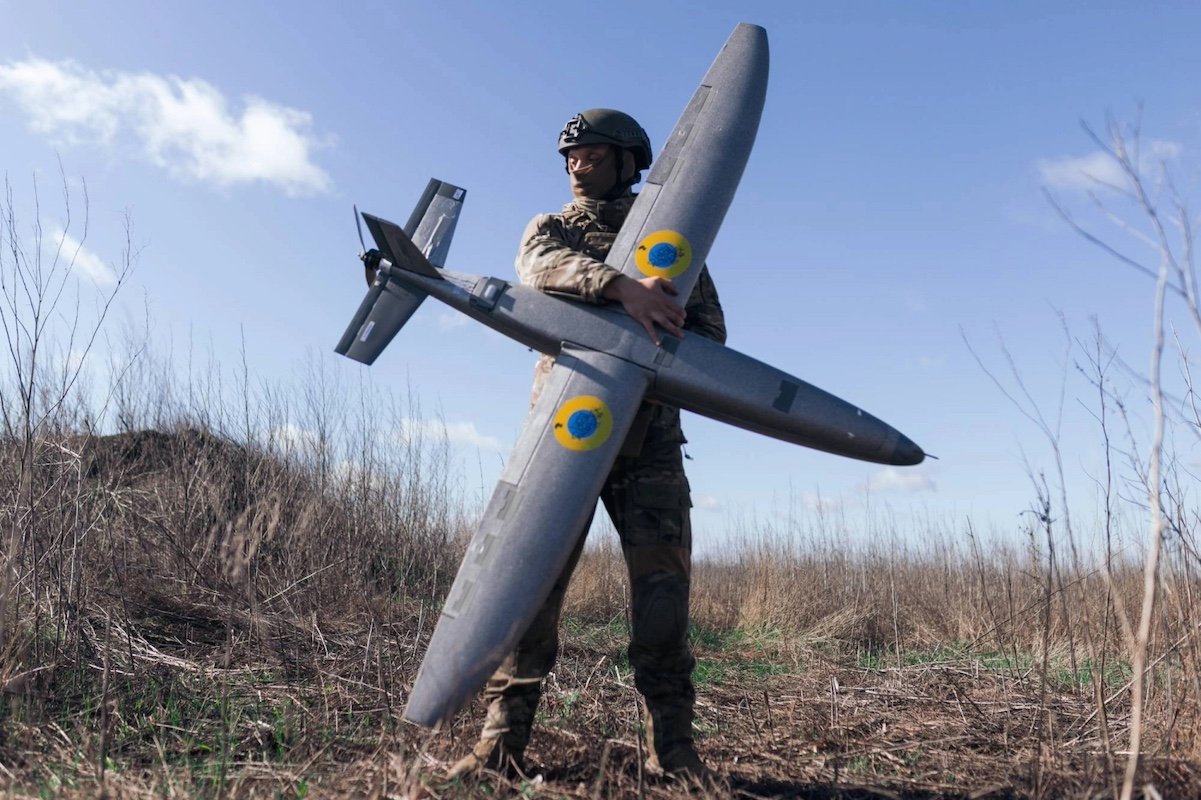
Terra Drone's involvement in Ukraine began in March 2026, when it announced a strategic investment in Amazing Drones, which develops and manufactures interceptor drones. By April, the company had deployed the short-range Terra A1 interceptor drone, developed jointly with Amazing Drones. At the end of that month, it reported the first successful interception of a long-range unmanned aerial threat. A second investment followed in WinnyLab, a Ukrainian defense tech firm specializing in fixed-wing interceptor drones and software integration, leading to the longer-range Terra A2 drone deployed in May.
The Terra A1 is a high-mobility interceptor designed for rapid launch, accelerating to 200 km/h within 10 seconds, with a top speed of 302 km/h and an operational range of up to 32 km. The Terra A2 offers a maximum speed of 310 km/h, a flight time of 40 minutes, and a range of 75 km.
Distributed Production Under Fire
Speaking at a joint press conference in Kyiv on March 31, Terra Drone CEO Toru Tokushige emphasized the importance of decentralized manufacturing. "If you build a large factory in the normal way, it becomes a target. Ukrainian engineers already have know-how – how to decentralize production and operate under constant threat. We are learning from that," he said. This approach mirrors the survival strategies seen in Iran's drone industry, which has also relied on dispersal and redundancy to withstand strikes.
Russia's Ministry of Defense and former President Dmitry Medvedev have explicitly warned that joint drone production with Ukraine would be a "step towards escalation." In mid-April, after Germany announced a €4 billion aid package for Ukrainian air defense and drones, Russia's MOD published a list of European drone manufacturers and their addresses on Telegram, calling them "potential targets." Medvedev wrote on X: "The list of European facilities which make drones & other equipment is a list of potential targets for the Russian armed forces. When strikes become a reality depends on what comes next. Sleep well, European partners!"
Against this backdrop, Terra Drone favors distributed small-scale production to reduce the risk to Japanese engineers and production specialists Tokushige plans to send to Ukraine. "Right now, the most important thing is real combat deployment. That is what we are working on," he said.
Amazing Drones CEO Maksym Klymenko noted the challenges: "The main challenge is scaling in a full-scale war—constant threats, strikes, and security risks. There is also a shortage of personnel, but we believe these challenges can be overcome."
Back in Kyiv on April 28, Tokushige highlighted Ukraine's advantages: "Ukraine has its advantages: speed of development and low cost. But there are also challenges – lack of experience in mass production and operating in global markets." The lessons from this partnership are expected to inform Japan's own defense modernization, as the country grapples with rising tensions in the Indo-Pacific. The broader trend of drone dominance redefining modern warfare is reshaping military thinking from Tokyo to Taipei.