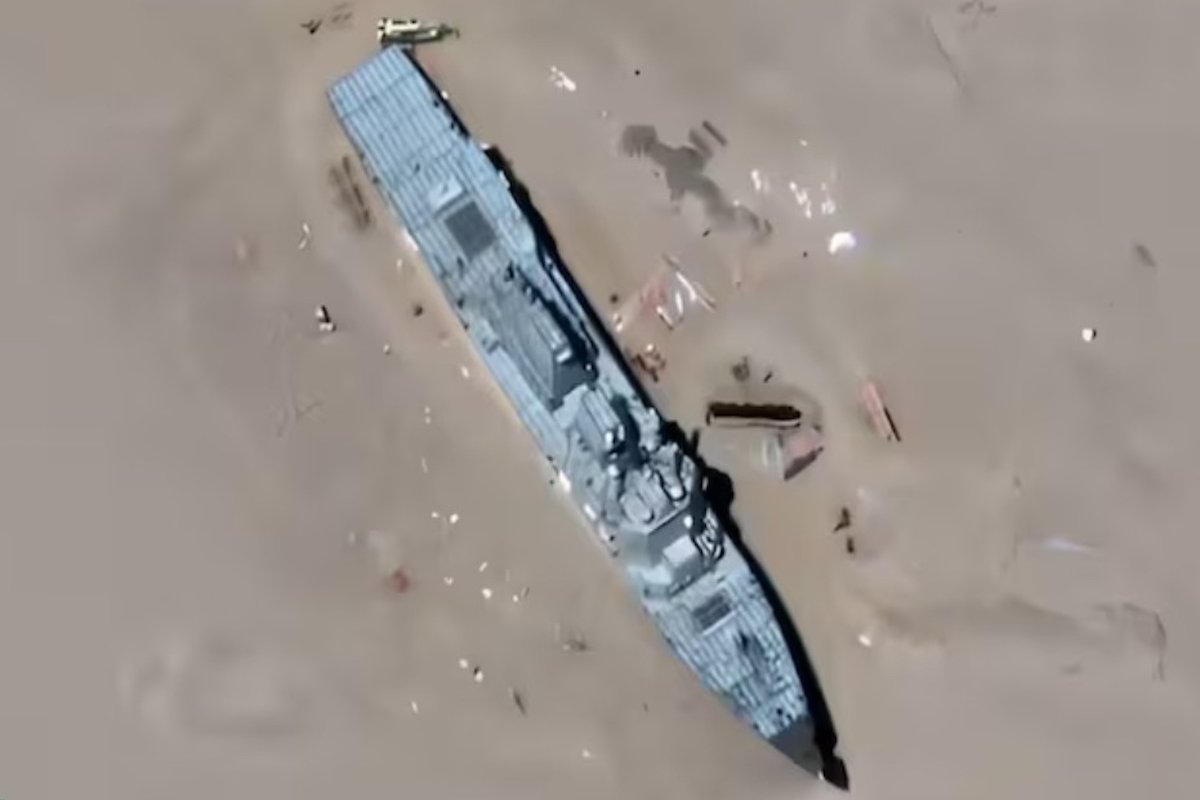
Satellite imagery released this month shows that China has constructed a full-scale, three-dimensional replica of a US Navy Arleigh Burke-class guided-missile destroyer at the Ruoqiao Test Range in the Taklamakan Desert, Xinjiang. The 155-meter mock-up, built between October 2025 and April 2026, represents a significant upgrade from earlier flat outlines of US aircraft carriers. It includes a complete mast, simulated radar equipment, and sensors designed to reproduce the radar profile of an active warship.
The facility, located more than 2,700 kilometers from the nearest ocean, is believed to support testing of anti-ship ballistic missiles, hypersonic weapons, and AI-assisted guidance systems against a more realistic target. The People's Liberation Army (PLA) can also simulate electronic countermeasures, refining target classification, over-the-horizon tracking, and weapon guidance. As one analyst noted, detecting a vessel is not enough; identifying its type and affiliation allows forces to verify targets and coordinate defenses.
From Flat Outlines to 3D Replicas
China previously built flat mock-ups of US carriers in Xinjiang, but the shift to a three-dimensional destroyer replica suggests a more nuanced approach. Rather than focusing solely on sinking a carrier, the PLA may be studying how to sequentially breach a carrier strike group's (CSG) defenses by targeting its escorts first. Losing a single Arleigh Burke destroyer would remove nearly 100 vertical-launch cells, a major radar and fire-control node, antisubmarine capability, and part of the formation's command network. The remaining ships would face larger surveillance sectors and greater magazine pressure, potentially forcing the carrier to withdraw or divert aircraft from strike missions.
In a May 2026 article in the peer-reviewed journal Tactical Missile Technology, researcher Gao Tianyun and co-authors argue that defeating a carrier group requires opening a narrow breach in its distributed defenses. Their proposed attack sequence begins with submarine-launched hypersonic missiles striking forward Aegis missile-defense nodes, while decoys and low-cost munitions draw defensive fire toward the flanks. Concentrated hypersonic salvos would then overwhelm successive escorts along a single attack corridor. A “leader-follower” missile swarm would re-task surviving weapons after each strike and guide ballistic missiles toward the carrier. Aircraft and expendable reconnaissance systems would assess damage, allowing AI to reallocate missiles and repeat the strike–assess–strike cycle until the group's defenses collapse.
However, striking a stationary desert mock-up is far easier than finding and attacking a moving target that can fight back. Arleigh Burke-class destroyers operate within multilayered defenses combining SM-6, SM-2, and RIM-116 interceptors, backed by close-in weapons systems, electronic warfare, chaff, and infrared flares. Space-based sensors may work well against ships in port, but tracking maneuvering vessels is limited by satellite coverage, revisit times, and network bandwidth; imagery only a few hours old may already be useless for targeting.
Countering China's A2/AD Strategy
The US could adopt an “Inside-Out Defense” approach, as developed by Thomas Mahnken, Travis Sharp, Billy Fabian, and Peter Kouretsos. This would combine survivable units inside the First Island Chain—such as mobile land-based cruise and anti-ship missile batteries, air and sea drones, special operations units, stealth fighters, and submarines—with supporting forces operating beyond the densest missile-threat zone. These forward units could pass targeting data to surface action groups and combat aircraft positioned near the zone's outer edge. Farther back, CSGs, amphibious ready groups, and strategic bombers would generate sorties and preserve nuclear deterrence.
Yet such a distributed posture remains dependent on the sensors, communications, and logistics networks connecting its widely separated forces. Rather than attacking carriers and destroyers directly, the PLA could target the force integrators—the networks and logistics assets that hold US joint operations together. Potential targets include forward air and naval bases, logistics ships, tankers, airborne early-warning aircraft, missile-defense radars, satellites, and computer networks. The aim would be to blind and starve US forces, fragment their operations, and create openings to destroy major warships.
This evolving dynamic underscores a broader challenge: a US-China naval clash may hinge less on the ability to destroy individual warships than on the capacity to fuse sensors, maintain targeting networks, and sustain missile salvos under combat disruption. As the US races to build up its industrial base and forward presence—a topic explored in US Wartime Buildup Races Against China's Industrial Clock in Indo-Pacific—the PLA's desert mock-up serves as a reminder that Beijing is methodically refining the tools to challenge American naval dominance in the Indo-Pacific.