President Vladimir Putin has publicly acknowledged for the first time that Ukraine's sustained drone campaign against Russia's energy infrastructure is causing real damage. Speaking to the United Russia party on June 28, Putin conceded that the country faces "a certain shortage" of fuel, admitting that "strikes on our infrastructure sites are creating problems."
The reality on the ground is far more severe than the Kremlin leader's understatement suggests. Throughout June, Ukrainian forces intensified strikes deep inside European Russia, hitting oil refineries in Moscow itself and disrupting supply chains across multiple regions. All areas of Russia now report fuel shortages, with knock-on effects including delays in food and other essential deliveries.
Russian-occupied Crimea has become a particular focus of Ukraine's strategy. On June 26, regional authorities declared a state of emergency as power outages, food shortages, and fuel rationing—including a ban on petrol sales to civilians—gripped the peninsula. Crimea's role as a vital logistics hub for Russian forces in Ukraine's Donbas region makes it a high-value target. The port of Sevastopol, a key base for Russia's Black Sea Fleet, has seen around 30% of its vessels damaged or destroyed by Ukrainian strikes since 2022, forcing a partial relocation of the fleet further east last year. Even remaining command-and-control units are reportedly planning to evacuate to mainland Russia.
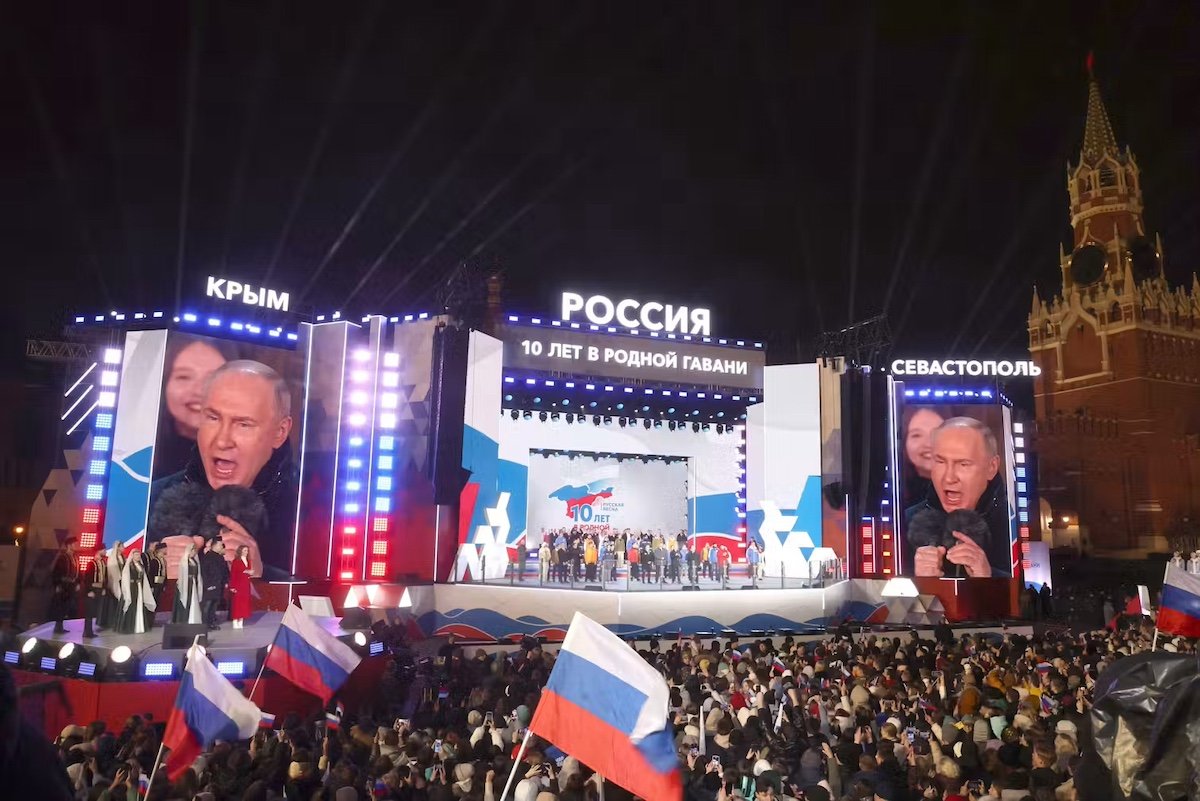
Beyond its military utility, Crimea holds immense symbolic weight for Moscow. Annexed in 2014 in a swift, bloodless operation that boosted Russian nationalist sentiment, the peninsula has been touted as the "crown jewel" of Putin's campaign in Ukraine. The phrase "Crimea is ours" became a social media meme and appeared on consumer goods. Russian state-backed films like the 2017 blockbuster Crimea and the 2018 romantic comedy Crimean Bridge – Made with Love!—written by RT chief Margarita Simonyan—portrayed the annexation as a triumphant, sun-drenched adventure. Moscow encouraged Russians to relocate there, with an estimated 200,000 people moving to the peninsula, lured by jobs and generous welfare benefits.
Ukraine's ability to strike Crimea with impunity is therefore deeply humiliating for the Kremlin. It exposes the myth of Putin's repeated claims that the war is proceeding according to plan. Even U.S. President Donald Trump, who in early 2025 told Ukrainian President Volodymyr Zelensky that Kyiv held no cards in the conflict, has reportedly acknowledged that Ukraine is "doing pretty well."
Russia's Tactical Stagnation
Moscow's failure to shield its own society from the war's economic consequences underscores a broader pattern of slow adaptation. While Ukraine has proven adept at innovating in weapons development, strategy, and tactics, Russia has struggled to respond effectively. In the short term, the Kremlin typically responds to setbacks by intensifying attacks on Ukrainian civilians, as seen in the massive overnight strikes on July 1 that killed at least 17 people and wounded dozens more. In the medium term, Russia adapts its tactics incrementally—for example, dispatching small groups of soldiers, sometimes on horseback, to avoid Ukrainian drone surveillance on the front lines.
This pattern suggests continuity rather than radical change in Russia's approach. Moscow is likely to emphasize anti-drone and anti-missile measures, but doubts remain about whether its thinly stretched defenses can protect the wide range of locations Ukraine targets. For Asian observers, the conflict offers lessons in the strategic value of drone warfare and the importance of military adaptability—themes explored in our analysis of how Asia must change its military culture to replicate Ukraine's drone success.
It is too early to declare that the tide of the war has turned decisively in Ukraine's favor. But unless Russia finds a more robust response to the challenges it faces, June 2025 may be remembered as the month when the Kremlin's grip on its prized possession—Crimea—began to slip.