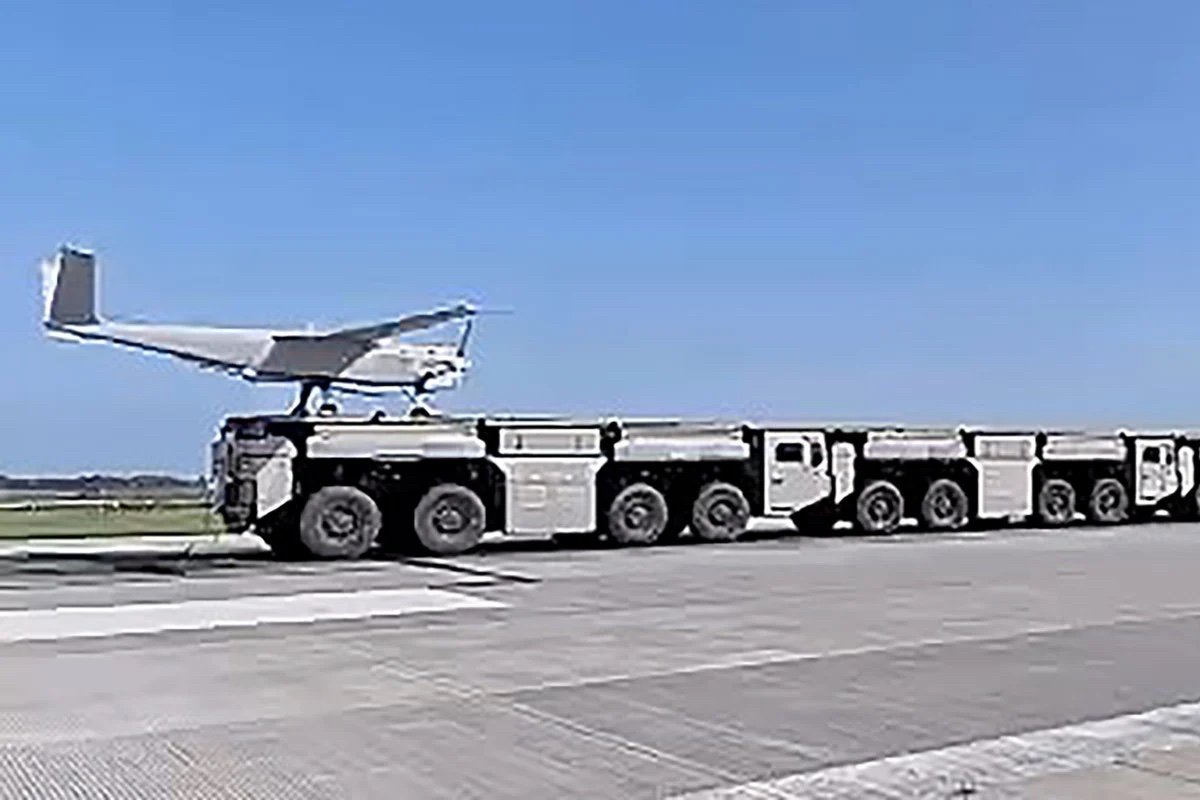
China has unveiled a mobile drone launcher that represents less a single weapon than a blueprint for dispersing airpower, exploiting civilian cover, and exporting low-cost strike reach to states priced out of traditional military aviation. The system, developed by the Beijing Institute of Technology (BIT), was shown in social media footage—since deleted—depicting three eight-wheeled flat-top trucks aligning and linking by mechanical hinges to form a launch platform for a fixed-wing propeller drone.
BIT stated that the launcher is part of a “containerized weapon module suite” involving the university and more than 70 Chinese research entities. The suite includes at least ten modules covering drones, air defense, anti-ship, anti-submarine, land-attack, radar, electronic warfare, and command and logistics systems. The project is framed as both national defense and export-oriented, particularly for Belt and Road Initiative (BRI) and Global South partners.
Strategic Implications for the Taiwan Strait
In the context of a potential US-China conflict over Taiwan, the truck-based launcher could mitigate vulnerabilities of China's forward airbases. In March 2026, Reuters reported that China has deployed over 200 outdated J-6 fighter jets, converted into supersonic attack drones, at six airbases near the Taiwan Strait, according to a report from the Mitchell Institute of Aerospace Studies. However, those bases are vulnerable to Taiwan's long-range precision-strike capabilities, including the Hsiung Feng IIE cruise missile with a range of 600 kilometers and extended-range variants reaching 1,200 kilometers.
Mobile launchers could reduce reliance on fixed airfields by multiplying launch sites, constantly moving, and blending into civilian highway traffic. This complicates adversary targeting, though it must contend with the US's formidable intelligence, surveillance, and reconnaissance (ISR) capabilities. A March 2026 US Central Command fact sheet shows that during Operation Epic Fury, the US struck more than 7,000 targets, using AI to accelerate kill chains. In a Taiwan scenario, the US may avoid direct strikes on mainland China but could use ISR to support Taiwanese attacks on Chinese airfields.
Maritime and Export Dimensions
At sea, the launchers could transform civilian vessels into ad hoc drone carriers, expanding China's naval advantage in hull numbers. In March 2026 testimony to the US-China Economic and Security Review Commission, Andrew Erickson noted that China now has the world's largest fleet, with 400 battle-force ships and 60 submarines. Sam Tangredi argued in a January 2023 Proceedings article that larger fleets tend to prevail because their ability to absorb losses can outweigh short-term technological advantages. Mounted on civilian ships, these launchers could exploit gray zone ambiguity by blending into maritime traffic near Taiwan, Okinawa, the Philippines, or Guam, pre-positioning for surprise attacks on US and allied installations.
This poses an operational dilemma for the US and its allies: inspect and board suspicious ships at the risk of escalation and resource strain, or let them pass and accept greater exposure. However, ad hoc drone carriers have clear limits: civilian ships lack the speed, layered defenses, armor, and compartmentalization of warships, and it is unclear whether China's merchant-marine institutions could withstand wartime stress.
China's plans to export truck-mounted drone launchers could appeal to countries with limited defense budgets but ambitions for power projection. Adya Madhavan wrote in an April 2025 Takshashila Institution report that China has sold unmanned combat aerial vehicles (UCAVs) to about 17–18 countries, especially in West Asia, the Gulf, and Central Africa, where buyers seek affordable armed drones and face US export restrictions. The Wing Loong 1/2 and Rainbow series are China's dominant exports, deepening influence in BRI states and providing battlefield feedback from conflicts in Yemen, Iraq, and Ethiopia.
This development echoes broader trends in the region, such as Japan's gray-zone resilience depending on civilian industry networks, where dual-use technologies blur the line between civilian and military applications. Similarly, India's nuclear buildup sharpens deterrence as Pakistan and China probe below the threshold, highlighting the evolving security landscape across Asia.