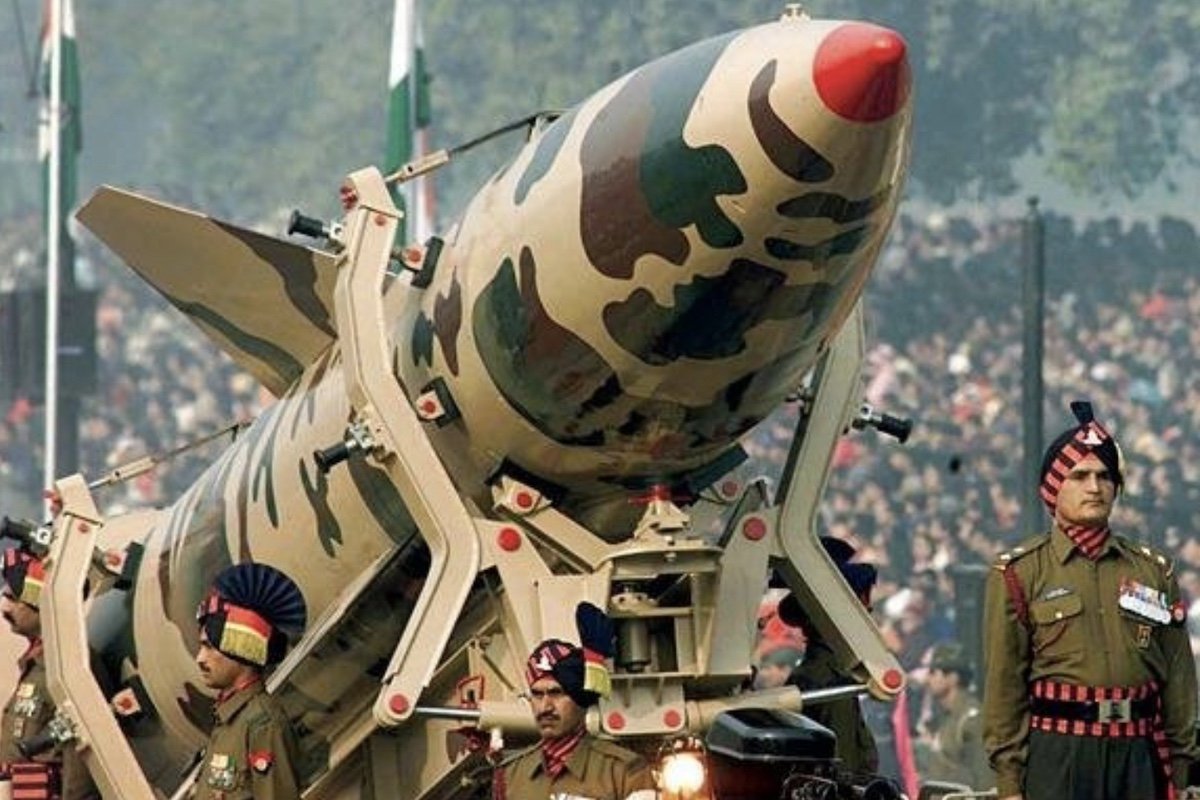
India's nuclear arsenal has expanded to an estimated 190 warheads as of January 2026, according to the Stockholm International Peace Research Institute (SIPRI), driven by its enduring rivalry with Pakistan and a growing strategic focus on countering China. The increase from 180 warheads in 2025 reflects New Delhi's steady development of a nuclear triad comprising aircraft, land-based missiles, and nuclear ballistic missile submarines (SSBNs). This buildup is intended to sharpen India's deterrent posture, but analysts warn that Pakistan and China are increasingly turning the domain below nuclear war into the real battlefield.
The expansion is fueled by deep-seated regional tensions, notably Operation Sindoor in May 2025, when India conducted conventional strikes on Pakistani bases with nuclear missions. To ensure a secure second-strike capability and bolster deterrence against Beijing, India is investing in longer-range systems and continuing fissile material production. Technological advances, such as the deployment of MIRVs on the Agni-V intermediate-range ballistic missile (IRBM), are accelerating this process. India is also shifting its peacetime posture by canisterizing land missiles and deploying a small number of warheads on a single submarine for occasional deterrence patrols, signaling a move toward mating warheads with operational launchers.
Below the Nuclear Threshold: The New Battlefield
Yet India's maturing nuclear triad emerges just as hybrid warfare, asymmetric capabilities, and risk-taking below the nuclear threshold are eroding older assumptions about strategic deterrence. Rose Gottemoeller, writing in a June 2026 Foreign Policy article, argues that recent conflicts—the Russia-Ukraine War, the Iran-Israel War, and Operation Sindoor—show that strategic deterrence is not foolproof. State and non-state actors are increasingly calling nuclear powers' bluff, as nuclear assets like strategic bombers, ICBMs, and SSBNs prove ineffective against massed cheap drone attacks, especially when nuclear states are reluctant to deploy them. Gottemoeller notes that the nuclear taboo established in 1945 remains strong, and leaders contemplating nuclear use risk severe backlash and infamy.
Despite these vulnerabilities, nuclear weapons retain a powerful psychological role. Patrick Cronin, in a 2026 Hudson Institute article, observes that nuclear-armed states have become more adept at exploiting nuclear fears to achieve conventional goals, with some believing that even tactical nuclear use might only provoke conventional retaliation. However, Cronin warns that coercion and conflict, along with the entanglement of conventional and nuclear domains, increase ambiguity and the risk of miscalculation.
For India, that ambiguity is no longer theoretical. Pakistan and China are testing the seams between nuclear deterrence, conventional restraint, and hybrid coercion, forcing New Delhi to think less in terms of deterring war outright and more in terms of managing violence below the nuclear threshold. From India's perspective, Pakistan has fused gray-zone warfare with nuclear deterrence. Ashok Shivane, in a March 2026 report for the Center for Land Warfare Studies (CLAWS), argues that Pakistan's nuclear posture provides strategic insulation for proxy warfare, lowering the nuclear threshold to deter India from exploiting its conventional military superiority. In effect, Shivane says, Pakistan seeks to fragment India's escalation calculus while preserving room for sub-conventional coercion.
However, Siddhant Kishore, writing in a November 2025 article for the Bulletin of the Atomic Scientists, contends that India strongly discounts Pakistan's nuclear threats, partly because Islamabad lacks a credible sea-based second-strike capability. By contrast, India's nuclear triad improves the survivability of its arsenal, while New Delhi maintains strategic ambiguity over its No First Use (NFU) posture and promises massive retaliation to any first strike. This gap demonstrates that nuclear deterrence can limit escalation without stopping competition, instead pushing rivals into more ambiguous forms of conflict where drones, cyber operations, precision strikes, information warfare, and coercive signaling become tools for fighting without formally crossing the nuclear line.
From Pakistan's perspective, Rabia Akhtar, in a June 2026 report for the French Institute of International Relations (IFRI), notes that despite the conventional escalation in May 2025, Pakistan's nuclear deterrent did not fail, as it prevented border clashes from escalating into a major war. However, Akhtar says that Pakistan's nuclear deterrent left dangerous gaps for conventional exchanges, information warfare, and coercive signaling. Muhammad Faisal and other authors, in a May 2026 War on the Rocks article, argue that Pakistan is developing conventional tools to manage escalation rather than relying solely on nuclear signaling. They say Islamabad is prioritizing multi-domain integration, combining AI, electronic warfare, cyber capabilities, and precision-strike systems with centralized command to maintain escalation discipline.
The China front presents a different but no less complex deterrence problem. Rakesh Sood, in a February 2026 article for the Carnegie Endowment for International Peace (CEIP), argues that India-China border tensions are structurally insulated from nuclear escalation by shared defensive frameworks. Sood points out that India and China's strict NFU policies create a more symmetrical nuclear posture, limiting nuclear rhetoric even during tense confrontations. Yet the broader strategic competition, including China's growing naval presence in the Indian Ocean and its partnership with Pakistan, continues to drive India's nuclear modernization. As New Delhi navigates these dual challenges, the region's security landscape is increasingly defined not by the threat of nuclear war, but by the contest for advantage in the gray zone beneath it.



