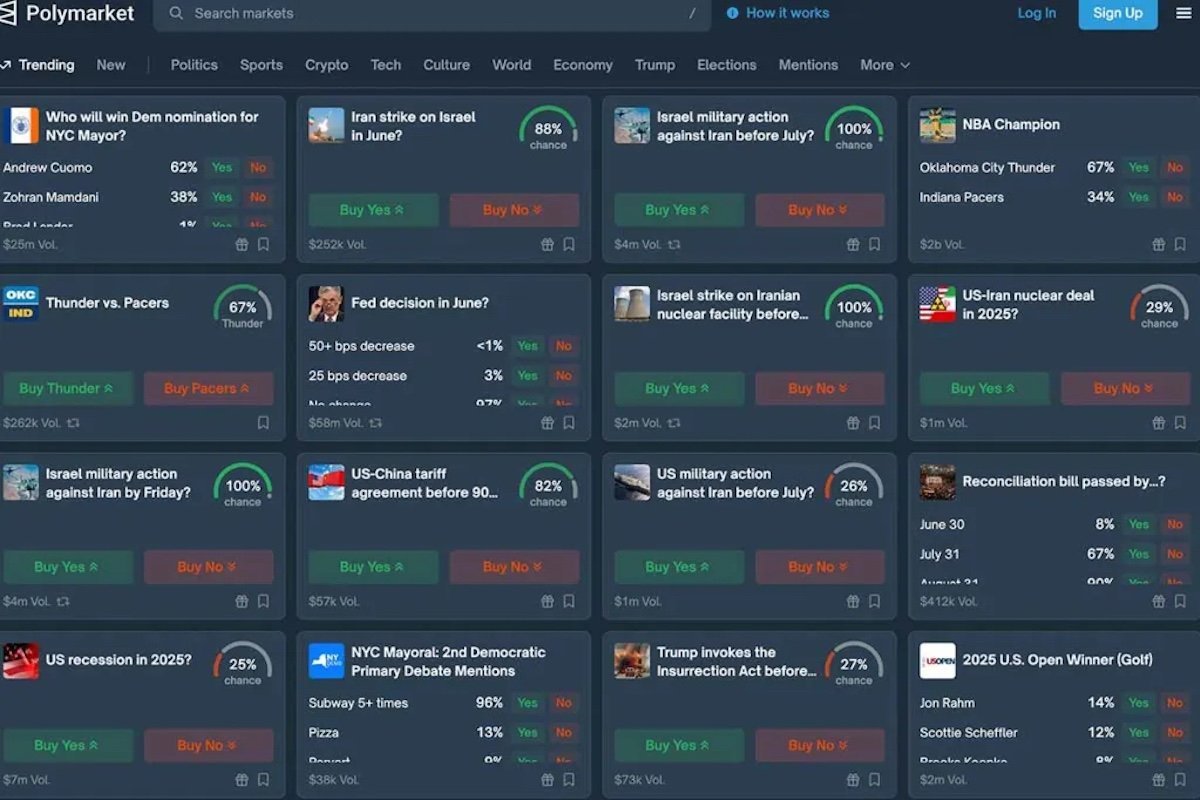
Prediction markets have moved from academic curiosity to mainstream financial instruments, allowing participants to buy and sell contracts tied to everything from election results to climate events. Platforms such as Polymarket and Kalshi have attracted millions in trading volume, but their rapid growth raises a deeper question: can these markets actually create the future they claim to predict?
The mechanics are straightforward. Users purchase contracts that pay $1 if a specific event occurs by a set date, and nothing if it does not. Prices fluctuate in real time as traders react to news, effectively producing a live probability estimate. Supporters argue this aggregation of information yields forecasts that often beat polls and expert opinions. Critics, however, see a system vulnerable to speculation, manipulation, and even insider trading.
How prediction markets work
Most contracts are binary—yes or no. A contract on whether the Bank of Japan will raise rates by December trades at a price that implies a probability. The market closes at a predetermined resolution date, and winners receive $1 per contract. This simplicity is a key appeal, but the underlying infrastructure varies.
Kalshi, founded in 2018, operates as a federally regulated exchange under the US Commodity Futures Trading Commission (CFTC). Polymarket, launched in 2020, initially built its platform on blockchain and used a decentralized oracle protocol called UMA to resolve outcomes. Disputed results are debated by UMA token holders on Discord before a vote. Polymarket has since established a CFTC-regulated US arm, Polymarket US, reflecting the industry's rapid evolution.
Other platforms remain niche, including Good Judgment Open, the Iowa Electronic Markets, Manifold, and PredictIt. Each offers a different flavor of event trading, but all share the core premise that markets can distill collective wisdom.
Forecasting tool or gambling den?
The debate over whether prediction markets are “truth machines” or glorified casinos is intensifying. Richard Warr, a finance professor at the Poole School of Management, sees them as decision-support tools. “Prediction markets are not just forecasting tools; they are decision-support tools,” he says, helping people incorporate changing information into decisions about uncertain events.
Yet the line between trading and gambling is thin. Platforms collect fees on each transaction, much like a poker room raking the pot. The distinction, argues Kalshi CEO Tarek Mansour, lies in the nature of risk. A bookmaker creates artificial risk through odds, while prediction markets address natural risk—the real possibility of an election upset or a wildfire. Users can hedge against that risk, he contends.
But the potential for manipulation is real. A well-funded trader could push prices to influence public perception, especially in politically sensitive markets. The decentralized governance of Polymarket's UMA oracle has drawn criticism for opacity, as token holders with significant voting power can sway disputed outcomes.
Prediction markets are also expanding beyond politics. In Asia, where financial innovation is rapid, platforms are beginning to cover regional events—from Japan's bond market stress to Hong Kong's first regulated stablecoin. This regional integration could amplify their influence on local markets and policy decisions.
The self-fulfilling prophecy concern is not merely theoretical. If a market signals a high probability of a political crisis, that signal itself can erode confidence and trigger capital flight, making the crisis more likely. Conversely, a market showing strong support for a policy might encourage policymakers to act in that direction. In this way, prediction markets may not just forecast the future—they may help shape it.
As these platforms grow, regulators worldwide are watching. The CFTC's oversight of Kalshi and Polymarket US is a step toward legitimacy, but the global nature of blockchain-based markets complicates enforcement. For now, prediction markets occupy a gray zone between finance, gambling, and prophecy—and their true impact on the events they track remains an open question.