Holtec International, a Florida-based company long known for managing nuclear waste and decommissioning old plants, is reinventing itself as a builder of next-generation reactors. On Friday, it filed paperwork with the US Securities and Exchange Commission for an initial public offering on the NASDAQ, betting that its 300-megawatt small modular reactor (SMR) can capture a growing market for clean, flexible power.
For decades, Holtec manufactured canisters to store spent fuel and dismantled shuttered nuclear stations—a role it describes as the industry's undertaker. Now it wants to become its midwife, producing and operating new electrical stations. The shift reflects a broader revival of nuclear energy in the United States, driven by surging electricity demand from data centers and manufacturing, and the need for carbon-free baseload power.
Small reactors, big ambitions
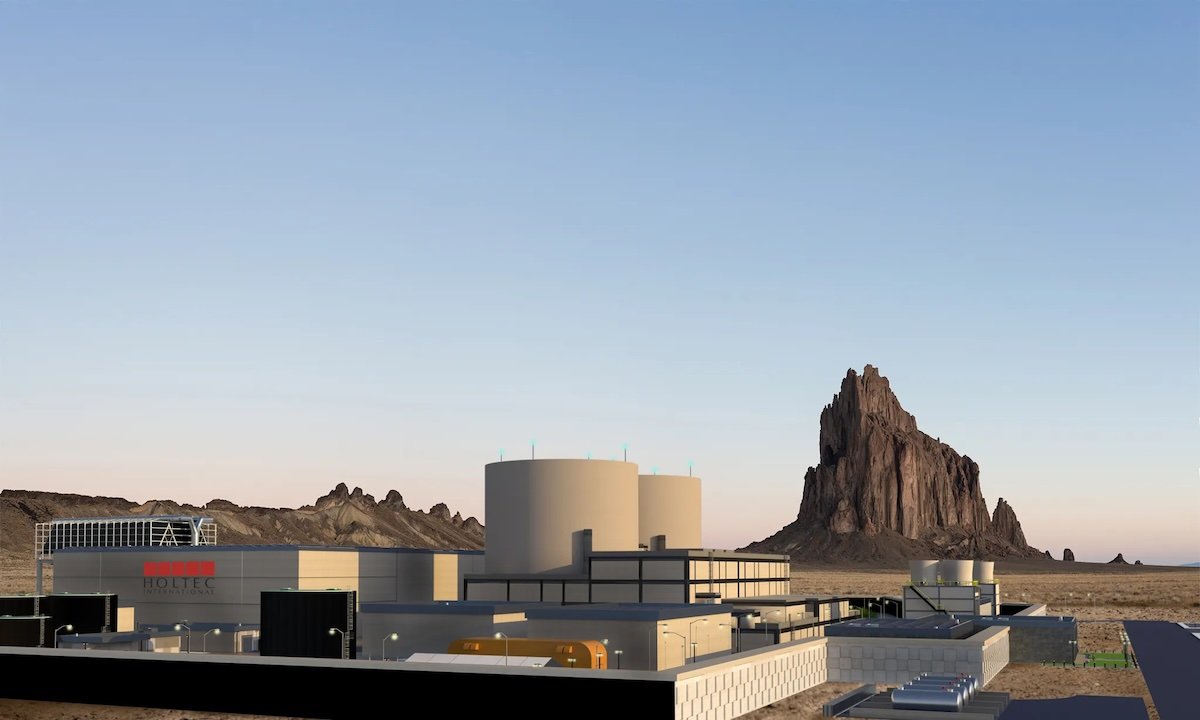
Holtec's SMR-300 is a pressurized-water reactor designed to generate about a third of the electricity of a conventional large-scale plant. Proponents argue that building identical units on assembly lines will lower costs through repetition, even if each reactor is smaller. The company's S-1 filing states that SMRs "will offer scalable, cost-effective solutions for new capacity with enhanced safety features, reduced construction timelines and reduced land and transmission infrastructure needs."
A single SMR-300 plant would require just 15 acres of land and take three years to build, according to the filing. By contrast, traditional reactors can occupy hundreds of acres and take nearly a decade to complete. Holtec expects regulatory approval for the SMR-300 in 2029, with first deployment "in the early 2030s."
The company also sees SMRs as a natural fit for converting retired coal-fired power plants. The US Department of Energy has studied this idea for years, noting that coal and nuclear plants both use steam-driven turbines. Replacing a 400-MW coal unit with a similarly sized reactor avoids costly transmission upgrades and land acquisition. "We believe that our SMR-300 plant can become a favored nuclear generation source over large reactors because of certain advantages," Holtec said in its filing.
Restarting old plants, building new ones
Holtec is simultaneously pursuing a parallel strategy: restarting shuttered conventional reactors. At its Palisades nuclear station in western Michigan, the company is restoring an 800-MW unit—the first US effort to return a permanently closed reactor to service. That project could be completed within months, though power sales to the local grid won't begin until next year. Holtec plans to deploy two SMR-300s at the same site, and has floated similar plans for New Jersey's Oyster Creek plant, which it has been decommissioning for eight years.
The company owns three other defunct plants—Massachusetts' Pilgrim, Michigan's Big Rock Point, and New York's Indian Point—that could also be candidates for reconstruction. The Trump administration has called for rebuilding Indian Point, but New York state officials remain opposed.
Global competition and government backing
Holtec's biggest challenge may not be local opposition but competition from state-owned nuclear giants in Russia and China. Rosatom, the Kremlin's nuclear export arm, dominates the international market, while China's two state-owned nuclear companies are building dozens of reactors at home and preparing to export. Virtually every Western nuclear developer struggles to match their scale and financing.
Still, Holtec has advantages. It is a profitable, established firm with operations in a dozen countries across four continents, and it is regulated by the US Nuclear Regulatory Commission. The company has also won significant federal support: a $1.52 billion loan from the Department of Energy to finance the Palisades restart, and $400 million to support construction of its first SMR-300s.
"We began work in 2011 on a small modular reactor solution, and drawing on our in-house capability to design, license, manufacture, construct, and commission nuclear systems, honed through decades of turnkey supply, we are now uniquely positioned to launch the development of our small nuclear reactor," Krishna Singh, Holtec's founder and chief executive, wrote in a letter to prospective investors.
The IPO comes as nuclear power gains traction across Asia and beyond. For a deeper look at how nuclear energy is reshaping competition in the region, see our analysis Nuclear Power Drives a New Space Race Across Asia and Beyond. Meanwhile, India's nuclear buildup is sharpening deterrence dynamics with Pakistan and China, as explored in India's Nuclear Buildup Sharpens Deterrence as Pakistan and China Probe Below the Threshold.
Whether Holtec can deliver on its promises remains to be seen. The SMR industry has yet to prove that factory-built reactors can achieve the cost reductions proponents claim. But with a clear regulatory path, federal funding, and a portfolio of existing sites, Holtec is positioning itself as a leading contender in the race to revive American nuclear power—and to compete with the state-backed behemoths of Russia and China.