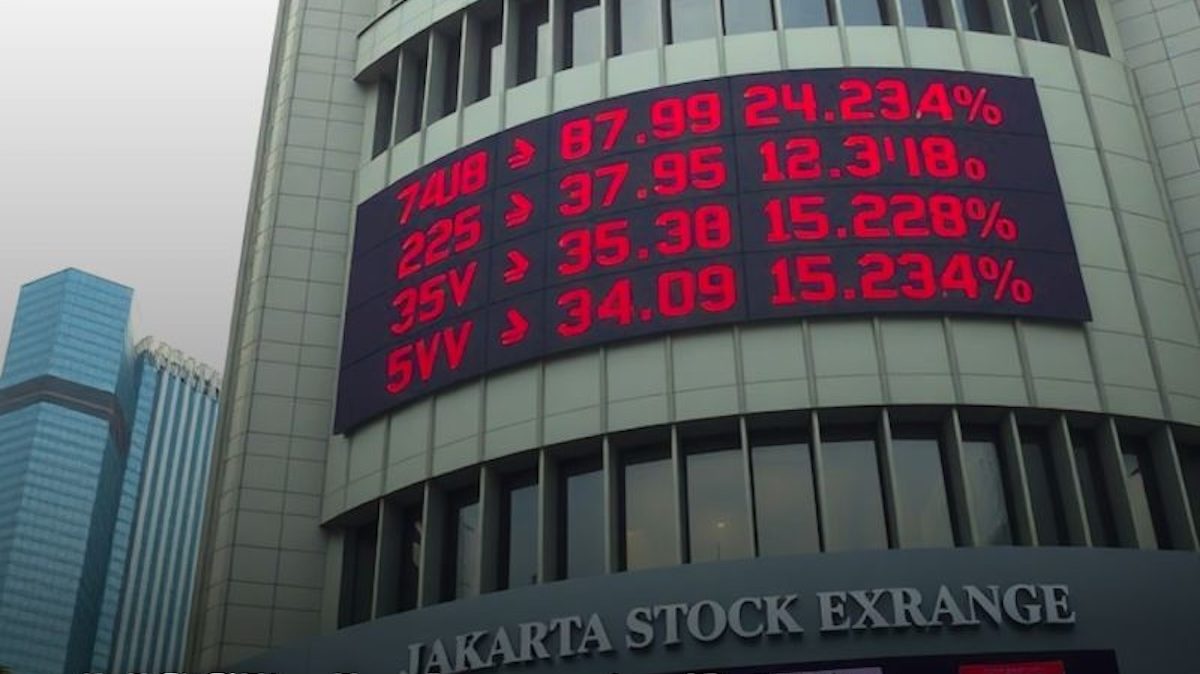
The May 2026 rebalancing by Morgan Stanley Capital International (MSCI) has delivered what many analysts describe as the most severe shock to Indonesia's equity market in modern history. The sweeping removal of 19 Indonesian companies from MSCI's Global Standard and Small Cap indices—without a single new addition—represents far more than a routine portfolio adjustment. It amounts to a structural verdict from global investors on the quality of corporate governance, ownership transparency, and market liquidity in Southeast Asia's largest economy.
Indonesia's Financial Services Authority had initially projected only two or three deletions. Instead, six firms were ejected from the Global Standard Index and 13 from the Small Cap Index. The immediate fallout was severe: foreign capital flight estimated at Rp31.5 trillion (US$1.8 billion) sent the Jakarta Composite Index plunging as much as 3.76% to 6,470, cementing Indonesia's position as one of Asia's worst-performing equity markets in 2026, with annual losses reaching 25.17%. The rupiah briefly weakened beyond Rp17,700 per US dollar, its lowest level on record, as capital fled Indonesian risk assets.
Ownership Transparency Under Fire
At the heart of the exodus lies not deteriorating corporate earnings but extreme shareholding concentration. Both MSCI and FTSE Russell have repeatedly warned that excessively concentrated ownership structures distort price discovery. Several removed companies displayed extraordinarily tight ownership: at Barito Renewables Energy, controlling shareholders held 97.31% of total shares, leaving an effective public free float of just 2.69%. A similar pattern emerged at Dian Swastatika Sentosa, where insider ownership stood at 95.76%.
Such concentration creates acute liquidity risks for global institutional investors. When only a tiny fraction of shares is genuinely available for trading, even moderate transactions can trigger extreme price swings. For MSCI, this becomes a major obstacle for passive funds attempting to replicate index performance. As a result, large Indonesian names including Amman Mineral Internasional, Chandra Asri Pacific, and Petrindo Jaya Kreasi were forced out of the Global Standard category. The consequences are largely mechanical: passive investment managers must sell stocks that no longer qualify, regardless of the underlying companies' business prospects.
The wave of exclusions also swept through the Small Cap category, where 13 Indonesian firms were removed, including Aneka Tambang, Bumi Serpong Damai, and Industri Jamu dan Farmasi Sido Muncul. Meanwhile, Sumber Alfaria Trijaya was downgraded from Global Standard to Small Cap status. MSCI's tighter liquidity and free-float requirements reflect increasingly demanding global transparency standards. Indonesia's earlier interim freeze on new additions had already signaled that the country's capital market reforms were under intense international scrutiny.
The financial impact was immediate and substantial. Various research institutions estimated passive outflows between Rp28 trillion and Rp31.5 trillion. The selling pressure drove the Jakarta Composite Index down sharply, and the rupiah's vulnerability was equally pronounced. This episode echoes broader regional challenges: as bond market shifts threaten Asia's AI-driven rally, Indonesia's market structure crisis adds another layer of fragility to the region's financial landscape.
Strong Companies, Weak Market Structure
Ironically, the sharp decline in many excluded stocks did not necessarily reflect deteriorating business fundamentals. For strategic investors, the post-rebalancing selloff may instead present accumulation opportunities in fundamentally strong companies whose valuations have been distorted by technical index pressures. Aneka Tambang, for instance, posted impressive first-quarter 2026 earnings, with net profit surging to Rp3.41 trillion from Rp2.13 trillion a year earlier. Maintaining an EBITDA margin of 16.3%, the company remains a critical player in the global nickel supply chain.
A similar story unfolded at Chandra Asri Pacific, which delivered its highest quarterly profit on record following the successful integration of strategic refinery assets in Singapore. Although its stock plunged nearly 15% after the MSCI announcement, the company still generated quarterly EBITDA of US$421 million, underscoring the resilience of its business amid volatile petrochemical markets. The paradox is revealing: MSCI's punishment was less an indictment of corporate viability than a critique of market structure and governance.
The mass removals send a clear warning: ownership transparency is no longer optional. It has become a prerequisite for remaining investable in the eyes of global capital markets. Indonesia's experience demonstrates how quickly a nation's cost of equity can rise when structural weaknesses undermine investor confidence. This crisis also intersects with broader geopolitical dynamics: as Indonesia navigates its strategic drift between the US and China, the country's financial credibility becomes a critical asset in attracting foreign investment.
For policymakers in Jakarta, the MSCI purge is a wake-up call. Without meaningful reforms to improve free float, enhance corporate governance, and boost market liquidity, Indonesia risks being sidelined in the competition for global capital. The rupiah's record low and the stock market's deep losses are symptoms of a deeper malaise that requires structural solutions, not just temporary fixes. As Indonesia's rupiah plunge tests central bank credibility, the broader lesson is clear: market quality must match economic ambition.