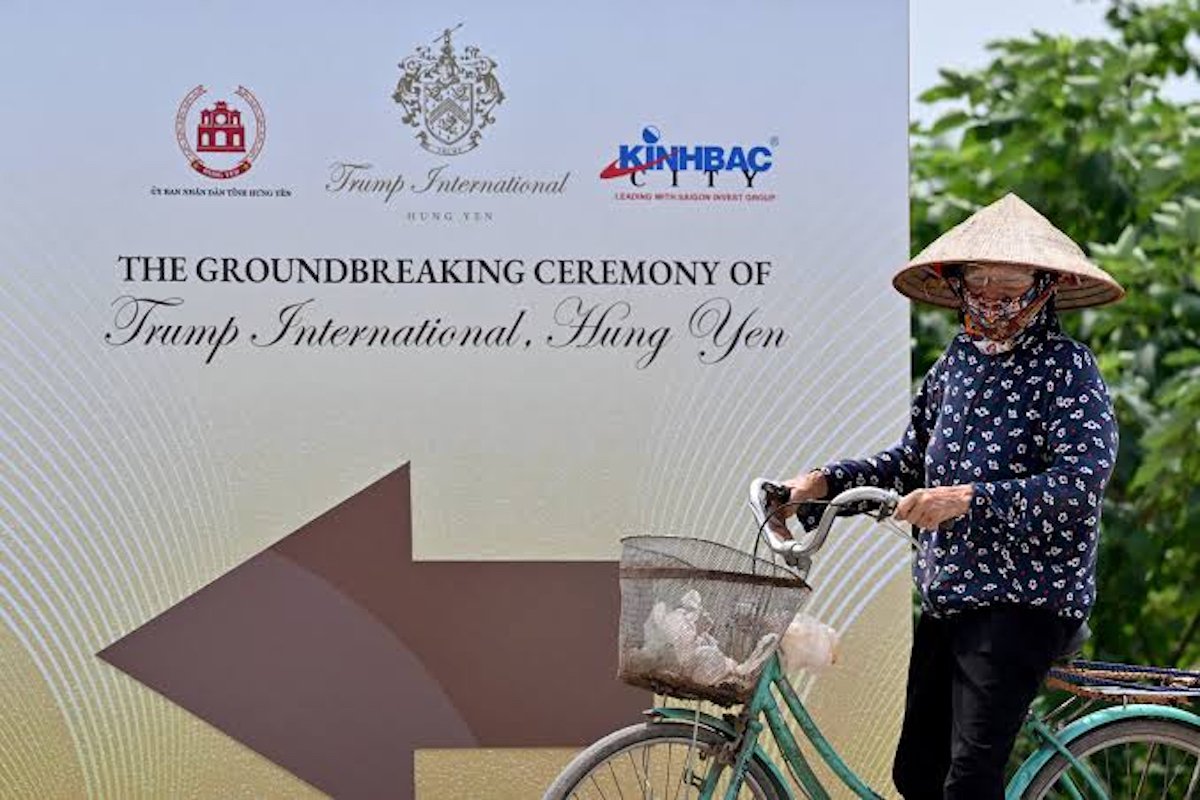
In Hung Yen province, northern Vietnam, construction crews are clearing a cemetery to make way for a sprawling Trump International golf resort and luxury real estate complex. The project, spanning 2,446 acres along the Red River, has required the exhumation of more than 3,500 ancestral graves and the relocation of over 4,000 families, according to Legal Initiatives for Vietnam (LIV), a human rights group based in Taiwan and registered in California.
The $1.5 billion development, comparable in size to Newark Liberty International Airport, includes two eco-residential areas with ecological golf courses, a commercial urban services zone, and social housing. The Trump Organization, which licenses its brand to the project, will operate the club upon completion. Vietnamese developers, led by Kinh Bac City Development Holding Corp. (KBC), manage the project and handle compensation payments, which residents say are scant.
Strategic Embrace of American Capital
Hanoi’s approval of the Trump resort underscores a broader shift in US-Vietnam relations since the war ended in 1975. Vietnam’s government, under recently reelected President To Lam, has actively courted American investment to reduce its economic vulnerability to China, its dominant trading partner across the northern border. The project received support from the finance ministry and the Hung Yen People’s Committee, a communist provincial body.
At the May 2025 groundbreaking, the Trump Organization described the resort as “a living icon of a new era,” located 45 minutes from Hanoi. The venture is part of a wave of US-linked projects in Vietnam, including a Starlink satellite operating license granted to Elon Musk’s SpaceX in February, and Apple’s growing manufacturing footprint. CEO Tim Cook told CNBC last year that “almost all of the country of origin” for US sales of Mac, iPad, AirPods, and Apple Watch is now Vietnam.
Starbucks has also deepened its presence, opening what it calls “the highest Starbucks coffeehouse in Asia” on Fansipan Mountain, the 10,312-foot peak that is the highest in Indochina. The café, accessible via a cable car, sits amid stone pavilions, a bell tower, and a giant Buddha statue, catering to tourists visiting the Sapa highlands.
Local Costs and Controversies
The Trump resort’s construction has sparked protests from residents forced to disinter ancestors and relocate with minimal compensation. LIV noted that the Trump Organization is not directly responsible for these payments; Vietnamese developers handle them. The project’s 50-year operating license was approved by the Ministry of Defense and Ministry of Public Security, which will guide security matters, including housing sales to foreigners.
IDG Capital Vietnam represents the Trump Organization in the project. Former Prime Minister Pham Minh Chinh, whose tenure ended in April, suggested the Trump Organization consider Vietnam as a strategic business hub for expansion into other sectors. KBC holds a 95.32% indirect ownership stake in Trump International Vietnam Joint Stock Company, according to a government statement filed with Hanoi’s Securities Commission.
Vietnam continues to grapple with corruption, population density, and demands for free speech, even as it welcomes foreign investment. The central coastal city of Da Nang has emerged as a hub for digital nomads, with Forbes ranking it among the top cities for creators and digital nomads in 2026, citing affordability, strong infrastructure, and a coastal lifestyle.
The Trump resort project mirrors other family-linked ventures in the region, such as the Trump Sons Poised to Profit from US-Funded Kazakh Tungsten Mine, highlighting the interplay of business and diplomacy. Meanwhile, the deepening US-Vietnam relationship reflects a strategic calculus that extends beyond commerce, as Hanoi seeks to balance its ties with Washington against its dependence on Beijing.