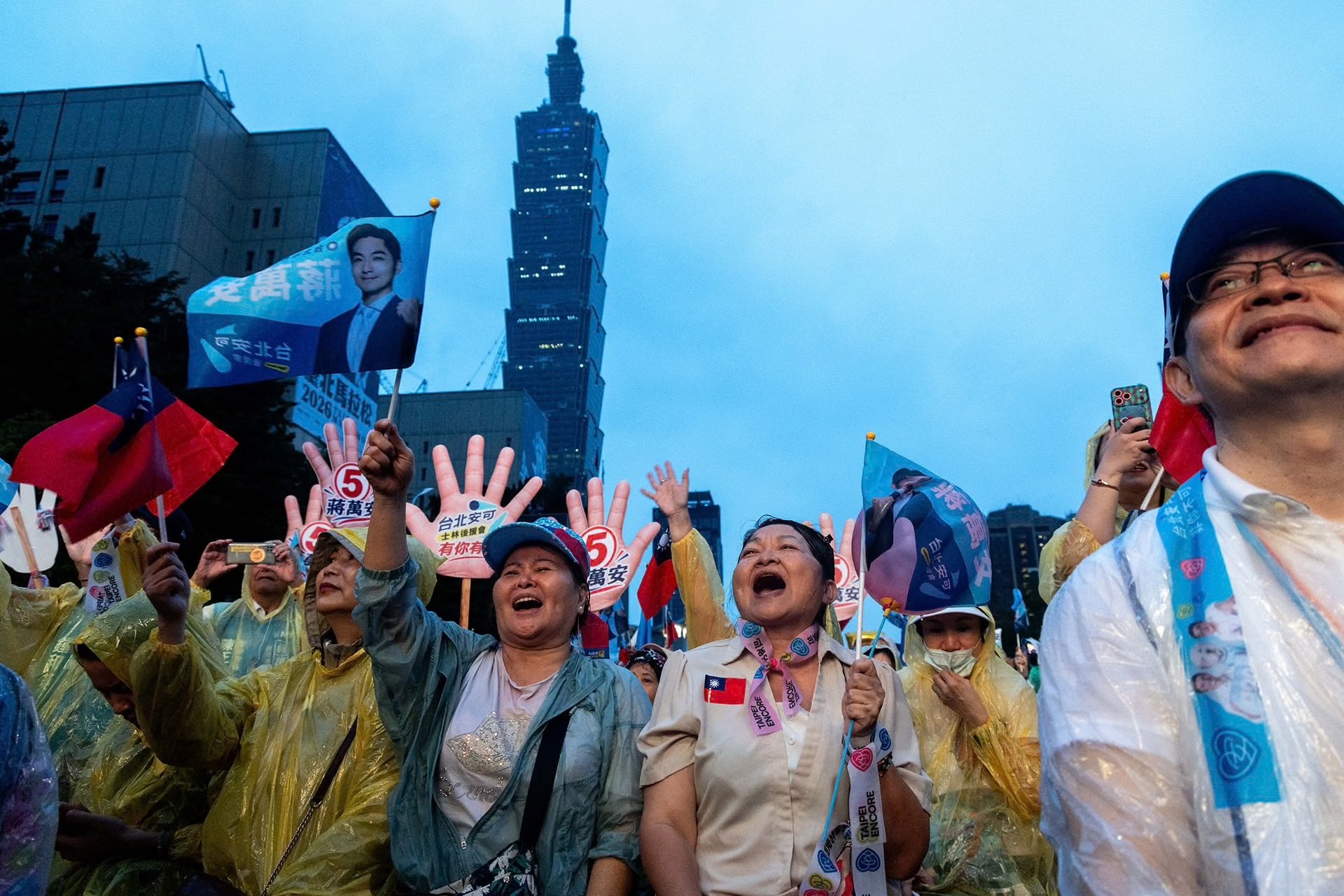
Taiwan's local elections on Saturday produced a mixed political picture, with the ruling Democratic Progressive Party (DPP) gaining ground in several regions while the opposition Kuomintang (KMT) held onto the capital, Taipei.
Taipei Mayor Chiang Wan-an, a KMT candidate, secured a second term by defeating Puma Shen, a DPP contender known for his critical stance toward China. The result keeps the KMT in control of Taiwan's largest city, a significant symbolic victory for the party that has traditionally favored closer ties with Beijing.
Yet the DPP, which currently holds the presidency and a legislative majority, won in nine cities and counties across the island, a marked improvement over its performance in the 2018 local elections, when it took only five. The gains suggest that, despite national-level challenges, the DPP retains substantial support at the grassroots level.
Regional shifts and political implications
The elections were closely watched not only for their local impact but also for what they signal about Taiwan's political trajectory ahead of the 2028 presidential race. Analysts note that the DPP's stronger showing in rural and southern areas could bolster its position in future national contests, while the KMT's hold on Taipei and other northern municipalities provides a counterweight.
Professor Lev Nachman of National Taiwan University, in an interview with Taiwan Plus, analyzed the results, highlighting the nuanced voter preferences that cut across party lines. He pointed out that local issues, such as infrastructure and economic development, often outweigh national identity debates in these races.
The outcome also carries implications for cross-strait relations. The DPP's platform includes a more assertive stance toward China, while the KMT favors dialogue and economic engagement. The mixed results suggest that Taiwanese voters are not uniformly aligned with either approach, reflecting a pragmatic electorate that weighs domestic concerns heavily.
For observers in the region, the elections offer a snapshot of Taiwan's democratic vitality. The island's ability to hold free and fair elections, with peaceful transfers of power, stands in contrast to the authoritarian governance across the strait. This contrast is likely to remain a central theme in international discussions about Taiwan's future.
Looking ahead, the results may influence how both major parties prepare for the next national elections. The DPP will likely seek to build on its regional gains, while the KMT will need to address its weaknesses outside its northern strongholds. The interplay between local and national politics will be crucial in shaping Taiwan's political landscape in the coming years.
As Taiwan navigates its complex relationship with China, the voices of its voters will continue to play a decisive role. The local elections have reaffirmed that, despite external pressures, Taiwan's democratic processes remain robust and responsive to the will of its people.