Humaiun Kobir is not your typical diplomat. The suits are impeccably tailored, the pocket squares occasionally daring, and a checkered jacket breaks the monotony of navy and black. His English carries a trace of British polish. But when he switches to his native Sylheti, he abandons diplomatic restraint entirely, favoring the earthy vernacular over the carefully modulated Bangla of the foreign service.
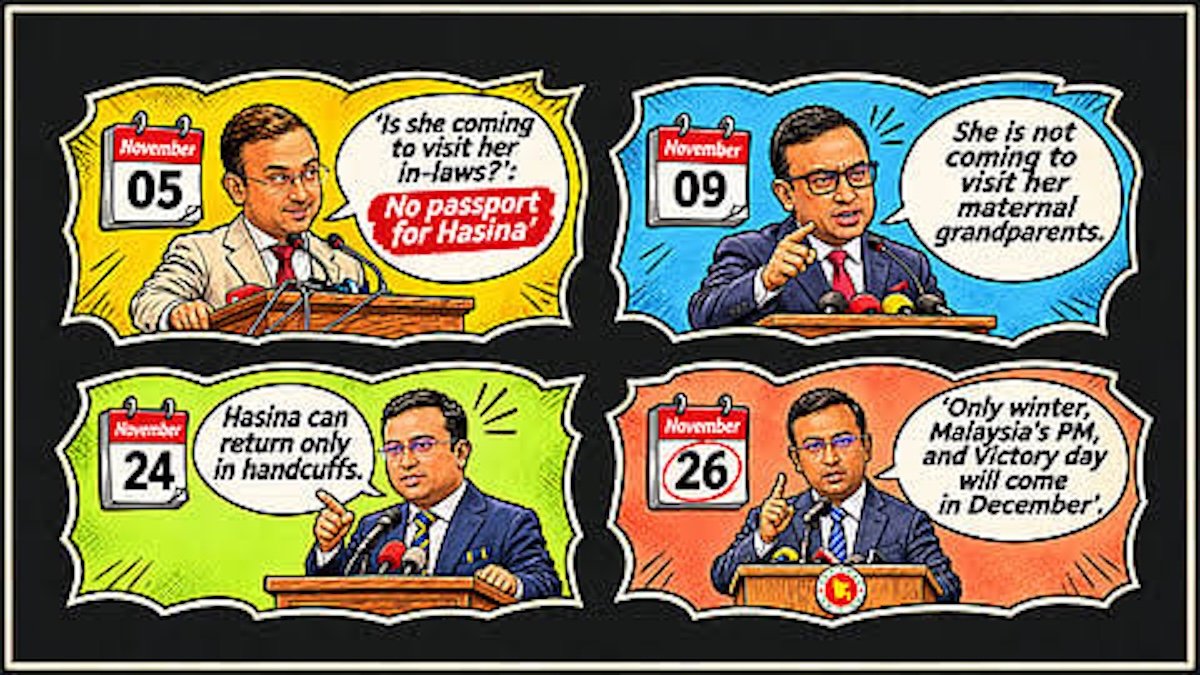
Two years ago, few Bangladeshis outside political circles knew his name. Today, his press briefings generate headlines, Facebook reels, and a steady stream of political memes. Consider his response to a question about Sheikh Hasina's proposed return to Bangladesh on December 16. Kobir suggested Bangladeshis prepare for winter instead, noting that the Malaysian prime minister might visit and Victory Day would certainly be observed. “No one else will come in December,” he declared.
The printed word hardly captures the performance. There is the smile, usually preceded by a measured stare when a reporter ventures a probing question. It begins with studied nonchalance, tinged with avuncular condescension, as if the question were unnecessary, possibly even silly. Then comes the brush-off, delivered in the musical cadence of Sylheti, with the occasional flourish of British-accented English adding spice to the dismissal. The delivery is so exquisitely casual that one might imagine he was discussing some random Ram, Shyam, Jadu, or Madhu, rather than a woman who ruled Bangladesh with an iron fist for 15 years.
“He doesn't seem to care a damn,” said one foreign ministry diplomat, requesting anonymity. “But he knows how to earn loyalty and respect.”
From London to the main stage
Kobir belongs to what some within the Bangladesh Nationalist Party (BNP) informally call the “Londoni party”: the inner circle that coalesced around Prime Minister Tarique Rahman during his long exile in Britain. Its members have gained considerable influence since the BNP returned to power in February with a two-thirds parliamentary majority. Born in Sylhet, Kobir moved to Britain at age two and a half. He studied at Sussex, the London School of Economics, and Cambridge, and was involved in Labour politics before becoming the BNP's joint secretary general for international affairs.
He subsequently became Tarique's foreign affairs adviser and deputy to Foreign Minister Khalilur Rahman. At their earlier joint appearances, the division of labor could look almost theatrical. Khalil supplied the rebuke; Kobir provided appreciative amusement from the side. When Khalil won the contested election for president of the 81st UN General Assembly in June, defeating Cyprus's Andreas Kakouris by 99 votes to 91, Kobir celebrated like the other half of a wrestling tag team whose partner had just secured the championship belt. The achievement was substantial: Bangladesh had won a competitive diplomatic election rather than inherited a ceremonial presidency through regional rotation alone.
Kobir's apprenticeship as second fiddle did not last long. He was sworn in as state minister on August 21. The subsequent distribution of portfolios made clear which deputy would handle the principal geopolitical relationships while Khalil attended to his responsibilities in New York. Kobir received bilateral and multilateral affairs and matters concerning non-resident Bangladeshis. Shama Obaed Islam, the other state minister, received human rights, climate change, research, LDC graduation, maritime resources, health diplomacy, and several other portfolios. These are perfectly respectable subjects, but they are not the principal bilateral relationships with India, China, America, or Pakistan. The ministry had effectively separated much of its geopolitical business from its specialist diplomacy.
Inside the ministry, however, Kobir's reputation is rather less jovial. Several diplomats who spoke to this correspondent described a minister with a keen interest in the political allegiances of his officials. Fifteen years of Awami League government had inevitably shaped the recruitment and promotion of much of Bangladesh's diplomatic establishment. “He is a shrewd player, and he knows whose allegiance lies where. But this purge has also created a distrust in the ministry,” said another diplomat.
Handcuffs, in-laws, and winter
If Hasina hoped to negotiate her return through lawyers and international media interviews, Kobir has made it considerably less dignified. On November 5, asked whether Bangladesh might issue her a passport, he responded: “Is she coming to visit her in-laws' home in Rangpur that we need to give her a passport?” Four days later, Reuters reported that lawyers from Britain's Matrix Chambers had approached Bangladesh's diplomatic mission in New Delhi seeking a passport and national identity card for Hasina.
Kobir's style has not only unsettled the opposition but also raised eyebrows among regional partners. His bluntness contrasts sharply with the more measured diplomacy of neighboring countries, and his comments on Hasina have already strained ties with India, which has traditionally sheltered Bangladeshi opposition figures. As Assam's chief minister escalates anti-Bangladesh rhetoric, Kobir's approach may complicate efforts to reset relations with New Delhi. Meanwhile, Tarique Rahman's first overseas trip will test whether this new diplomatic style can translate into concrete gains.
For now, Kobir seems to relish the role of provocateur. His press briefings have become must-watch events, blending policy with performance. Whether this approach will serve Bangladesh's long-term interests remains an open question. But one thing is certain: Humaiun Kobir has made Bangladeshi diplomacy anything but boring.