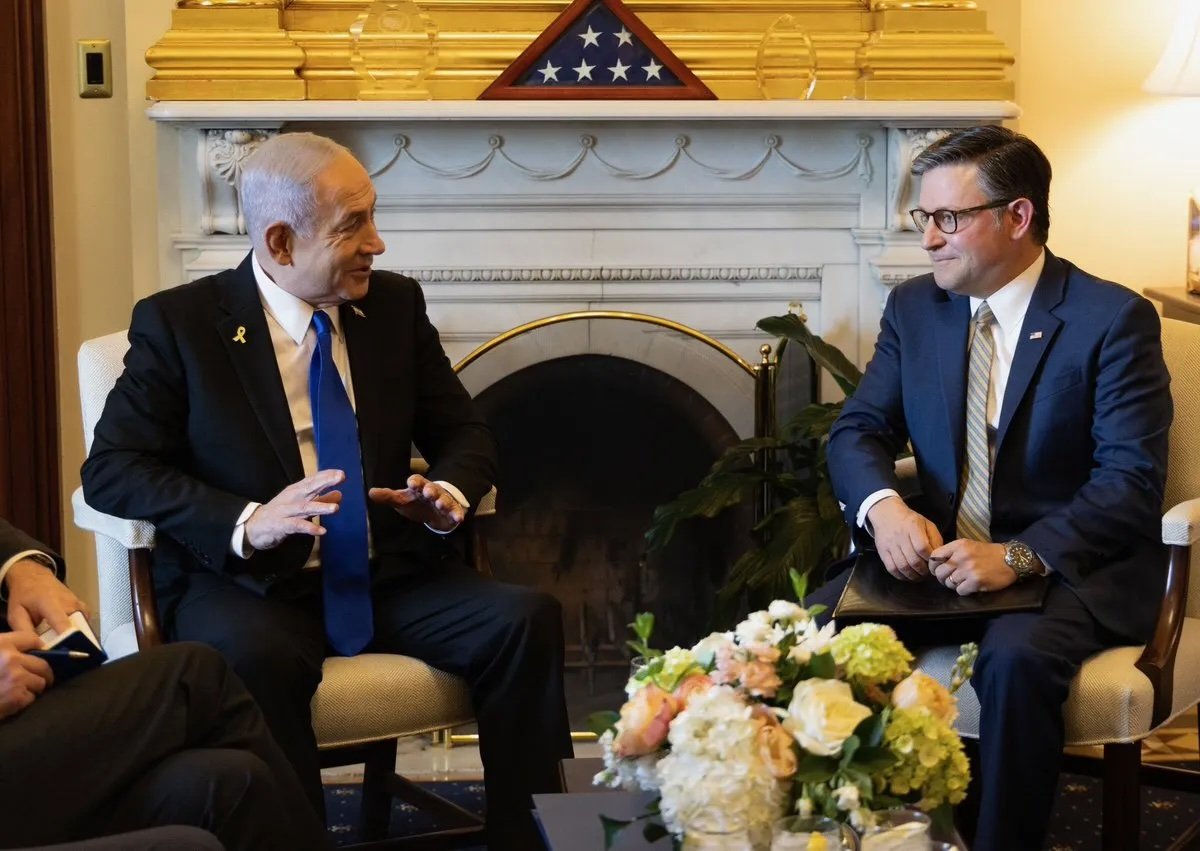
In July 2025, Israeli Prime Minister Benjamin Netanyahu met with US House Speaker Mike Johnson in the latter's Capitol Hill office. The meeting, which took place weeks after the US and Israel launched strikes on Iran's nuclear facilities, was ostensibly about strengthening bilateral ties. But what Johnson shared with Netanyahu during their private conversation has only now come to light.
According to Johnson's own account in the 2025 annual report of Capitol Ministries, a group that runs Bible studies for members of Congress and the White House, he gave Netanyahu a two-part Bible study pamphlet titled "The Biblical Case for Defending Israel." The pamphlet, written by Capitol Ministries founder Ralph Drollinger, argues that the US should support Israel—but it does so by repeating a centuries-old antisemitic trope: that the Jews killed Jesus.
The pamphlet's first lesson states that Israel is in a "time-out" for having "executed the Messiah," and that God has temporarily transferred blessings to the Church until Israel is "grafted back in." In a companion video, Drollinger elaborates: "Israel has stumbled. They're on the side track of God's plan as He grafts in the gentiles into His kingdom. And they've been sidetracked because they crucified their messiah."
This is not a fringe view. The deicide claim—that all Jews, across generations, bear responsibility for the crucifixion—was formally renounced by the Catholic Church at the Second Vatican Council in 1965 and has been rejected by most mainstream Protestant denominations. Yet it persists in certain evangelical circles, and its presence in a document handed to a sitting prime minister by the third-highest-ranking US official is deeply troubling.
Evangelical influence on US policy
Capitol Ministries has long been a fixture in Washington. Senate Majority Leader John Thune has praised its leaders, Ralph and Danielle Drollinger, for over a decade. Defense Secretary Pete Hegseth participates in its White House Bible studies. The group's materials have been distributed to congressional and executive branch officials since at least 2011, often with a focus on Israel and Iran.
The pamphlet Johnson gave Netanyahu was not new. It was recycled from earlier lessons, with language about Iran's "nearly-enriched nuclear threat" dating back to 2011. The June 2025 edition was posted online just days after Israel's strikes on Iran, and it was clearly intended to bolster the case for US support of Israel's military actions.
Johnson's meeting with Netanyahu was not the first time he has engaged in what might be called evangelical shadow diplomacy. In 2024, he met with a representative of Ukraine's Fellowship Foundation, a Christian group, and subsequently supported US aid to Ukraine. But the Netanyahu meeting raises particular concerns because it involved a foreign leader and a document that contains antisemitic content.
Neither Johnson's office nor the Israeli embassy in Washington responded to requests for comment. The meeting itself was reported by Spectrum News, but the pamphlet exchange was not disclosed until Johnson's annual report to Capitol Ministries was published.
This incident underscores the growing influence of evangelical Christianity on US foreign policy, particularly in the Middle East. It also highlights a paradox: many evangelicals are staunch supporters of Israel, yet their theology often contains elements that are deeply offensive to Jews. For Asian observers, this is a reminder that US policy in the Indo-Pacific is not shaped solely by strategic calculations, but also by domestic religious currents that can be unpredictable and, at times, contradictory.
As the US continues to navigate its role in the Middle East and beyond, the question of who speaks for American values—and what those values are—remains as pertinent as ever. The pamphlet Johnson gave Netanyahu is a small but telling artifact of a broader trend, one that deserves scrutiny from all who care about the region's stability and the health of US alliances.