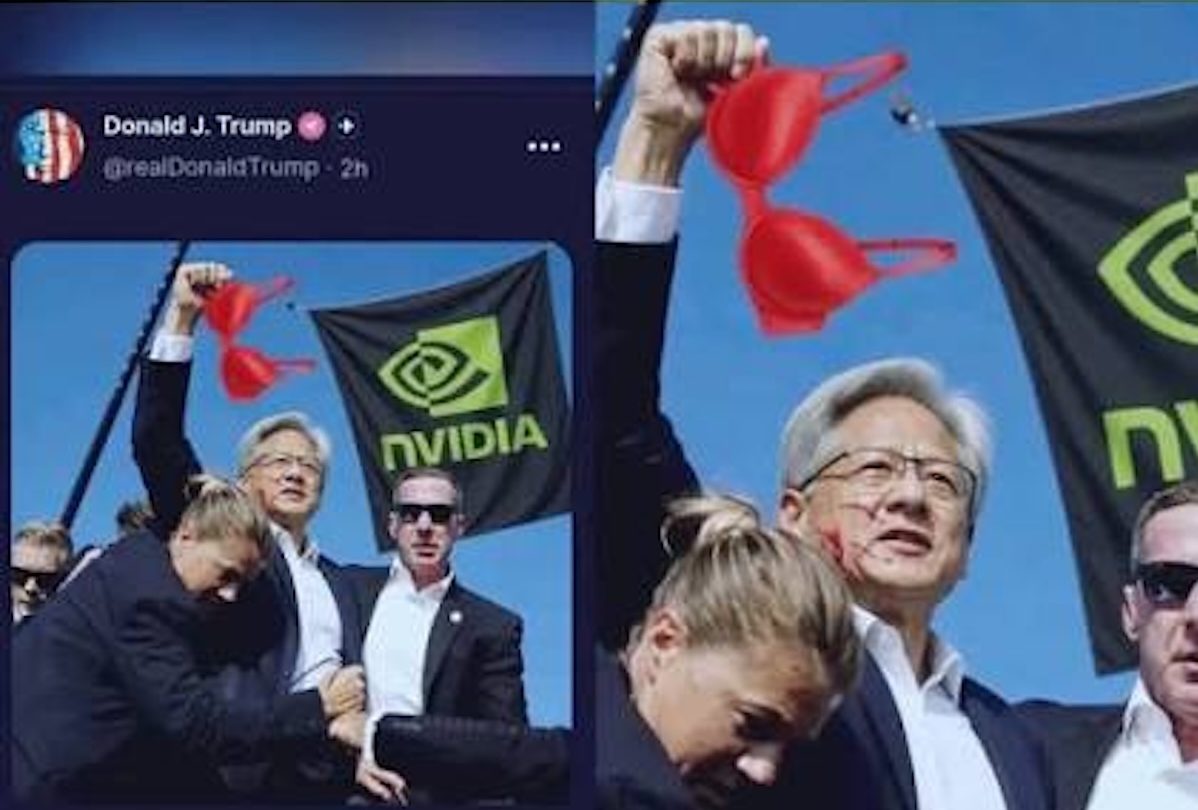
US President Donald Trump said Tuesday he would be open to pardoning Nvidia CEO Jensen Huang for any potential federal crimes, as top Justice Department officials declined to confirm whether Huang is or ever was under investigation. The remarks, made in an interview with the New York Post, come just days after Huang was reinstated as chief executive of the world's most valuable chipmaker, following a brief resignation earlier this month.
Trump, whose personal investment accounts hold hundreds of thousands of Nvidia shares, said a pardon is “always an option” should Huang face charges during the remainder of his second term. “I’ve always found him to be 100% aboveboard and, you know, a very smart person,” Trump said, adding that he does not think a pardon will “be necessary.”
The president’s comments came as Attorney General Todd Blanche, a former personal lawyer for Trump, gave evasive answers during a news conference on Tuesday. When asked whether Huang had been investigated by the Department of Justice, Blanche responded, “What does that mean?” and “For what?” He claimed he had seen no news reports or “leaks” suggesting an investigation. On Monday, Trump told CNBC that the Justice Department “did a pretty good investigation” and concluded Huang was “exonerated.”
Congressional scrutiny intensifies
Representative Jamie Raskin, a Maryland Democrat in line to chair the House Judiciary Committee, sharply criticized Blanche for playing “dumb” on questions about Huang and Nvidia, which the attorney general called “a good corporate citizen.” Raskin questioned the basis for Trump’s claim of exoneration, noting the president, Commerce Secretary Howard Lutnick, and others have “converging personal, political, corporate and financial interests” in keeping Huang in place and “the secret pipeline for our most sensitive AI chips to go to China stays securely covered up.”
“Do they just want to sweep the whole matter under the rug?” Raskin asked. “While the Attorney General turns a blind eye to alleged espionage, circumvention of export laws, and rampant corruption in the Administration, Congress is stepping in to get all the facts.”
The controversy centers on allegations that Huang violated US export controls by facilitating the transfer of advanced AI chips to China, potentially compromising national security. Huang, one of the world’s richest men and a close ally of the White House, has also faced scrutiny over personal conduct, including an extramarital affair that some have linked to security risks.
Nvidia’s stock has surged since Huang’s return, adding roughly $15 million to Trump’s holdings, as reported by our analysis of the president's Nvidia stake. The company’s dominance in AI chips has made it a central player in the US-China technology rivalry, with Washington imposing strict export controls to prevent China from acquiring cutting-edge semiconductors.
Huang’s reinstatement has also raised questions about the broader implications for Nvidia's ties to US statecraft, as the company navigates a delicate balance between commercial interests and national security demands. In Southeast Asia, governments are grappling with how to police chip smuggling, a challenge highlighted by Trump's intervention in the region.
Critics argue that Trump’s willingness to pardon Huang, combined with the Justice Department’s reluctance to clarify its position, undermines the rule of law and sets a dangerous precedent. “The president is treating the pardon power as a tool to protect his allies and financial interests,” said a former federal prosecutor who spoke on condition of anonymity. “This is not how justice is supposed to work.”
Meanwhile, Huang has denied any wrongdoing, and Nvidia has emphasized its compliance with all applicable laws. The company did not respond to requests for comment on Trump’s pardon remarks.
As the story develops, the focus remains on whether the Justice Department will provide clarity on Huang’s legal status, and whether Congress will launch its own investigation. For now, the intersection of money, power, and national security continues to shape the narrative around one of the most consequential figures in the global tech industry.