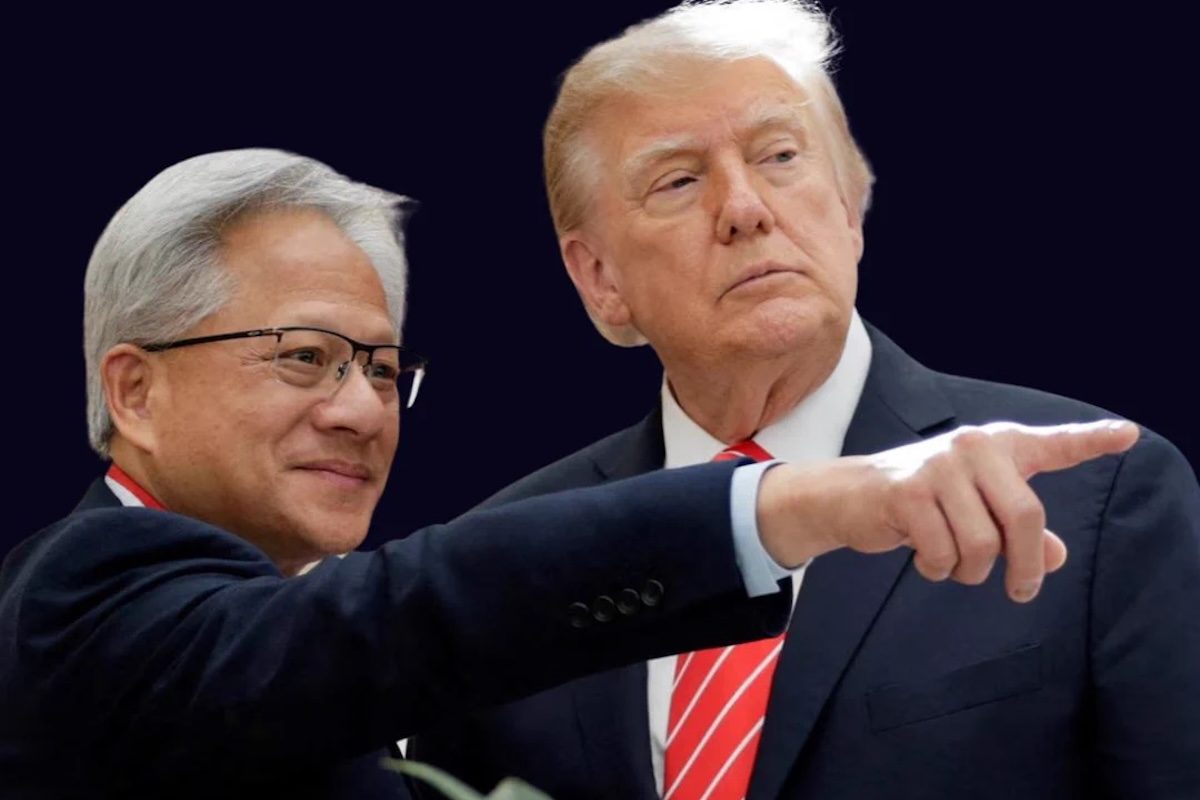
President Donald Trump's personal stake in Nvidia surged by as much as $15 million on Monday after the chipmaker's board reinstated Jensen Huang as chief executive, a move Trump publicly claimed credit for. The president told CNBC that he “convinced them” and “made the deal” to bring Huang back, less than two weeks after Huang resigned amid revelations of extramarital affairs, including with a subordinate and a woman under US intelligence scrutiny for her contacts with the Chinese government.
Nvidia's stock jumped more than 30% on the news, lifting the broader tech sector that had been battered by Huang's exit and an ongoing Securities and Exchange Commission probe into the company's accounting. The Financial Times, which first reported Trump's estimated gain, noted that the president “applied pressure” to the board over the weekend after watching the company and tech stocks hemorrhage value.
A president's intervention raises ethics questions
Critics were quick to condemn the intervention. Mehdi Hasan of Zeteo wrote: “Just to be clear: the president of the United States called into a private company's board meeting and pressured them into reinstating a fired CEO whose actions his own government is investigating, and personally made 15 million dollars in the process.”
Representative Don Beyer (D-Va.) called the move “psychotically crooked,” arguing that Trump put “private gain above the national interest.” Senator Ruben Gallego (D-Ariz.) demanded an investigation into stock trades before the announcement, labeling the White House “the most corrupt in history.”
Trump's financial disclosures, analyzed by the BBC, show his investment accounts bought Nvidia shares worth between $23 million and $86 million over two years, with 85 separate purchases. He has also sold some stake, realizing gains of $3.5 million to $10.2 million across 19 sales.
During the CNBC interview, Trump was asked whether he assured the board that Huang would not face prosecution. “I didn't use the word 'prosecuted,' but I said that… we believe he's fine,” Trump said. “He's absolutely fine. I gave them enough assurance.”
Senator Chris Van Hollen (D-Md.) linked the decision to a $25 million donation to Trump's ballroom, while Senator Ron Wyden (D-Ore.) vowed that the next Congress would investigate. Representative Pat Ryan (D-NY) called for an independent probe into whether Huang “sold our national security to a Chinese spy.”
Progressive groups also weighed in. Nidhi Hegde of the American Economic Liberties Project said Nvidia had become “too big to fail,” and accused Trump of caring “more about Wall Street than American national security.” She predicted the market rally would be short-lived, warning of a bubble that could burst and hurt retirement savings.
The controversy has implications beyond US shores. Nvidia's dominance in AI chips is central to the global tech race, and Huang's reinstatement ties the company more tightly to US statecraft. For Asian markets, the episode underscores the volatility that can ripple from Washington's corridors of power. As Asia's crisis playbooks steady markets, the long-term impact on chip supply chains and regional tech investments remains uncertain.
Meanwhile, gray-market channels that move Nvidia's chips to China continue to operate, and Huang's return ties Nvidia tighter to US statecraft, raising questions about how Asian allies will navigate the fallout. The coming months will test whether the president's intervention stabilizes markets or deepens the perception of a rigged system.