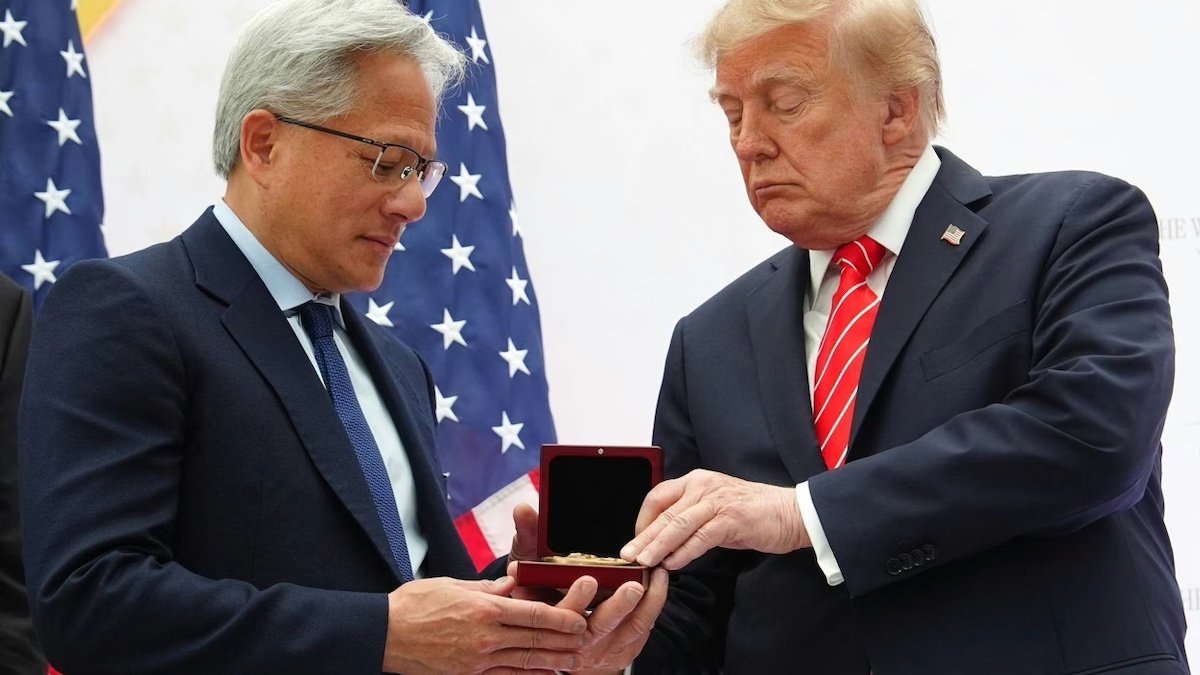
Less than two weeks after stepping down over his ties to Alice Huang, the longtime head of Singapore-registered Megaspeed, Jensen Huang is back as Nvidia's chief executive. The company's board reinstated him just a day after The New York Times reported that Alice Huang had been in contact with an officer of China's Ministry of State Security for over a year. President Donald Trump took credit for the comeback, telling CNBC, "I convinced them. I made the deal." He also said he had discussed the Nvidia CEO with Chinese President Xi Jinping.
Trump's boast sits awkwardly beside Washington's campaign to keep advanced AI hardware out of China. Just a week before Jensen Huang's return, the Commerce Department issued rules requiring case-by-case licenses for advanced AI chips shipped to Singapore, Malaysia, Indonesia, and Thailand. When Trump backs the return of an executive despite those ties, while piling compliance burdens onto Southeast Asian partners, it suggests that the president himself is not taking the smuggling seriously, even as lawmakers from both parties question the decision. Trump's conduct makes America's demand that smaller neighbors police the trade ring hollow.
Southeast Asia as a staging ground
Chinese smugglers have turned Southeast Asia into a staging ground for moving Nvidia chips into China, but the demand they serve originates in Beijing. A state-backed data-center boom is sweeping the country, and Beijing's top economic planner anticipates some 4 trillion yuan ($560 billion) in fresh computing investment over the next five years. Because most leading Chinese AI models rely on Nvidia's CUDA software platform, local officials racing to unlock central funds have little choice but to fill their server racks with Nvidia processors, which domestic chipmakers still cannot supply in sufficient volume.
A Reuters review of more than 150 documents uncovered over 23 billion yuan in computing projects engineered around restricted Nvidia chips. Nor does demand for high-end Nvidia chips stop at provincial data centers. Once inside China, those chips are bought and sold in broad daylight: in October, Northwestern Polytechnical University, a defense-linked institution on the US Entity List, bought H200 processors from a domestic supplier and posted the purchase on its procurement website.
With Washington repeatedly shifting its export stance and Beijing turning away some legal imports at customs, Chinese companies naturally look to overseas data centers and computing leases, which have become a convenient route for smuggling chips into China. Megaspeed's rise shows how quickly, and on what scale, Southeast Asia became a testing ground for that arrangement. The Singapore-registered firm emerged as one of Nvidia's largest customers in the region, and in 2025 alone its Malaysian unit declared roughly $4.6 billion in imports, according to the Financial Times.
On paper, Megaspeed was the buyer. But according to The New York Times, Alibaba agreed to serve as its anchor customer, a commitment that helped Megaspeed raise financing and install processors in third-party data centers. The Times also reported that, under an agreement with an Alibaba subsidiary, a default by Megaspeed would hand all of its servers, chips, and intellectual property to the Chinese tech giant. That raises an obvious question about who the real buyer was. People familiar with the matter also told the Times that chips intended for such facilities were sometimes smuggled into China.
Regional governments carry the burden
Southeast Asian governments are already carrying a heavy share of the burden of enforcing Washington's chip controls. In Singapore, prosecutors have charged five individuals and six companies in connection with alleged chip diversion, including a defendant facing 41 charges over 917 servers packed with restricted Nvidia hardware, while authorities have frozen roughly 55 million Singapore dollars in property. Across the border, Malaysia began requiring export and transshipment permits for advanced AI chips in July 2025, and its trade ministry is investigating whether Megaspeed's local unit improperly re-exported hardware, with Prime Minister Anwar Ibrahim pledging cooperation with international probes.
Rather than easing pressure on partners already doing much of the work, Washington's November 16 rules add new hurdles for local firms, giving data centers worldwide just 90 days to seek approval if they serve Chinese clients at scale. In hubs like Kuala Lumpur and Bangkok, regional operators face licensing queues and, as Malaysia's trade minister acknowledged, uncertainty over financing, while American cloud giants keep receiving hardware under reporting exemptions.
Moreover, squeezing regional data centers does little to stop the trade when blacklisted China-linked firms simply change names. After Nvidia placed Megaspeed on an internal no-sell list in June 2025, the same team resurfaced under a new banner, Novagate Cloud, which took delivery of at least $300 million in Nvidia-equipped hardware in Malaysia in the first five months of this year alone, according to The Wall Street Journal.
Chinese smugglers are not the only ones using Southeast Asia as a staging ground. One of the largest alleged schemes uncovered so far began inside an American company. In March, US federal prosecutors charged a co-founder of Super Micro, a Nasdaq-listed server maker and one of Nvidia's most important partners, with routing roughly $2.5 billion worth of Nvidia-equipped servers to China through Southeast Asian middlemen.
Trump's intervention in Huang's reinstatement, and his public boasts about it, undercut the credibility of US export controls. As Huang's return ties Nvidia tighter to US statecraft, the burden of enforcement falls on Southeast Asian states that have little say in Washington's shifting policies. The result is a system where American leadership appears more interested in political wins than in stopping the flow of advanced chips to China, leaving allies to clean up the mess.