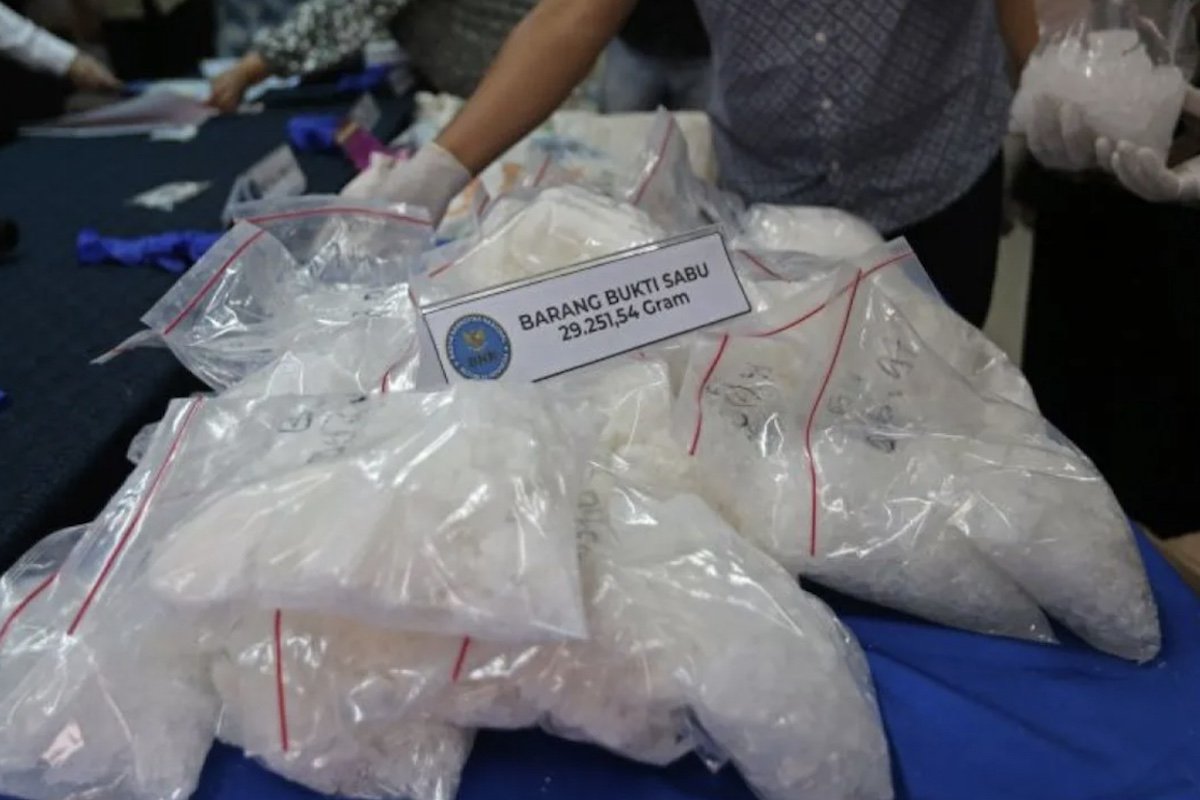
On a quiet street in Banda Aceh, a shophouse that blended into its surroundings concealed a clandestine methamphetamine laboratory. When Indonesian authorities raided the premises on October 21, they uncovered approximately 1.2 tons of methamphetamine, some still in liquid form. Eleven individuals were arrested in Indonesia, including two Chinese nationals, while seven more were detained in China.
The intelligence that triggered the raid did not originate locally. It came from Beijing, where investigators had been monitoring the network since October 2025 before sharing their findings with Indonesia's National Narcotics Agency (BNN) in September. Malaysian police also joined the operation, as the suspects had transited through Malaysia en route to Aceh.
Officials in all three capitals have hailed the bust as a model of cross-border cooperation. Yet the deeper significance lies in the fact that this is the first known instance where China, Indonesia, and Malaysia worked together on the same drug network. For over a decade, their bilateral ties have been built piecemeal: Indonesia and China signed a memorandum on narcotics control in 2012, extended in 2017, which yielded actionable intelligence—by 2017, Beijing had notified Jakarta of 1,097 tons of precursor chemicals shipped to Indonesia since 2014. Malaysia's channel to Beijing has also been productive, with Chinese intelligence leading to a 1.03-ton fentanyl citrate seizure in August 2025. Indonesia and Malaysia have the longest record, having dismantled a Malaysia-Aceh-Medan syndicate in 2018.
Each bilateral relationship operated within its own lane. The Aceh network, however, crossed all three lanes simultaneously: a Chinese lead, a Malaysian transit route, and an Indonesian lab. Catching it required the three agencies to move together—and in October, they did.
A growing threat
The timing is critical, as the regional drug trade is expanding faster than the tools built to stop it. The United Nations Office on Drugs and Crime (UNODC) reported that East and Southeast Asia seized 349 tons of methamphetamine in 2025, a 48% increase from the previous year and more than five times the haul of a decade ago. Inside Indonesia, BNN estimates potential spending on illegal drugs at 524 trillion rupiah (roughly US$32 billion) annually.
The business model is also evolving. Crystal meth once crossed the Strait of Malacca ready for sale, packed into fishing boats. Now traffickers increasingly ship liquid drugs, which are easier to hide, and finish them close to their customers. In January, BNN raided a North Jakarta apartment that was converting narcotics into vape liquid for what it called a China-Malaysia network. The Aceh lab operated on the same principle at a far larger scale. Indonesia is no longer merely a market; it is becoming a production hub.
The route begins in Myanmar's Shan State, identified by the UNODC as the region's primary source of methamphetamine, then runs through Malaysia and across the strait to Sumatra. Each of the three countries can see one stretch of it, but none can see the whole picture.
Toward a permanent trilateral mechanism
The solution is within reach. A permanent trilateral channel, with liaison officers in Beijing, Jakarta, and Kuala Lumpur, would ensure that the next lead does not sit for eleven months before reaching the agency that can act on it. Financial intelligence units should also be included, as the money financing the Aceh lab almost certainly moved across borders. Beijing holds two levers no one else has: tighter oversight of precursor exports and influence over armed groups along its border with Myanmar.
Jakarta and Kuala Lumpur should also push to formalize the arrangement in writing and make it public. Informal police cooperation tends to fade when diplomatic relations cool. Public rules on data sharing and legal safeguards would protect citizens and sustain the partnership beyond any single government.
Seizures alone will not shrink demand, and the buyers waiting for the Aceh shipment have not disappeared. Treatment and prevention deserve the same cross-border energy that enforcement is now receiving. On the supply side, however, the three governments finally have a model tested on a real case. The task now is to make it routine, so the next lab is found by design rather than by luck.
Muhammad Zulfikar Rakhmat is the director of the China-Indonesia Desk at the Jakarta-based Center of Economic and Law Studies (CELIOS), an independent research institute. Yeta Purnama is a researcher at CELIOS.