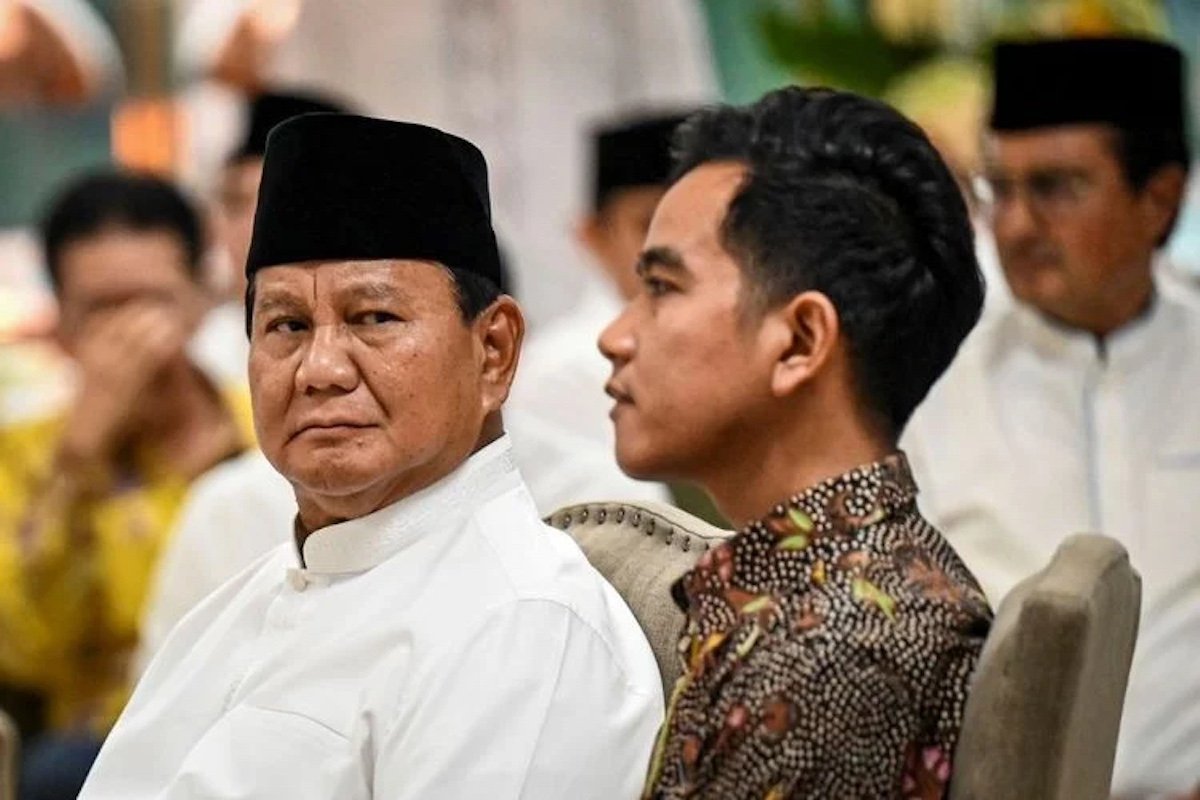
Indonesian Vice President Gibran Rakabuming Raka’s resignation on November 11 marks a significant shift in the country’s political landscape, weakening the influence of former President Joko Widodo and consolidating President Prabowo Subianto’s control over the executive branch.
Gibran, who is Widodo’s eldest son, submitted his resignation to Prabowo after 120 lawmakers from eight parliamentary factions, including members of Prabowo’s own Gerindra party and coalition partner Golkar, signed a proposal to challenge his eligibility. The move, which is not an impeachment but could lead to a constitutional review, centers on the educational documents Gibran used to qualify for the 2024 vice-presidential race.
This is not the first time Gibran’s candidacy has faced legal scrutiny. In 2023, when Prabowo selected him as running mate, Gibran was 36—four years below the constitutional minimum age of 40. A controversial Constitutional Court ruling in October 2023 allowed younger candidates if they had held elected office, an exception that applied to Gibran, then mayor of Solo. The court’s chief justice at the time, Anwar Usman, is Widodo’s brother-in-law and Gibran’s uncle by marriage. An ethics panel later found that Usman should have recused himself and removed him from the bench, but the ruling stood, and Gibran remained on the ticket.
Erosion of the Solo network
Gibran’s departure is the most visible sign of the decline of what is often called the “Solo group,” a political network built around Widodo’s personal loyalty, access to state institutions, and ties to business and political elites. The network’s influence depended heavily on the assumption that Widodo would continue to shape decisions after leaving the palace, with Gibran as his direct channel into the new administration.
Beyond Gibran, the pressure on Widodo’s circle has been mounting. Three police generals, including former national police chief Listyo Sigit Prabowo—who recently moved to the post of presidential chief of staff—have been detained in an investigation into alleged illegal wiretapping of President Prabowo and others. Some suspects have links to Widodo’s network, though there is no evidence that the former president directed or knew about the surveillance.
There have also been resignations from the Indonesian Solidarity Party (PSI), which is closely associated with Widodo’s family. Raja Juli Antoni, Giring Ganesha, and Isyana Bagoes Oka have stepped down from party positions, citing a desire to focus on government responsibilities. While this does not mean the party has abandoned Widodo, it illustrates how loyalties can shift toward a sitting president when government access becomes more valuable than party roles.
These developments point to an erosion of Widodo’s bargaining power, though not to irrelevance. He retains name recognition, personal networks, and a political following. But influence and leverage are different things. Influence draws attention or commands loyalty; leverage turns those assets into concessions from another actor. Widodo may still have the first while losing some of the second.
In 2024, Prabowo had reason to value Widodo’s popularity and endorsement. Two years into his term, he has his own electoral mandate, control of the executive, and a broad parliamentary coalition. The more alternatives he has, the less he needs his predecessor. None of this shows that Prabowo engineered the Solo network’s decline, but the relationship is now less symmetrical.
For Prabowo, Gibran’s departure could provide political insulation. The two men won the 2024 election on one ticket, but the resignation lets Prabowo separate his administration’s future from the controversy surrounding his deputy while keeping the presidency intact. Under Article 8 of the Constitution, the People’s Consultative Assembly will fill the vacancy from two candidates nominated by the president, giving Prabowo a central role in shaping the next configuration of power.
For Gibran, resignation may be less damaging than removal by impeachment, allowing him to leave on his own initiative rather than after a prolonged constitutional confrontation. It doesn’t settle questions about his eligibility, however, and it doesn’t automatically end the parliamentary process already underway.
Comparisons with Mohammad Hatta, Indonesia’s first vice president, deserve caution. Hatta resigned in 1956 over fundamental disagreements with President Sukarno about the republic’s direction. His departure was an ideological rupture, not a response to questions about the documents behind his candidacy.
The two political projects that once reinforced each other are now separating. Prabowo’s administration is gaining autonomy, while Widodo’s network is learning the limits of influence without formal authority. A former president can remain influential and can shape electoral calculations, but without institutional access, cohesive networks, and a direct presence in government, that influence is harder to convert into tangible outcomes.