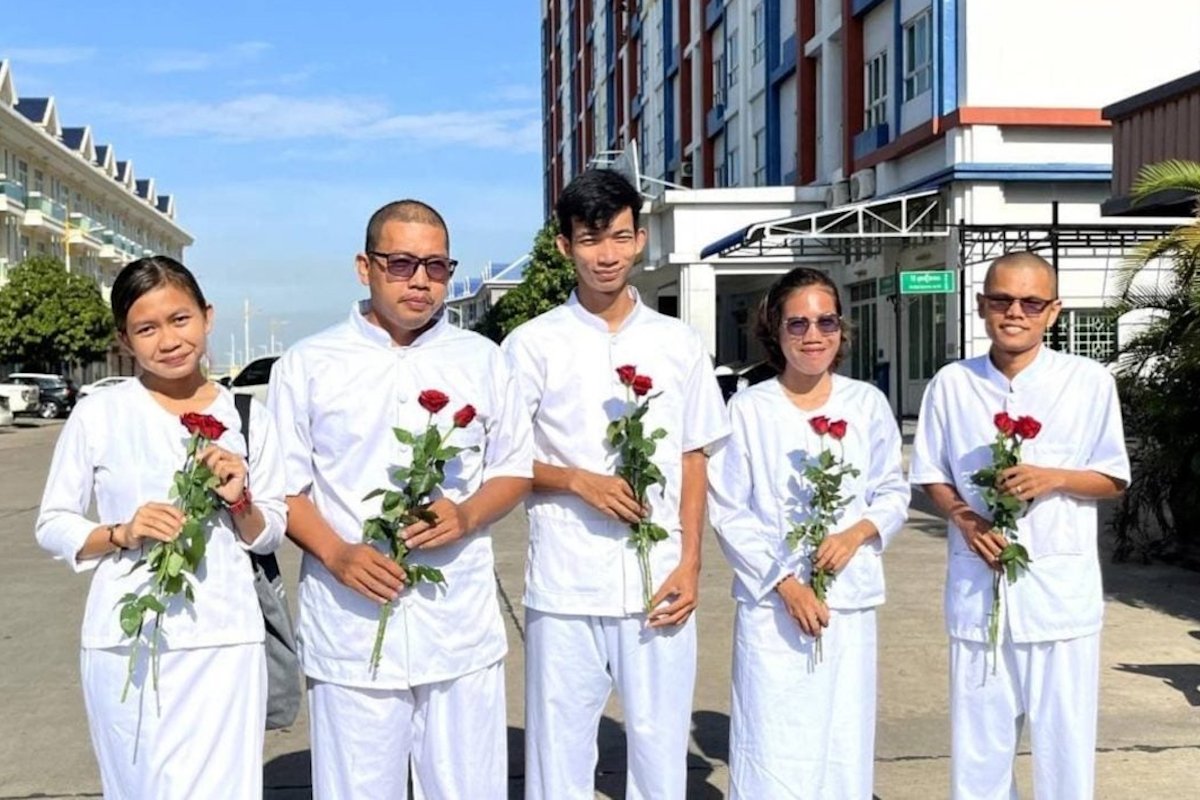
When leaders from across the Francophone world assemble in Phnom Penh on November 15, they will do so in a city where five of Cambodia's most prominent environmental activists are marking their 866th day behind bars. The five—Ly Chandaravuth, Thun Ratha, Yim Leanghy, Phuon Keoraksmey, and Long Kunthea—are known collectively as the Mother Nature Cambodia 5, or MNC5.
Before their arrest, the group worked with rural communities to defend forests, wetlands, rivers, and coastal areas. They conducted research, exposed failures in environmental protection, and used social media to bring these issues to public attention. Their efforts were not marginal: Mother Nature Cambodia played a central role in campaigns that resonated across the country.
One of their most notable victories was halting the Stung Cheay Areng hydropower dam, which would have flooded homes, indigenous lands, and pristine forests in the Areng Valley of Koh Kong province. They also uncovered the environmental damage caused by sand dredging and the corruption tied to exports to Singapore's construction sector—a campaign that led to a multi-year export ban, since lifted.
They protested the destruction of Boeung Tamok, a vital wetland in Phnom Penh, and illegal logging in the Prey Lang Wildlife Sanctuary. They stood against the loss of mangrove forests and coastal habitats in Koh Kong, and documented pollution in the Tonle Sap River. Their methods were peaceful: public protests, research, and advocacy.
Their alleged crime? Speaking out against corruption and greed driving the plunder of Cambodia's natural resources. When authorities ignored their calls, they organized symbolic protests. The government responded by revoking the group's legal registration, harassing its members, and eventually imprisoning its top activists.
In 2024, the five were convicted of “plotting” against the government and sentenced to six years. Their lawyer appealed in July 2024, but no hearing has been scheduled. The UN Working Group on Arbitrary Detention (WGAD) investigated and concluded that their detention is arbitrary and unjust, recommending immediate release and compensation. UN Special Rapporteur Tom Andrews raised their case in his October 2026 report to the Human Rights Council.
The government has deliberately separated the five, placing them in prisons far from their families. Keoraksmey, known as Akeo, is from Bavet City near the Vietnam border but is held in Pursat prison, a seven-hour drive away. Cambodian prisons are among the most overcrowded in the world, with inadequate food and water. Each of the MNC5 faces these conditions daily, and their families—who relied on them as breadwinners—are struggling.
Despite the hardship, the activists remain resolute. “We are willing to express our thanks to the authorities if we are released, but we will not apologize to them,” Ly said from prison.
A test for the Francophonie
The Francophonie summit is an opportunity for leaders to raise the MNC5 case directly with Cambodian Prime Minister Hun Manet. The organisation's mandate explicitly includes promoting peace, democracy, and human rights. Ignoring the plight of these activists would undermine that commitment.
At a time when environmental protection and climate action are global priorities, the continued imprisonment of Cambodia's leading environmental group sends a troubling signal. It contradicts the spirit of civil society engagement that the Francophonie claims to support.
At minimum, Francophonie leaders should urge Cambodia to schedule the appeal hearing so the courts can consider the WGAD's finding that the initial trial was unfair. More boldly, they should call for the unconditional release of the MNC5 and for a shift toward dialogue with environmental defenders rather than criminalization.
The Francophonie community has a chance to make a difference. The question is whether it will take it. As Cambodia navigates its regional relationships, the treatment of its own citizens remains a critical test of its governance. The summit in Phnom Penh is not just a diplomatic gathering; it is a moment to uphold the values the Francophonie professes.