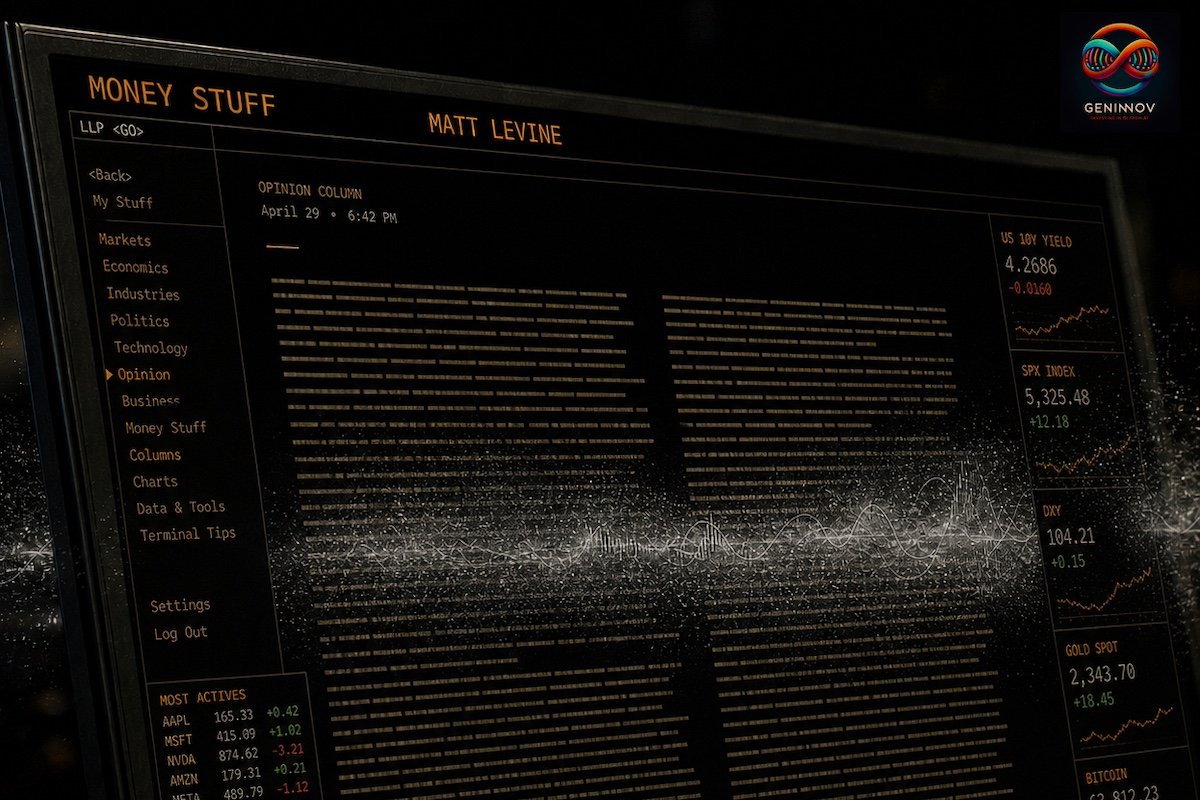
Running money has a hidden cost: you stop having time to read the people you most want to read. For many, that includes Matt Levine, whose Money Stuff column on Bloomberg has spent a decade explaining financial plumbing with wit and clarity. This piece borrows his machinery—a simple model, some actual rules, and the hope that the rules do the joke for you. The goal is to discuss something that feels off without being accusatory.
Everything is expectations
From first principles, you might think a company's value depends on how much money it makes. Sell $100 worth of boxes, good. Sell $103, better. Shares rise. But that's not how public markets work today. Value is determined by the derivative of profits against expectations. Analysts write down $100, you report $103, and the stock should go up. Instead, it falls 9% in four minutes.
A TV pundit calls it a “massive beat.” A trader says the buy-side expected $105. Both are telling the truth. You beat the number on the Bloomberg terminal but missed the number inside the hedge fund manager's head. This is the whisper number—an unofficial, unwritten estimate that often moves markets more than the published consensus.
The problem? The whisper number has no author, no timestamp, and no methodology. It's a ghost in the machine.
The official number is a manufactured product
The “consensus” estimate is not a grand philosophical agreement. It's a data vendor scraping 30 Excel spreadsheets, applying proprietary rules about what “adjusted” means, and dividing by 30. It has manufacturing defects. A paper by Larocque, Watkins, and Weisbrod compared five major forecast providers—Bloomberg, Capital IQ, FactSet, I/B/E/S, and Zacks—across 94,030 firm-quarters. They found substantial differences in forecasts, reported street numbers, and even whether a company beat or missed at all.
So the company reports one objective reality, but the market is supplied with five different baselines. Consensus is flawed, but at least it has an audit trail. You can see which analysts submitted what. The whisper number arrives as a correction to a benchmark that is stale or mechanically averaged—but with zero documentation.
The illegal origin story
The standard whisper number origin story goes like this: an analyst builds a model in October, publishes $100, then learns new facts. She doesn't want to republish a 40-page PDF every time, so her “live” number drifts. Then she tells a client, “Honestly, it's $105.” The client trades on that. This is elegant—and wildly illegal.
In 2000, the SEC passed Regulation FD, making it illegal to selectively disclose material information. Then came the Global Research Analyst Settlement of 2003, Regulation AC, and FINRA Rule 2241. The SEC clearly saw the problem. Yet whisper numbers persist, often as informal chatter between analysts and favored clients.
For Asia, this matters more than ever. As markets in Tokyo, Mumbai, and Singapore integrate with global capital flows, the whisper-impact spread—the gap between official and whispered numbers—has gone global. A hedge fund in Hong Kong can trade on a whisper number for a Korean tech stock, while a retail investor in Jakarta sees only the official consensus. The asymmetry is stark.
Some argue whisper numbers are just market efficiency in action—a way to incorporate information faster. But without transparency, they create a two-tier market: those in the know and those left out. Regulators in Asia are watching. Japan's FSA and India's SEBI have tightened rules on selective disclosure, but enforcement remains uneven.
The takeaway? When you see a stock plunge after a “beat,” remember: the number that mattered wasn't on the terminal. It was whispered. And that whisper, for all its power, remains unregulated, undocumented, and deeply human.