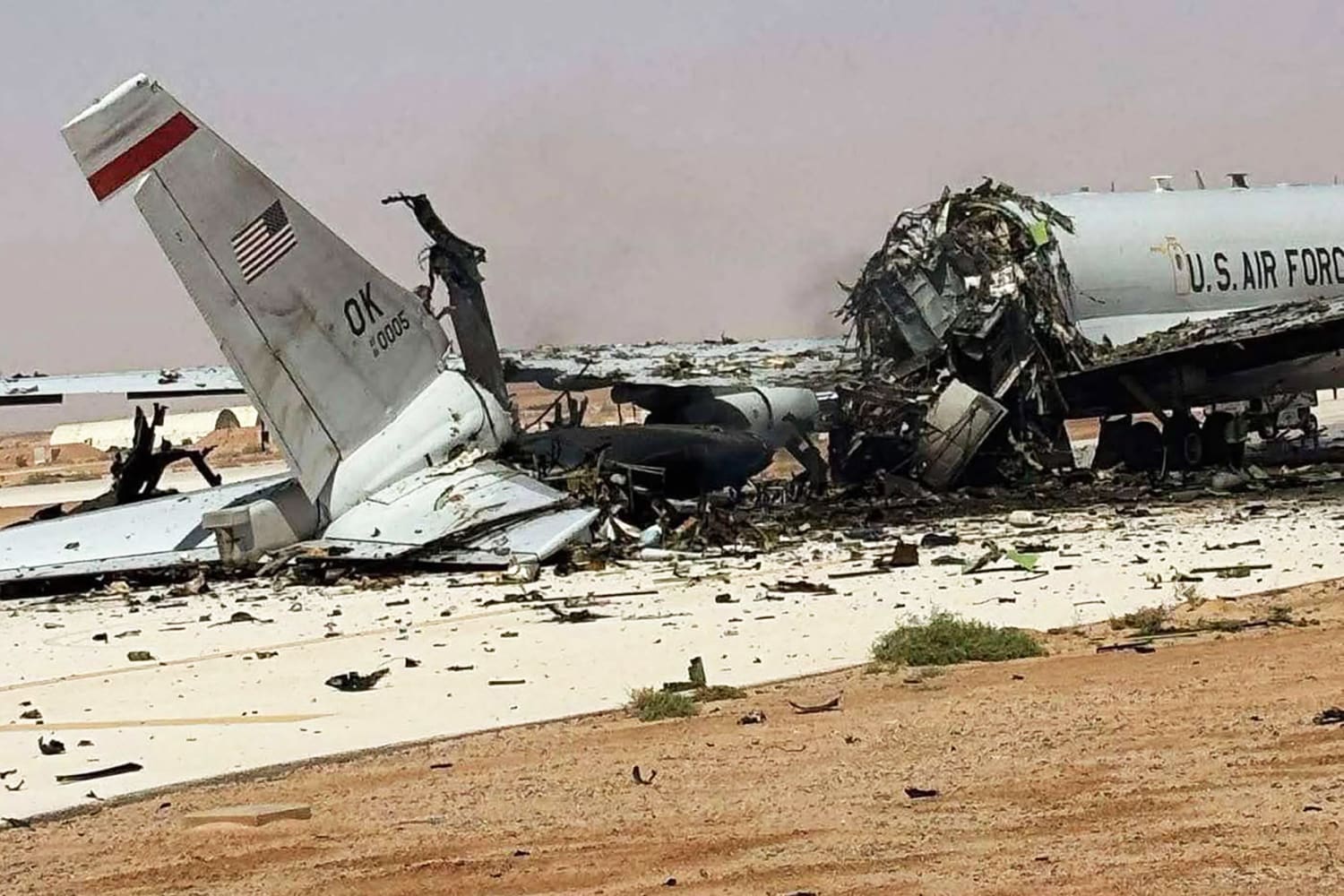
The United States has suffered significant aircraft losses in its ongoing military campaign against Iran, raising serious questions about the sustainability of American airpower in a potential future conflict with China in the Indo-Pacific. According to a March 2026 report from the US Congressional Research Service (CRS), the US has lost or damaged 42 aircraft during Operation Epic Fury, the joint US-Israeli campaign launched in February 2026.
The losses span a wide range of platforms, including four F-15E Strike Eagles (three destroyed by friendly fire over Kuwait in March and one shot down over Iran in April), one damaged F-35A stealth fighter, one A-10 Thunderbolt II, seven KC-135 Stratotanker refueling aircraft, one E-3 Sentry AWACS, two MC-130J special operations aircraft, one HH-60W rescue helicopter, 24 MQ-9 Reaper drones, and one MQ-4C Triton drone. Iranian missile and drone strikes also damaged several aircraft on the ground at Prince Sultan Air Base in Saudi Arabia, while two MC-130Js were intentionally destroyed in Iran after becoming stranded during a rescue mission.
Lessons for the Pacific
The CRS report notes that the US Department of Defense has not released a comprehensive loss assessment, but lawmakers are expected to scrutinize the operational, budgetary, and industrial implications of replacing these high-value assets. The losses reflect not only tactical failures but also the resilience of Iranian air defenses, vulnerabilities in US doctrine, and enhanced Iranian strike capabilities reportedly supported by Chinese and Russian assistance.
Peter Suciu, writing in Forbes in March 2026, pointed to possible tactical causes such as fog of war, communications overload, electronic warfare, and problems with data linking and identification friend-or-foe (IFF) systems. He also cited human factors like poorly trained operators and pilots forgetting procedures in dense multinational operating environments.
Beyond these tactical issues, Iran’s surviving air defenses imposed meaningful operational costs. Before the conflict, Iran operated a mix of Russian TOR-M1, SA-5, SA-6, SA-10/S-300PMU, Chinese HQ-2 and FM-80 systems, upgraded HAWK missiles, and British Rapier and Swedish RBS-70 missiles. The TOR-M1 can engage aircraft, UAVs, and precision weapons in dense electronic warfare environments, while the S-300PMU remains Iran’s most capable system, with longer range and improved lethality. Although US and Israeli strikes may have degraded larger systems like the S-300PMU, mobile and concealed systems continue to pose a threat.
Lower-cost systems have proven especially difficult to suppress. The Robert Lansing Institute reported in February 2026 that Russia, under a €500 million contract signed in December 2025, agreed to supply Iran with 500 Verba man-portable air defense systems (MANPADS) and 2,500 9M336 missiles between 2027 and 2029. These systems can engage low-flying aircraft, helicopters, cruise missiles, and UAVs, creating localized no-go zones that complicate intelligence, surveillance, and reconnaissance (ISR), combat search and rescue (CSAR), and rapid-strike operations.
The conflict also exposed vulnerabilities in US operational doctrine. In a July 2024 Proceedings article, Michael Blaser noted that the US Agile Combat Employment (ACE) doctrine aims to disperse aircraft to increase survivability by operating faster than enemy targeting. However, Blaser argued that this strategy relies on two unlikely conditions: the enemy’s lack of long-range fires capable of hitting many airfields and a slower kill chain than US sortie generation. The CRS report noted that six US aircraft were destroyed at Prince Sultan Air Base by Iranian strikes—five KC-135 Stratotankers and one E-3 Sentry AWACS—highlighting the vulnerability of dispersed assets to precision strikes.
Blaser warned that AI, machine learning, and persistent space-based sensors could shrink the kill chain to under 24 hours, allowing adversaries to identify and target dispersed aircraft faster than the US can relocate them. These vulnerabilities may be compounded by alleged Chinese and Russian ISR and targeting support for Iran. China has reportedly supplied Iran with commercial satellite imagery, ground-station access, and AI-driven intelligence tools that analyze satellite imagery, flight tracking, and shipping data.
For the Indo-Pacific, the implications are stark. China’s military modernization, including advanced air defenses, long-range precision strikes, and AI-enabled targeting, could pose similar or greater challenges to US air operations. The US ability to sustain attrition in a Pacific war—where distances are vast, bases are limited, and China’s truck-mounted drone launchers blur military and civilian lines—remains an open question. As the US reviews its losses over Iran, the lessons for a potential conflict with China are grimly clear: air superiority is not guaranteed, and the cost of achieving it may be far higher than anticipated.