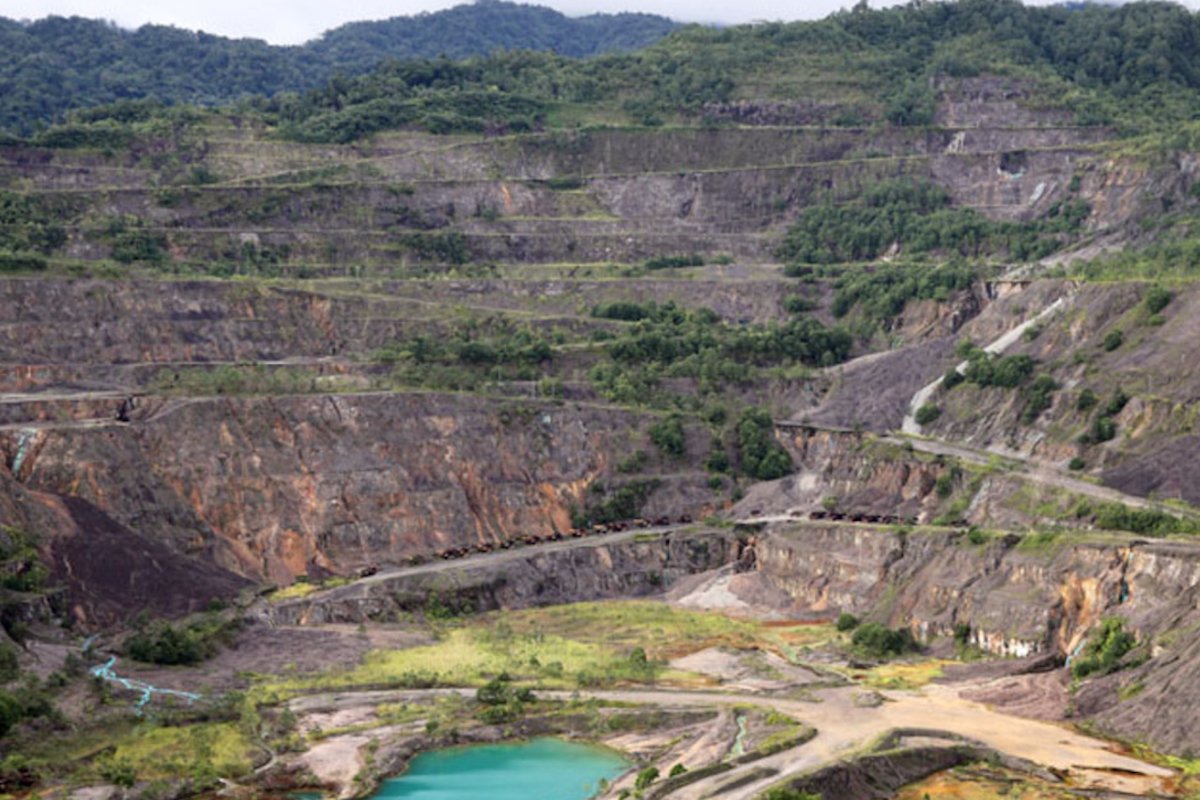
The long-dormant Panguna mine on Bougainville Island could be on the verge of a revival, thanks to a partnership between an Indian mining firm and the autonomous government, with potential backing from a new US-India critical minerals agreement. The move comes as Bougainville seeks to secure its economic future ahead of a planned independence referendum.
In November 2025, the Autonomous Bougainville Government (ABG) endorsed India's Lloyds Metals and Energy Limited to redevelop the Panguna mine, one of the world's largest open-pit copper and gold mines. The mine has been closed since 1989, when local grievances over profit-sharing and environmental damage sparked a decade-long civil war that claimed over 15,000 lives.
Bougainville Copper Limited (BCL), the licensed exploration holder, lacks the financial and technical capacity to reopen the mine independently. In January 2026, the ABG became BCL's majority shareholder with a 72.9% stake, positioning itself to drive the project forward. The ABG rejected a rival proposal from China's CMOC Group, which had sought to dilute the government's shares as part of a partnership.
A mine with a troubled past and a promising future
Panguna was a major economic engine for Papua New Guinea (PNG) from 1972 until its closure, contributing nearly 44% of the country's export earnings and about 17% of its internal revenue. Yet only 2% of profits reached local landowners, fueling resentment that erupted into conflict. The mine's redevelopment is seen as crucial for Bougainville's economic viability, especially as the region pushes for independence.
A 2021 study by BCL estimated that reopening the mine would require a $6 billion upfront investment and seven years of development. The mine holds reserves of 5.3 million tons of copper and 19.3 million ounces of gold, worth a combined $160 billion at current prices. The ABG's decision to partner with Lloyds Metals follows a competitive bidding process, with the Indian firm incorporating a subsidiary, Lloyds Panguna Metals and Energy Ltd, in April 2026 to begin the redevelopment phase.
The redevelopment plan complies with the 2015 Bougainville Mining Act, focusing on pre-feasibility studies, land ownership identification, social mapping, and environmental baselining. The ABG's predecessor government has raised concerns about whether the current partnership can mobilize adequate resources to reach production.
US-India minerals framework could be a game-changer
The US and India, two of the world's largest consumers of critical minerals and rare earths, signed the Strategic Critical Minerals Cooperation Framework in May 2026. This bilateral agreement aims to strengthen supply chain resilience through collaborative mining, processing, and recycling projects. It expands the US-led Forum on Geostrategic Engagement (FORGE), a 17-nation initiative launched in February 2026 to coordinate public-private partnerships in critical minerals.
For Bougainville, this framework could provide the financial and diplomatic backing needed to attract investment and de-risk the Panguna project. The mine's copper and gold deposits are vital for global supply chains, particularly as demand for electric vehicles and renewable energy technologies surges. The US and India's interest in securing critical minerals aligns with Bougainville's need for a reliable partner.
However, the political future of Bougainville remains unresolved. The 2019 referendum saw nearly 98% of voters choose independence, but the final decision rests with PNG's National Parliament. The ABG has set a de facto deadline of September 1, 2027, for effective independence, but negotiations with Port Moresby are ongoing. The success of the Panguna redevelopment could strengthen Bougainville's case for self-determination, but it also carries risks of renewed conflict if benefits are not equitably shared.
As the US and India deepen their minerals cooperation, the Panguna mine could become a test case for how international partnerships can support post-conflict economic recovery. The involvement of Lloyds Metals, an Indian firm, also signals a shift in the region's mining landscape, traditionally dominated by Australian and Chinese companies. For Bougainville, the stakes are high: a successful reopening could transform its economy, while failure could prolong its dependence on PNG.
The US-India framework, if leveraged effectively, could provide the financial guarantees and technical expertise needed to overcome the mine's historical challenges. But as the ABG navigates its path to independence, it must ensure that the benefits of Panguna's riches reach the people who have waited decades for justice.