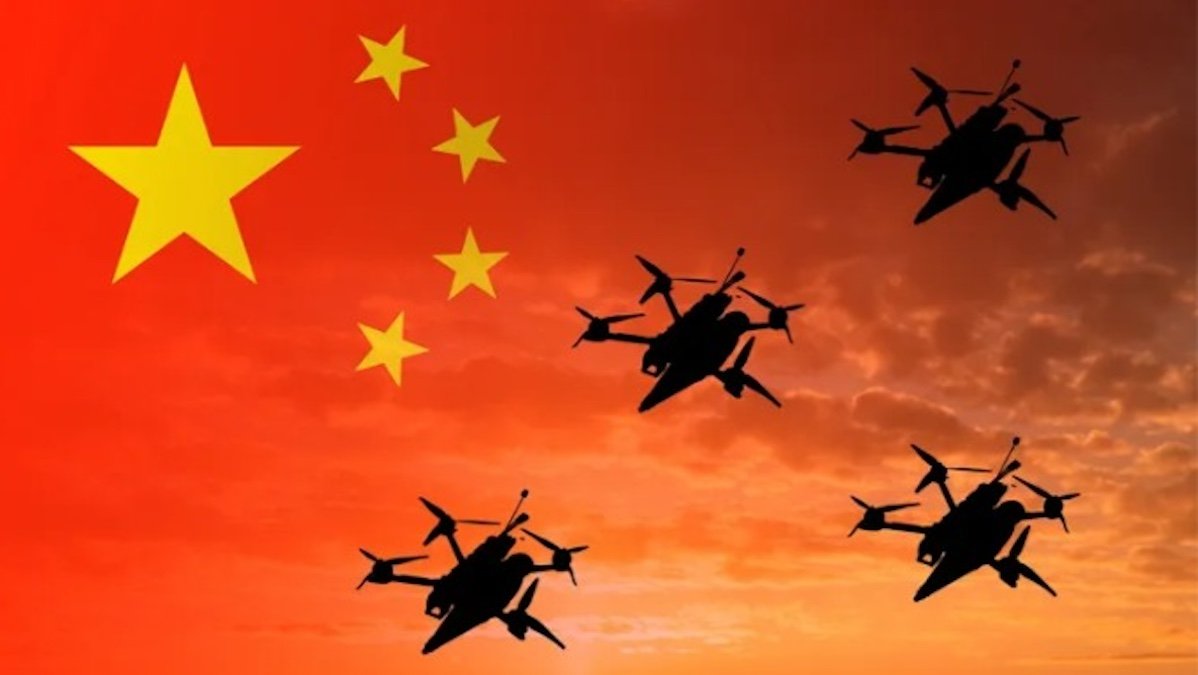
China is moving beyond single-domain drone swarms toward a vision of multidomain autonomous warfare, where uncrewed systems across air, land, and sea operate as a single, networked force. According to an assessment by the Intelligent Technology Research Institute of China Electronics Technology Group Corporation (CETC), large-scale field tests have demonstrated swarms that can autonomously reconfigure, avoid collisions, and allocate tasks even under heavy electromagnetic interference or combat losses.
The systems, as reported by the South China Morning Post, fuse sensor data from multiple drones across wide areas to detect camouflaged targets and execute the full kill chain—from electromagnetic suppression to precision strikes. This reflects a broader effort by Beijing to turn autonomous systems from standalone weapons into the connective tissue of a networked form of warfare built around speed, redundancy, and system-level disruption.
From homogeneous swarms to cross-domain integration
CETC's research highlights a shift from homogeneous aerial swarms to heterogeneous, cross-domain integration. The goal is to create distributed combat networks that can overwhelm adversaries through coordinated attacks from multiple domains. However, CETC acknowledges significant bottlenecks, including challenges in heterogeneous cross-domain coordination, joint-branch military integration, and real-time autonomous tactical decision-making against capable adversaries.
The harder question is whether the People's Liberation Army (PLA) can turn these varied platforms into a theater-wide combat network that still connects sensors, decision nodes, and effectors when communications are contested and centralized command slows adaptation. This ambition is already shaping Chinese thinking about how swarms should fight.
In a July 2026 CNA report, analyst Catherine Welch notes that Chinese researchers treat uncrewed swarms as force multipliers for dynamic kill webs, combining low-cost distributed sensors and strike effectors with algorithmic task allocation to match platforms to changing operational demands. Beyond offensive swarming, Welch highlights that Chinese researchers extensively simulate counter-swarm kill architectures, including cloud-edge collaborative networks and multi-tiered interceptor drones to neutralize incoming adversary swarms.
Tactical advantages and system-level vulnerabilities
At the tactical level, heterogeneous drone swarms offer functional complementarity, not just numerical mass. In a 2024 article in the peer-reviewed Strategic Study of the Chinese Academy of Engineering journal, Bitao Jiang and colleagues argue that intelligent unmanned swarm systems are core forces for new-domain warfare, emphasizing that cross-domain collaboration across air, sea, ground, and space enhances system capabilities. They stress the importance of dynamic multi-source information fusion, resilient decision-making, and standardized open-architecture networks.
The tactical advantage lies less in swarm size than in substitution: if one sensor, relay, or effector is lost, another node can assume its function and keep the kill web operating. However, this integrated network creates a system-level security problem that no individual-asset measure can resolve. Wen Shi and other writers, in a 2021 article in the same journal, point out that communication and interaction security is critical for network protection, noting that if network security falls short, control over multiple unmanned systems cannot be guaranteed.
While autonomy can let Chinese drone swarms operate without network access, the US Department of Defense's 2025 China Military Power Report notes that China's unmanned systems typically still depend on human operators for tasks such as preprogramming fixed targets, remotely piloting the systems, or supplying extensive inputs. This creates a tactical paradox: the more resilient the swarm becomes at the platform level, the more its effectiveness may depend on preserving the network that lets those platforms cooperate.
Operational scaling and institutional pathways
At the operational level, the challenge is scaling tactical resilience across a theater. John Chen and Emilie Stewart note in an April 2025 report from the China Aerospace Studies Institute (CASI) that Chinese theorists envision multi-modal operations and hierarchical “mothership warfare,” with naval, aerial, or ground platforms deploying and coordinating dispersed uncrewed clusters. According to Chen and Stewart, swarms covertly infiltrate contested zones to execute synchronized anti-ship, anti-submarine, ground-strike, and air-defense missions, leveraging heterogeneous uncrewed systems into a distributed lethal network.
Competitions and games may be a viable means for China to build an institutional pathway from experimentation to fielding cross-domain drone swarms. Julie George notes in an April 2026 CSET report that the PLA leverages structured technology events across air, land, sea, and cross-domain operational environments to accelerate uncrewed platform development and address autonomy bottlenecks. Events such as the “Game of Huashan” and “Yuanrong Qihang” target aerial swarm coordination and counter-UAV defense algorithms, while the “Overcoming Obstacles” challenge advances ground uncrewed systems.
Initiatives like the 2025 Unmanned Platform 3D Cross-Domain Collaboration Challenge test multi-tier synchronization across air, surface, and underwater assets, using nationwide military-civil competitions to incubate dynamic trajectory planning, swarm logistics, and collaborative electronic-acoustic targeting. These efforts underscore China's determination to dominate future intelligent warfare, even as it grapples with the inherent vulnerabilities of networked autonomy.
For regional observers, the implications are clear: China's drone swarm ambitions are not just about platform numbers but about redefining how wars are fought. As Beijing continues to invest in these technologies, the balance of power in the Indo-Pacific could shift, making it essential for other nations to monitor and adapt to these developments. Relatedly, China's broader defense industrial push is also visible in its shift toward stealthy unmanned bombers, and its embedded AI strategy is changing the nature of competition itself.