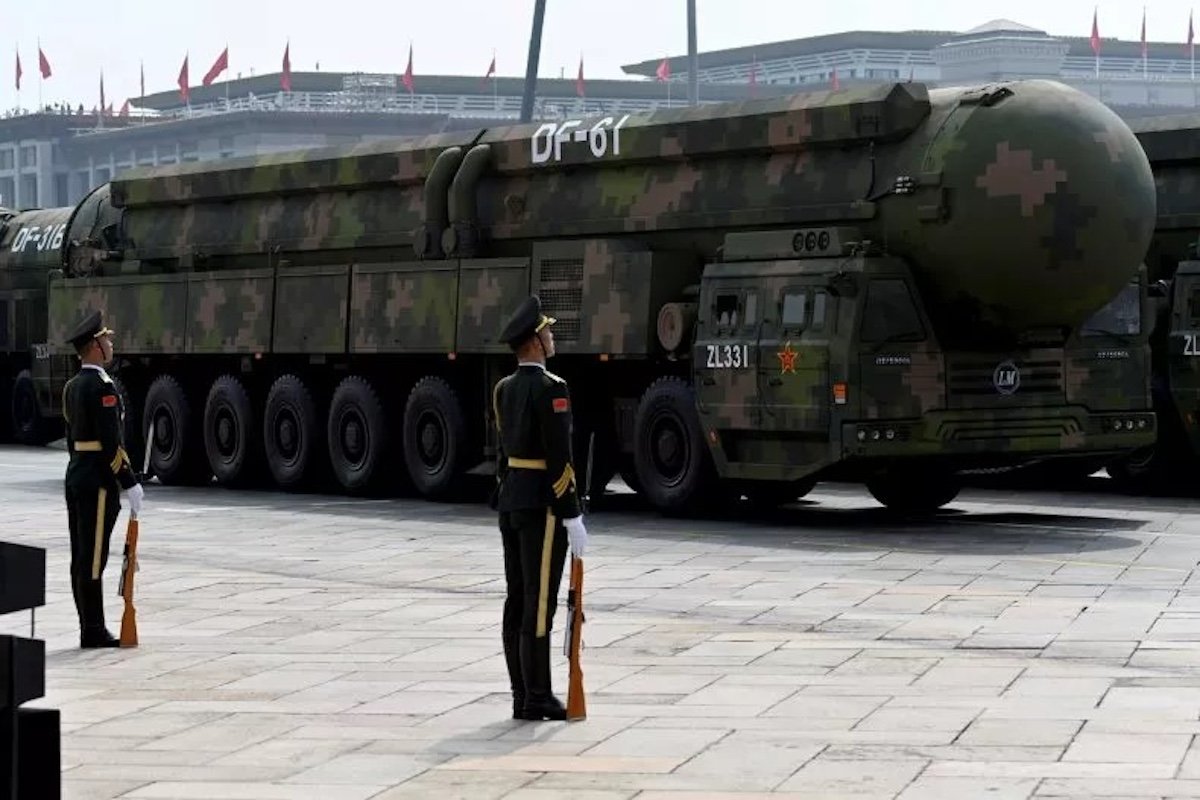
China's newest road-mobile intercontinental ballistic missile, the DF-61, has moved into routine training with the People's Liberation Army Rocket Force (PLARF) just 14 months after its public debut, according to multiple media reports this month. The rapid integration signals an accelerated push to modernize China's land-based nuclear deterrent and address technical vulnerabilities of earlier systems.
The DF-61 first appeared during a military parade in September 2025 and now participates in field maneuvers, repositioning drills, and simulated launch sequences. Chinese state media report that the missile completed development, design finalization, trial deployment, and reliability testing before its public unveiling.
Analysts suggest the fast timeline stems from design continuity rather than an accelerated development cycle. The DF-61 is mounted on a 16-wheel transporter-erector-launcher (TEL) nearly identical to that of the older DF-41, indicating an evolutionary upgrade compatible with existing command, support, and training infrastructure.
Technical specifications and improvements
While technical specifications remain classified, estimates suggest a solid-fuel range of 12,000 to 18,000 kilometers and multiple independently targetable reentry vehicle (MIRV) capability. Dispersal training complicates adversary pre-launch tracking, reinforcing China's second-strike survivability alongside expanding silo fields, though full operational readiness across active units remains unconfirmed.
Understanding the limitations of the DF-41 provides clues on what the DF-61 is engineered to address. According to the Missile Threat project, the DF-41 is a three-stage solid-fuel ICBM capable of striking targets up to 15,000 kilometers away. It measures between 20 and 22 meters, weighs 80,000 kilograms, and carries a 2,500-kilogram payload that accommodates up to 10 MIRVs, along with penetration aids.
However, M.S. Prathibha noted in a 2019 article for the Manohar Parrikar Institute for Defense Studies and Analyses that the DF-41 can carry only three or four nuclear warheads without severely compromising its 11,000-kilometer range, due to throw-weight constraints and China's less advanced reentry vehicle miniaturization compared to US technology. Prathibha also pointed out that the DF-41's vehicle-weight burden challenges claims of true off-road mobility, while reliance on hot-launch mechanisms generates intense exhaust heat that degrades launcher lifespans, forcing China to retain the heavy, liquid-fueled DF-5 ICBM.
Compared to the DF-41, the DF-61 may possess longer range, increased throw weight, carry more warheads and penetration aids, and incorporate cold-launch capability, building directly on the former's technology while addressing its mechanical and operational limitations.
Strategic role in China's nuclear triad
Road-mobile ICBMs form a foundational component of China's land-based nuclear deterrent. Hans Kristensen and others noted in a July 2026 Bulletin of the Atomic Scientists article that such missiles form the backbone of China's secure second-strike nuclear deterrent, designed to survive an adversary's first strike through dispersal and camouflage.
These units differ from silo-based forces by storing warheads separately during peacetime. During crises, crews must quickly mate warheads and reposition off-road before firing, prioritizing launch survivability and flexible retaliation over immediate hair-trigger readiness.
Silo-based ICBMs deter adversaries through constant readiness and serving as a “nuclear sponge” and tripwire, requiring attacks on hundreds of dispersed sites away from strategic locations to weaken retaliation. But their vulnerability to preemptive strikes pressures commanders to adopt risky “launch-under-attack” postures, with narrow decision windows prone to false alarms.
Despite advantages over silo-based ICBMs, road-mobile platforms rely on predictable routes, garrison choke points, and support infrastructure exposed to wide-area surveillance. Convoys' thermal, physical, and electronic signatures make them vulnerable to quick strikes before they reach secure launch sites. Centralized peacetime warhead storage also delays retaliation and requires vulnerable mating procedures.
Both road- and silo-based ICBMs reinforce China's nuclear triad, offering unique capabilities that increase survivability while mitigating the vulnerabilities of the air- and sea-based legs. Strategic bombers such as China's H-6 series are the most flexible leg of a nuclear triad because they can be retargeted or recalled midflight, but they are also the most visible. This visibility enables strategic messaging through deployments in the South China Sea and beyond.
The DF-61's rapid integration comes amid an unprecedented nuclear expansion by Beijing, which has also been building new silo fields and developing a new generation of submarines and bombers. The move is likely to heighten concerns among regional neighbors and the United States, as China continues to modernize its nuclear forces at a pace not seen since the Cold War.