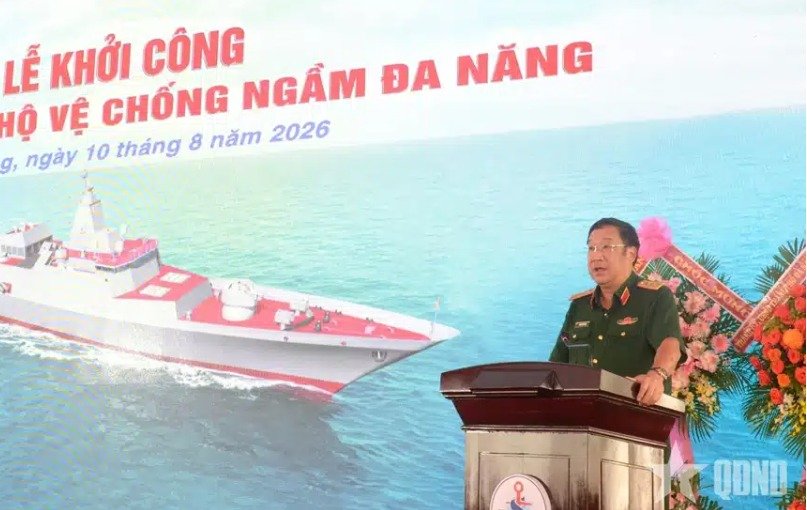
Vietnam has taken a significant step toward naval self-reliance with the start of construction on its first domestically designed anti-submarine frigate. The steel-cutting ceremony took place at the Song Thu Shipyard in Da Nang, overseen by the Vietnam People’s Navy and the defense ministry’s Song Thu Corporation. The unnamed vessel is expected to be completed within 36 months and is intended to strengthen Vietnam’s maritime sovereignty and counter sub-surface threats in the South China Sea.
A leap in domestic shipbuilding
The frigate integrates a range of indigenous systems, including active electronically scanned array (AESA) radar, air-defense missiles, and the VCM-01 anti-ship missile, developed with state-owned telecom giant Viettel and other domestic defense units. The ship is also designed to carry a Kamov Ka-28 anti-submarine helicopter and retains Russian-derived armament such as a 76.2-millimeter main gun, RBU-6000 anti-submarine rocket launchers, vertical launch systems, and torpedo tubes.
At the groundbreaking ceremony, Vietnamese Deputy Minister of Defense Lieutenant General Pham Hoai Nam framed the project as part of a broader effort to modernize the navy and achieve greater strategic autonomy in weapons and shipbuilding. Domestic production, he said, is aimed at reducing dependence on foreign military technology.
Asymmetric strategy against China
Vietnamese officials have not publicly identified a specific adversary, but the frigate is widely seen as a response to China’s growing naval presence in the South China Sea. Vietnam has long-standing territorial disputes with China and has experienced naval clashes over contested features. As of March 2026, China operates about 60 submarines, including nuclear-powered attack and ballistic missile submarines, while Vietnam has only six Kilo-class conventional submarines.
To address this imbalance, analysts suggest Vietnam could adopt a two-tier asymmetric posture: its Kilo-class submarines would hold Chinese surface combatants at risk, while the new anti-submarine frigates would threaten Chinese submarines. This approach fits a fleet-in-being strategy, where the mere presence of capable assets in critical waters like the Gulf of Tonkin complicates China’s operational planning without requiring a decisive fleet engagement.
Operational and financial hurdles
However, turning this concept into a credible wartime capability faces significant challenges. Evan Laksmana, in a February 2026 report for the International Institute for Strategic Studies (IISS), notes that Vietnam conducts only one blue-water exercise per year, and its Gepard-class frigates and other ships go to sea only two or three times a month, rarely beyond the country’s exclusive economic zone. Maintenance costs for the Kilo-class submarines may be three times their acquisition cost, keeping them mostly in port.
Vietnam’s shipbuilding industry also struggles with outdated technology, reliance on imported materials, and insufficient capital. Nory Ly, writing in a June 2026 Modern Diplomacy article, points out that the state-owned Shipbuilding Industry Corporation (SBIC) has entered bankruptcy proceedings, and secondary sanctions risks on Russian arms purchases add further complexity.
Diversifying beyond Russia
Despite the push for self-reliance, Vietnam remains heavily dependent on Russian technology. Nghiem Tuan Hung, in a 2025 article in the Russian Journal of Vietnamese Studies, notes that 70% of Vietnam’s heavy military equipment still comes from Russia, making a sudden switch impractical. Maintenance, spare parts, and training keep Russia central to Vietnam’s defense architecture.
Yet Russia’s increasingly close ties with China have raised questions about its reliability as a strategic partner. Le Thi Phuong Loan and Bach Thai Hien, writing in an April 2026 issue of the Journal of Science and Technology of the University of Da Nang, observe that the Russia-Vietnam defense framework prioritizes stability over military integration, avoiding joint defense commitments.
In response, Vietnam has diversified its defense partnerships. In May 2026, it signed a deal with India for BrahMos supersonic cruise missiles, becoming the second customer after the Philippines. Israel has also emerged as a key supplier, providing small arms, spy satellites, SPYDER air defense systems, Heron drones, and EXTRA rocket artillery systems, some of which are reportedly deployed on Vietnamese-held features in the South China Sea. South Korea has supplied K9 155-millimeter howitzers.
These moves reflect a broader strategy to plug capability gaps and reduce reliance on any single supplier. As Vietnam’s defense industry matures, the new frigate represents both an ambition and a test of whether the country can translate its limited resources into a credible deterrent. The coming years will reveal whether Hanoi can overcome the financial and technical hurdles that have long constrained its naval ambitions.