Two American philanthropic organizations recently unveiled a new fund to combat forest fires, aiming to raise US$100 million to help countries detect blazes faster and extinguish them sooner. But the initiative, announced on the sidelines of the UN General Assembly in New York, is confined to South America, home to the Amazon rainforest. Southeast Asia—and Indonesia in particular—has been left out. Jakarta should not accept this quietly. The government should formally request to join the fund and advocate for its extension to protect Indonesian forests as well.
The fund is led by Renaissance Philanthropy and Conservation X Labs, with seed contributions of US$30 million from the Gordon and Betty Moore Foundation and US$5 million from the David and Lucile Packard Foundation. Its model replicates proven approaches, such as a camera network in Brazil that detects smoke early and a team of Indigenous firefighters in Bolivia with 15 years of experience. Indonesia urgently needs these tools.
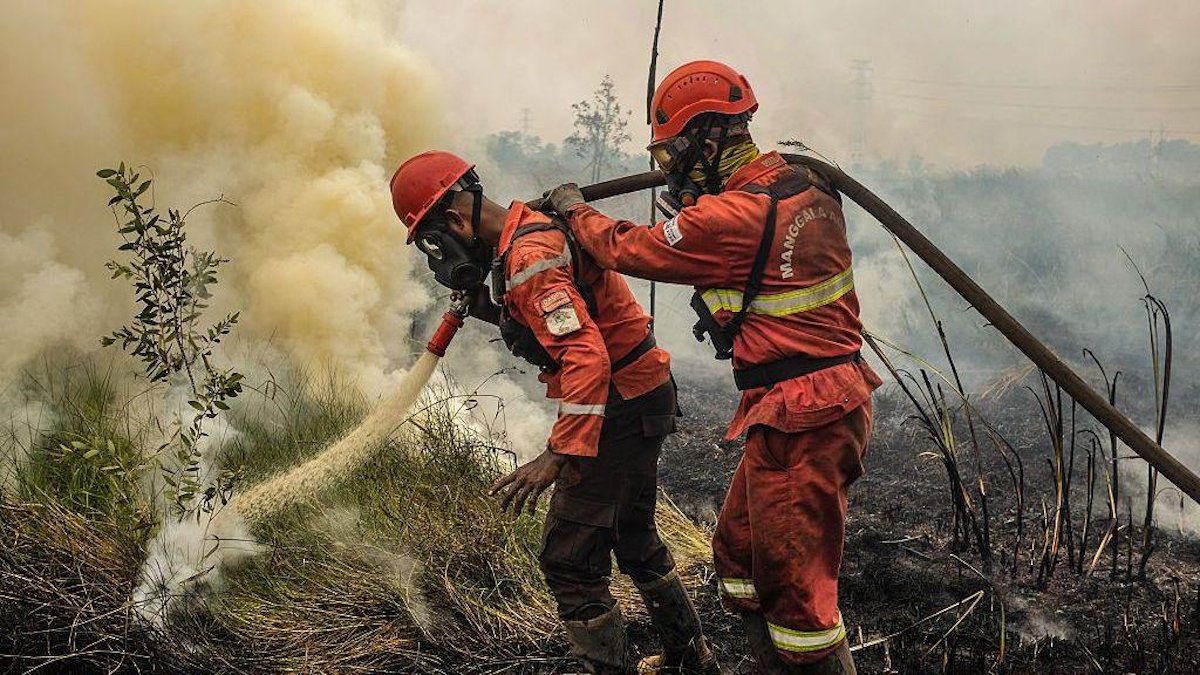
This year has been particularly harsh for Indonesia. Government data show that fires consumed more than 202,000 hectares from January to June, with an additional 95,000 hectares burned in July alone. In just six months, the country lost an area nearly three times the size of Singapore. In West Kalimantan, thick smoke blanketed Pontianak, making the city nearly invisible from the air. Schools closed, flights were delayed, and the haze drifted across borders, affecting Malaysia, Singapore, Brunei, and the Philippines.
The economic toll is staggering. The Center of Economic and Law Studies (CELIOS), a Jakarta-based think tank, estimates that fires from January to August cost Indonesia between 40 trillion and 123 trillion rupiah in lost business and healthcare expenses. In 2015, the World Bank calculated that fires cost the country US$16 billion—more than double the amount needed to rebuild Aceh after the 2004 tsunami.
Why Indonesia's fires are so hard to extinguish
A major factor is peat. Peat is soft, waterlogged soil formed from dead vegetation accumulated over millennia. Indonesia holds about 36% of the world's tropical peat. When peat dries out, fires can spread underground, where water dropped from aircraft cannot reach them. This year, El Niño—a climate pattern that brings prolonged dry spells to the region—has exacerbated the drought.
Some may argue that the fund was designed for the Amazon and that Indonesia should solve its own problems. That view is shortsighted for three reasons.
First, the financial gap is enormous. A UN report released the same week found that the world needs US$66.8 billion more by 2030 to protect tropical forests, yet only US$14.6 billion was spent in 2023. Nearly 80% of the world's remaining rainforest is concentrated in three regions: the Amazon, the Congo Basin, and Borneo—the island shared by Indonesia, Malaysia, and Brunei. If donors fund only one of these, the others will continue to wait. Excluding Southeast Asia was a significant oversight.
Second, Indonesia has valuable expertise to offer. Having battled peat fires for about three decades, Indonesia's Forestry Ministry tracks fire hotspots in near real-time using data from American satellites. Brazil and Bolivia could learn from Indonesia's mistakes, while Indonesia could adopt their camera networks and Indigenous firefighting teams. A fund that connects the Amazon and Borneo would be far more effective than one focused on a single region.
Third, and most importantly, most of Indonesia's fires are human-caused. Farmers and companies often burn land because it is the cheapest way to clear it for palm oil plantations, other crops, or mining operations. If Indonesia joins an international fund, partners will ask difficult questions about land management and enforcement. The government should welcome such scrutiny. Transparent data and fair legal processes will attract more support than excuses.
Bambang Hero Saharjo, who leads a fire management center for Southeast Asia, has appealed for international help. But help rarely comes to a country that waits passively. Jakarta should act now: the Forestry Ministry and Foreign Ministry should contact the fund's leaders before the end of this year. Indonesia could contribute even a modest amount of its own money to demonstrate seriousness, and it should invite Malaysia and Brunei to join, given that fires on Borneo affect all three nations.
The fires will return next year and the year after. El Niño comes and goes, but dry peat and cheap land clearing persist. A fund that already exists, with money already raised, is a practical starting point. Indonesia should knock on its door now.
Bhima Yudhistira Adhinegara is the executive director of CELIOS. Muhammad Zulfikar Rakhmat is the director of the China-Indonesia and MENA-Indonesia desks at CELIOS.