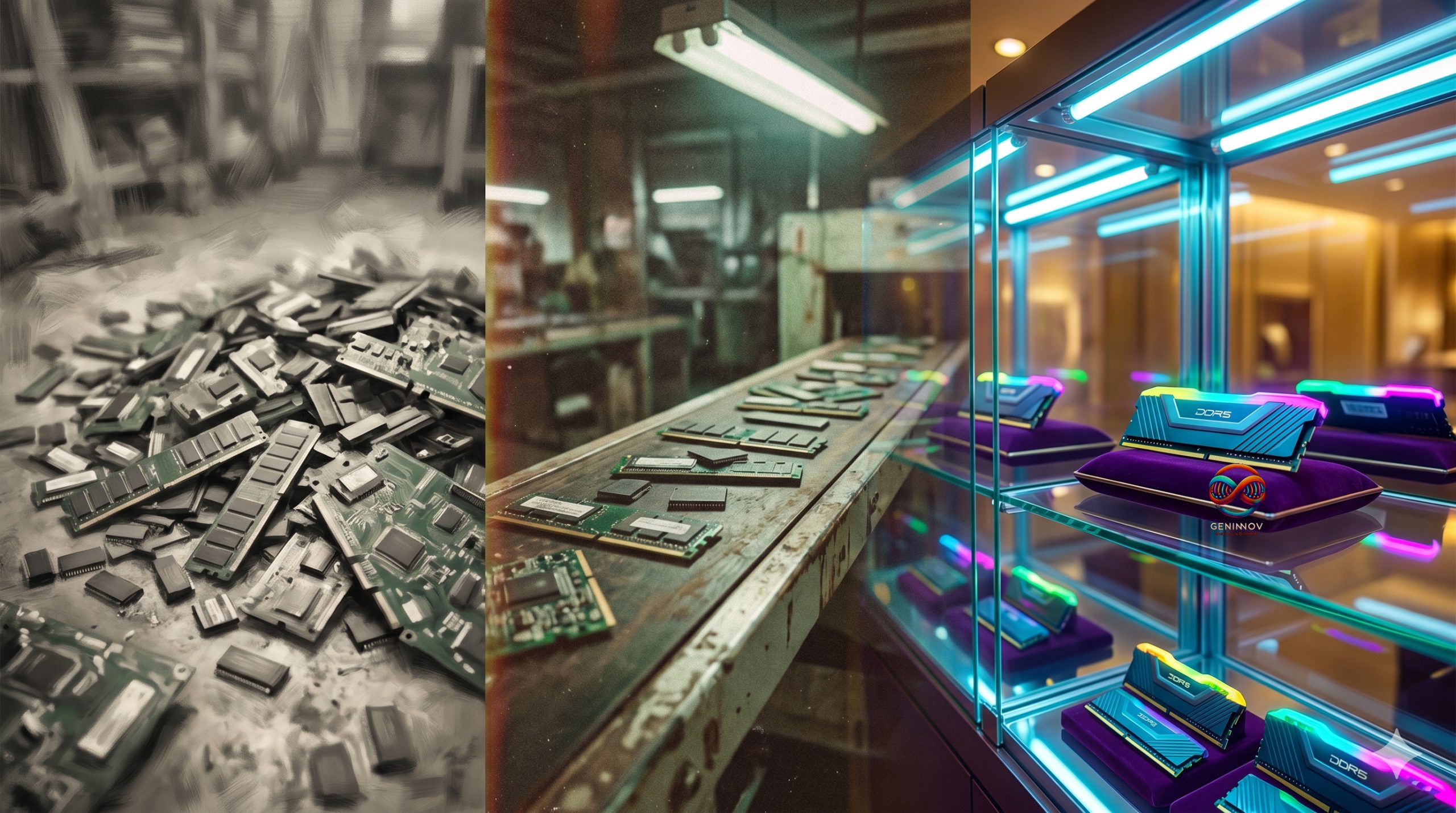
In October 1929, economist Irving Fisher declared that stocks had reached a permanently high plateau. Days later, the market crashed. The phrase has been a punchline ever since. So let us state plainly at the outset: we are not predicting that memory prices or profits will rise forever. Every industry has its winters. What we are arguing is narrower and stranger—and may be the least explored, most consequential subject in global innovation investing today.
Consider what has happened, largely unremarked. A sector that the investment world has treated for forty years as the bottom of the technology barrel now contains three companies worth more than a trillion dollars each: Samsung Electronics of South Korea, SK Hynix of South Korea, and Micron Technology of the United States. Each is on course to earn over a hundred billion dollars in profits. At least two, perhaps all three, may out-earn every member of the Magnificent Seven and Taiwan Semiconductor Manufacturing Company within a year or two. And yet the memory makers are still discussed, and still priced, as though they have been lucky tenants in a house that belongs to someone else.
The old prejudice has taken new forms. In much of the investment world, making money from memory is almost regarded as beneath notice. Few serious tech investors want to display top holdings that include memory names. Analysts have abandoned price-to-book-based fair valuation methods because the historic range has ruptured, but any anchoring based on price-to-earnings ratios is more arbitrary than anything seen in tech analysis. These stocks' PE range history is unusable. No one has the courage to apply even high-teens multiples, let alone 20x or 30x multiples, normally applied to the lowest-quality technology names in other segments. Meanwhile, skeptical veterans wait for any 20-30% correction to say aloud what they have been muttering under their breath: these commodity stocks will repeat history and retreat to some sub-1-2x price-to-book ratio before anyone can detect bubbles elsewhere.
The Disdain Was Once Earned
To some degree, the disdain was earned. For decades, memory really was undifferentiated capacity sold to the lowest bidder. The snobbery was simply an accurate reading of the economics. But whether the prejudice has outlived its cause requires answering whether memory companies are different from here on—in other words, whether they are at a permanently higher plateau.
For a change, we can now read long reports on memory price implications that run to dozens of pages. They discuss almost everything except the memory companies themselves. They discuss demand: hyperscaler capital expenditure, token growth, server units, the bit-demand curve. They discuss sustainability, circularity, the risk of a bubble. They have begun to discuss implications for other technology companies and even macroeconomic factors. They discuss everything that might be happening outside the building. What they rarely discuss is the companies themselves—their management, their products, and what is changing inside them that is handing them so much power. The firms are treated as weather vanes, not as actors.
That assumption is the subject of this piece. If these companies remain without any control over their destinies, they are surely different from every toolmaker, packaging company, optical component supplier, or even passive component supplier—let alone a foundry, chip design company, or software/model-making company—irrespective of the money they make now. We think it is wrong, and we think it is wrong in ways that matter for whether the profits are a fluke or a fixture.
To take the industry seriously, on its own terms, requires answering a list of questions that the prevailing coverage almost never raises:
- Evidence of business decisions, rather than mere demand factors, that changed the technology world and redirected hundreds of billions of profit dollars;
- The reduced commoditized nature of memory in recent years, and the difference between something that is a commodity versus something that is cyclical;
- Why, if the whole world can see this happening, no one can walk in and take it—not TSMC, not Intel, not China in any foreseeable future;
- Where the industry's old scaffolding of common standards is quietly coming apart, and what that tells us;
- How far customization has traveled, and whether a memory part that you cannot unplug is a historic departure or a footnote; and
- The behavioral changes that the one-time gains have brought about, and why memory business decisions are no longer demand-side driven, with non-management layers within the companies and surrounding governments joining the decision-making.
The questions sound aggressive. They are meant to. But they are asked in good faith, and the answers require everyone in investment decisions to take these companies more seriously than they have so far. We begin where the silence is loudest: with a decision, taken a year ago, that moved hundreds of billions of dollars and was met with a shrug.
A year ago, three companies took a decision that moved hundreds of billions of dollars, and the world produced roughly nothing to mark it. No magazine cover. No congressional hearing into why the memory inside every phone, every laptop, and every server on earth is now controlled by a trio of firms that have quietly rewritten the rules of the semiconductor industry. The decision was to shift from standardized commodity memory to customized, application-specific products—a move that effectively locks in customers and raises barriers to entry. This is not a temporary cyclical upswing; it is a structural change that may well be permanent.
For investors, the implications are profound. The AI boom is driving real yields structurally higher, and memory is at the heart of that transformation. As Asia's wealthy families rewrite regional funding dynamics, the memory giants are becoming central to the region's economic architecture. The question is whether the market will finally recognize what has changed inside these companies, or whether it will continue to treat them as mere weather vanes.