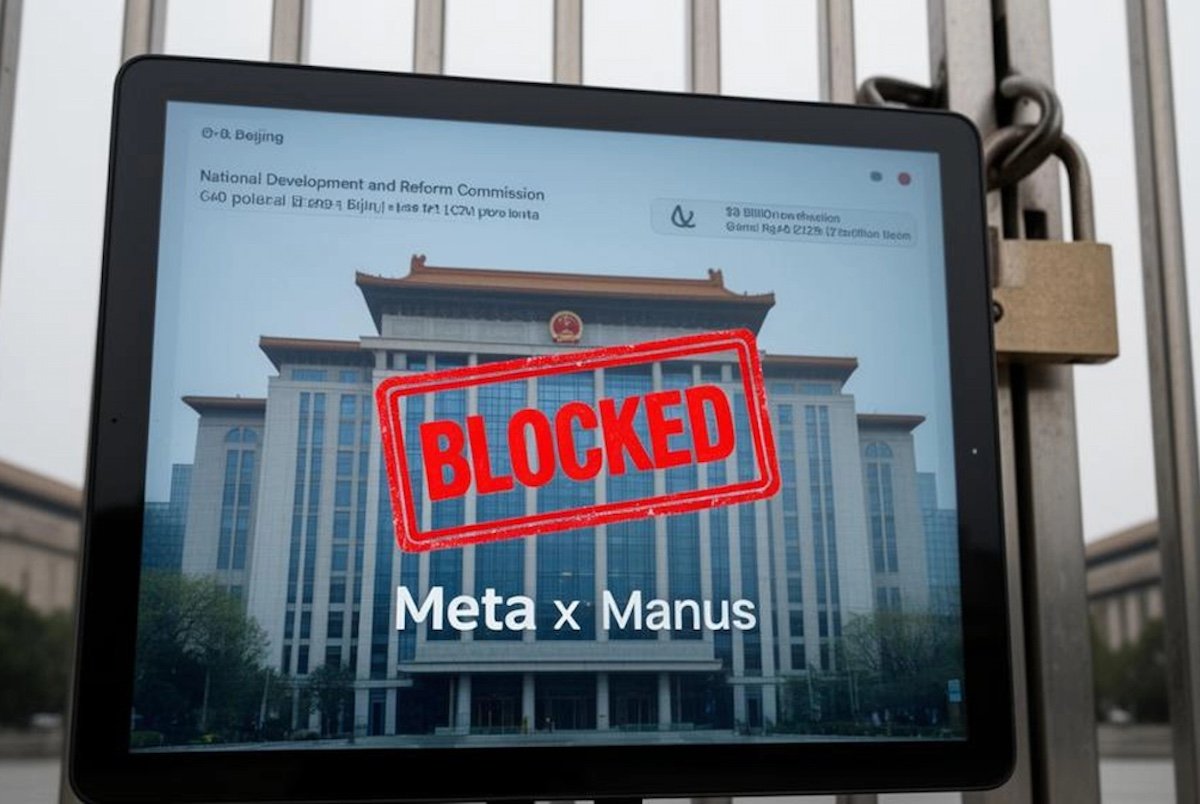
In April, China's National Development and Reform Commission blocked Meta's planned US$2 billion acquisition of Manus, an AI-agent startup founded in Beijing that had moved its headquarters to Singapore in mid-2025. The deal, agreed in December, unraveled after co-founders Xiao Hong and Ji Yichao were barred from leaving China while regulators reviewed the transaction.
This case has been framed largely as a US-China story: a test of how far Washington and Beijing will allow AI talent and capital to flow between them. That reading is correct but incomplete. For capital allocators across the Indo-Pacific, the Manus saga reveals something more consequential: the fragility of a corporate strategy that financial media has dubbed “Singapore washing.”
The Mechanics of Singapore Washing
The strategy is straightforward. Chinese-founded firms relocate part of their corporate structure to Singapore to access Western capital and present a neutral face, while operations, intellectual property and the substance of the business remain in China. Shein, which moved its headquarters to Singapore in 2021 while keeping its roughly 10,000-supplier base in Guangdong, is a prominent example. Manus took the approach to its logical end in 2025, closing its China offices and moving its core team to Singapore in the months leading up to the Meta deal.
For a time, the gap between paper and substance did not matter, because no one with the power to act chose to look. Beijing's unraveling of the Manus-Meta deal was the moment someone looked and balked. The intervention established that a Chinese-founded company cannot simply re-domicile its way out of Chinese jurisdiction when its core technology and talent remain at home.
The message, as one reading of the case put it, is that Singapore can be a launch pad but not an exit ramp. That is a problem for Chinese founders. And it is a larger problem for Singapore.
The Cost to Singapore
When the integrity of a Singapore corporate structure becomes contingent on whether Beijing decides to assert a claim over what is inside it, the Singapore flag stops being a clean signal. It becomes a question, and the cost of that question does not fall only on the firms that misused the playbook. It falls on every legitimately Singaporean company that now has to prove it is not one of them.
This matters more now because regional capital is already under strain. Southeast Asian venture funding is contracting sharply. PitchBook's data points to a 33.9% year-on-year decline in regional venture capital deal value in 2025, to US$6.3 billion across 805 transactions, a fall the firm attributes partly to reduced cross-border participation and tighter diligence standards. In a tightening market, investors become far less willing to underwrite structures they cannot fully verify. Ambiguity that was tolerated in a capital-abundant cycle gets repriced to zero in a capital-scarce one.
The accounting fraud at eFishery, once one of the region's most celebrated startups, had already reset diligence standards across Southeast Asia. The Manus block adds a second lesson: the corporate structure itself might not be what it appears to be, and a jurisdiction's protection is only as durable as the substance beneath it. Together, these cases are teaching capital to look harder at Asia's cross-border structures. Singapore, as the region's preferred neutral domicile, has the most to gain if that scrutiny finds substance, and the most to lose if it does not.
A Pattern Below the Headlines
The Manus case played out at the $2 billion level, which is why it made headlines. But the same structure shows up far below the headlines, in the deals investors actually see every week. Earlier this year, a founder pitched me on his semiconductor company. The pitch was for a Singapore-incorporated business for which the deck was clean, the market was real and the technology was genuinely differentiated. Then I asked three questions: Where does your intellectual property legally sit? Who owns the entity that owns it? And if I wire money into your Singapore company tomorrow, what exactly am I buying? He could not answer any of them cleanly. The IP sat in China. The product was built in China. The team was in China. The Singapore entity he was raising owned almost nothing of substance.
It was, in miniature and entirely sincerely, the same structure Beijing had just enforced against at the $2 billion level. The founder was not running a scheme. He had simply done what the ecosystem had taught him to do: put a Singapore wrapper on a Chinese business and assume the wrapper was enough. But it is no longer enough, and the Manus case is the clearest signal yet that Singapore washing will never be the same.
For investors, the lesson is clear: due diligence must now go beyond paper. For Singapore, the challenge is to ensure its corporate structures remain credible in a world where Beijing is willing to look inside them. The region's capital markets will be watching closely.