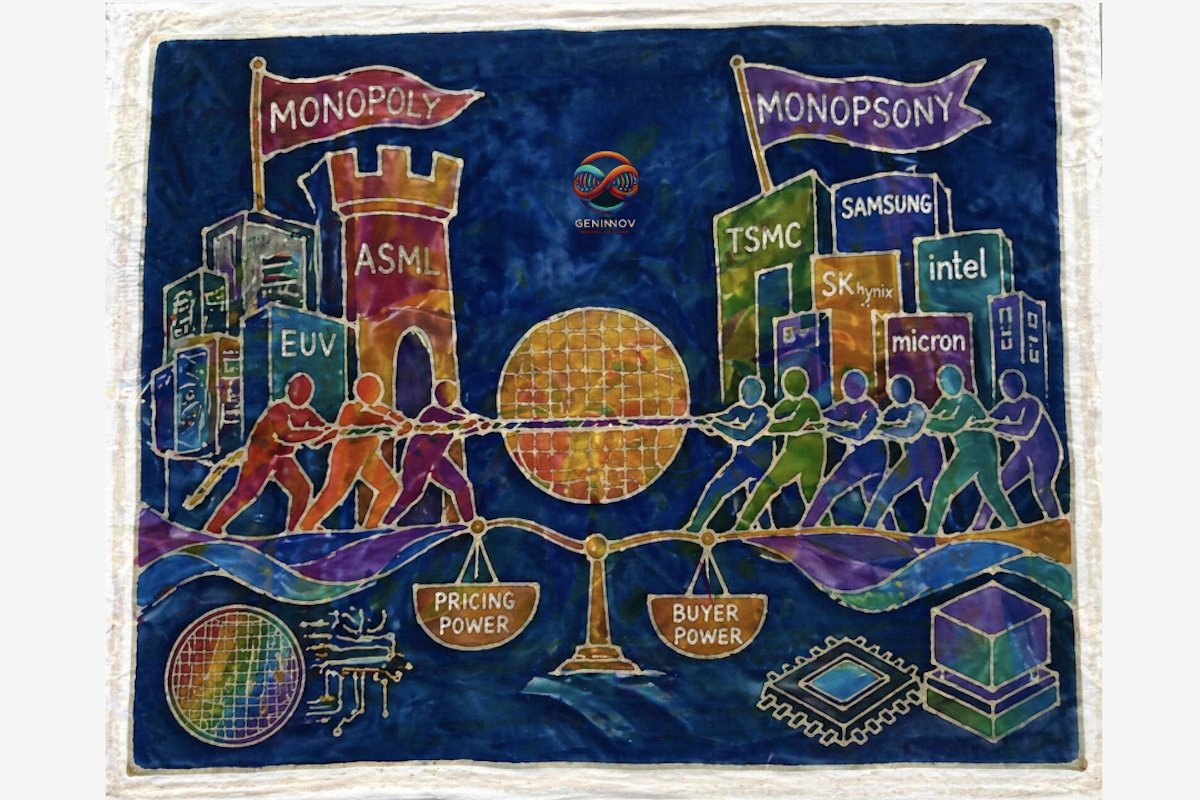
Some events, though seemingly routine, carry implications so vast that they demand their own analysis. TSMC's highly unusual public complaint about ASML's latest EUV pricing falls squarely into that category. The complaint is remarkable not only because TSMC itself is relentless in wielding its own pricing power, but also because these two giants rarely air their grievances in public.
This clash between a near-monopsony (TSMC) and a near-monopoly (ASML) was first explored in 2024. Now, as we examine Elon Musk's Terafab, Japan's Rapidus, Samsung's labor strike, and other developments, it is worth asking whether ASML's famed machines are sufficient for building a fab—and whether they are even necessary.
Part One: The Sufficient Question
The premise sounds rhetorical, almost juvenile. Of course a fab is more than an ASML machine. But the sharper version of this question is worth asking: every semiconductor fab in the world is a collection of equipment whose suppliers are well-known and, China aside, accessible to any major economy or tech oligarch with the cash to pay. So can someone with enough will and enough budget build a leading-edge fab from a standing start?
The catalog is open. You get EUV scanners from ASML. You get deposition and etch tools from Lam Research, Applied Materials, and Tokyo Electron. You fold in metrology and materials from KLA, Shin-Etsu, Lasertec, BESI, and Teradyne. The tools are astronomically expensive, but the catalog is wide open.
Yet this open catalog raises a glaring paradox: Why would TSMC, currently benefiting from an unprecedented global supply crunch, use plans to defer its latest fab development as a negotiating tool against its suppliers? The lesson the catalog does not teach is that the equipment, even when assembled in a multi-billion-dollar clean room, is the easy part. The hard part is everywhere. Most of those problems are not solved by buying a tool.
Each is solved by tens of thousands of correction loops, accumulated over decades, written in process documents that no single engineer carries in their head and no rival can copy by hiring twenty defectors. The table below covers some of the more devilish operating challenges that even with the best equipment up and running.
The above list is a small sample of what goes into making a successful fab operation. In fact, what goes into making a cutting-edge fab is as describable as writing an essay on what makes a great artist with common pestles in her hand. It is the art part that makes TSMC wield its pricing power against everyone around it, including the supposed 100% market-share supplier like ASML.
New Clients, or Just Aspirations?
Regardless of the above, a rising horde of entities want to build semiconductor manufacturing facilities, including at the most advanced end. We may claim that the cutting edge is impossible for anyone without experience, but not everyone believes it.
Musk is certainly one of them. Everything about Terafab defies conventional logic. The initial budget is massive, but plausible at around US$25 billion. While the project will have Intel as a partner, one must remember the lack of experience and no working chip team. The target of a terawatt of compute requires over 20 million Rubin-class wafers and over 15 million HBM4E wafers, apart from a lot of other things. At realistic yields and cycle times, that is more than the capacity of a few hundred of the best current fabs. The spread between announcement and physics is two orders of magnitude.
A more grounded, yet incredibly risky, plan is unfolding in Japan. Rapidus, founded in 2022, has backing from eight Japanese conglomerates and the government, as well as technology transferred from IBM. Cumulative public funding has reached roughly $15 billion. Mass production is targeted for 2027, starting at 6,000 wafers per month and scaling to 30,000 later. For comparison, TSMC produces over 150,000 at leading nodes. There is no way to say whether Rapidus will succeed, but some experts see the possibility of competitive operations in single digits even by 2030.
China is the third experiment, the forced one. Sanctions block EUV. SMIC has nonetheless built a 7nm-class node using DUV multi-patterning, and Huawei's Kirin 9030 sits between 7nm and 5nm. The engineering is genuine. So is the cost. SMIC's 7nm yield is estimated at 20-40% against TSMC's ~80% at the same node. The 5nm-class yield is reportedly under 20%. Per-chip cost runs roughly 50% above TSMC's EUV-based equivalent.
The pattern across three live experiments is the same, supplemented by half a dozen other announcements from Saudi Arabia, India, to Germany and other places in Europe. Money buys the equipment, and possibly the people. What it cannot buy is the experience that is critical in mastering the tiny steps. The instruments are sold from a catalog. The art is not.
The Apple Paradigm: The Danger of Weaponized Leverage
The cleanest way to test the "money plus engineering equals fab" thesis is to walk through the graveyard of those who tried. The list of entities that failed to crack the leading edge of semiconductor manufacturing reads like a tech hall of fame: IBM, Motorola, Texas Instruments, and a litany of once-dominant Japanese conglomerates. None of these titans lacked capital. None lacked brilliant engineers. Each had access to the exact same equipment catalog as TSMC, often years earlier. What they lacked was the institutional art.
ASML, for now, remains the last polite monopolist—a company that holds a near-total monopoly on EUV lithography but exercises its power with restraint, knowing that its customers are the only ones who can turn its machines into profit. But as new entrants and geopolitical pressures mount, that politeness may not last. The real question is not whether ASML's machines are sufficient, but whether the world's chip ambitions can survive without the decades of art that TSMC and a few others have mastered.