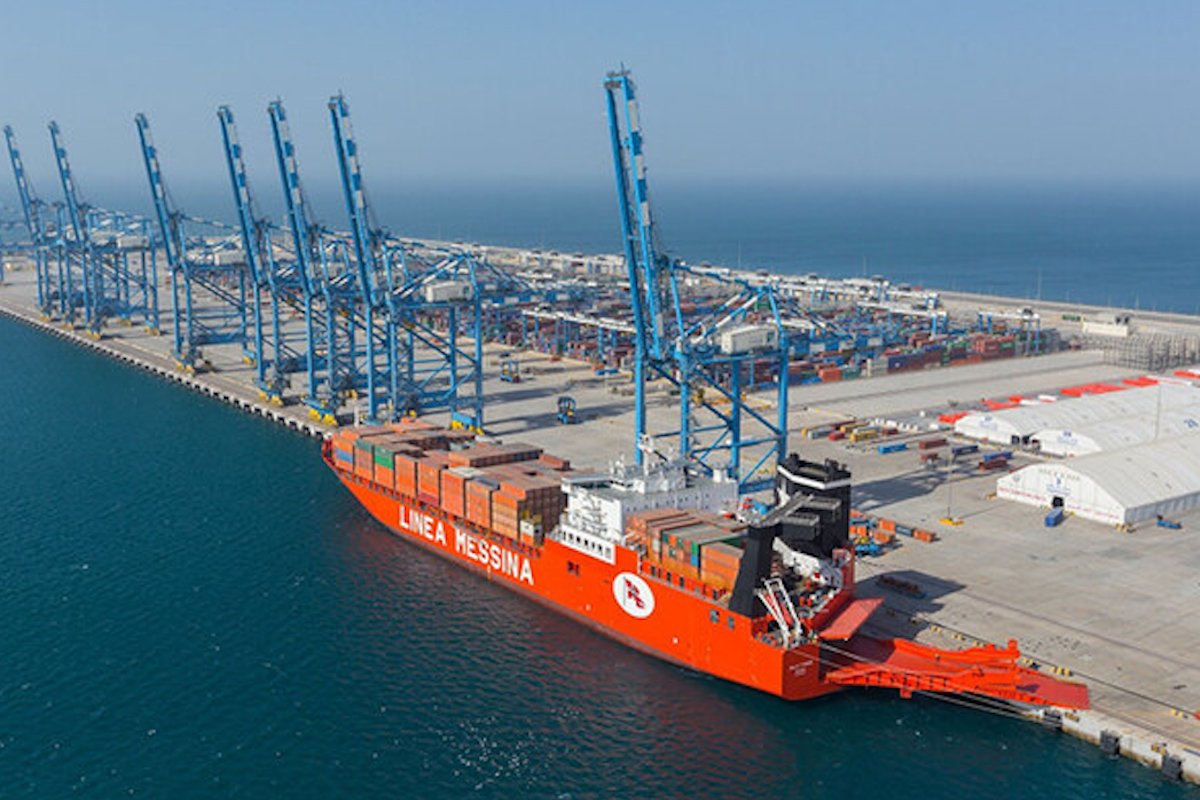
Nineteen years after Pakistan signed away Gwadar Port's commercial future for four decades, the government's own scorecard reveals a stark underperformance. On February 6, 2007, Islamabad committed to building roads, an airport, an expressway, and a breakwater, while a private concession-holder was to run the port, fill the Free Zone, and attract shipping lines. The result, according to a strategic research brief prepared for the Minister of Planning, Development and Special Initiatives by Noor Ul Haq Baloch, chairman of the Gwadar Port Authority (GPA), is a cumulative total of just 4,789 containers handled since operations began—against an installed annual capacity of 240,000 twenty-foot equivalent units (TEUs).
The brief, presented on June 16, paints a grim picture: the Free Zone is only 1.2% occupied out of 2,323 acres allotted, fewer than 300 jobs have been created against 38,140 promised under the Master Plan, and the concession-holder—China Overseas Port Holding Company Limited (COPHCL)—has deployed roughly US$250 million of a committed $1.2 billion while collecting 91% of port revenue to the state's 9%.
A Deal Without Teeth
The port was handed over under a 40-year Build-Operate-Transfer agreement, originally signed with PSA Gwadar and novated to COPHCL in April 2013. The deal bundled three integrated businesses—the Multipurpose Terminal, the Container Terminal, and Marine Services—along with a separate 923-hectare Free Zone lease executed in 2015, all under exclusive commercial rights. In exchange, GPA was to receive 9% of terminal revenue, 15% of Free Zone revenue, and 9% of marine services revenue. What the agreement did not include, according to the brief, were clear performance milestones. No Key Performance Indicators (KPIs), no minimum throughput targets, no timeline for attracting shipping lines, and no occupancy benchmarks for the Free Zone.
Two decades on, the absence of that scaffolding shows. GPA's cumulative receipts across every revenue head combined come to just 313 million rupees against 61.2 billion rupees in public money spent building the port's surrounding infrastructure. Three berths are operational, fitted with five ship-to-shore cranes, but the port has never secured a main-line liner relationship—the regular, scheduled vessel calls from major global shipping alliances that turn a terminal into a functioning trade node rather than a berth waiting for business.
The Tanger Med Benchmark
The brief reaches for an uncomfortable benchmark: Tanger Med, the Moroccan port that began, like Gwadar, on an empty coastline. Within 15 years, Tanger Med had reached 10.2 million TEUs annually and attracted more than 1,100 export-oriented firms into its free zone. Gwadar, at a comparable stage in its own development, has 1.2% Free Zone occupancy and no equivalent industrial base to show for it. The brief's central diagnosis is that Tanger Med succeeded because the port and its surrounding industrial zone were built and filled as a single program, not as sequential projects.
Gwadar, by contrast, built the quay and left the rest—the connecting road corridor to the mineral belt in Chagai, the border facility at Gabd (87 kilometers from Iran's already-built Rimdan zone), and reliable water and power for industrial tenants—either incomplete or entirely absent. The brief counts five such connectivity gaps, from an unfinished hinterland corridor to a single 1.2 million gallons per day (MGD) desalination plant serving a city still on grid load-shedding. Fine infrastructure on the quay is not the same as a working connection to the cargo and markets that would fill it.
A Closing Window
The stakes go beyond one underperforming terminal. The brief frames 2026 as a closing window: competing regional transshipment hubs—Duqm in Oman, Salalah, the Grand Faw project in Iraq—are advancing now, while Gwadar's structural advantage as a port 180 nautical miles from the Strait of Hormuz sits largely unused. Pakistan is also facing a specific and newly urgent case for developing Gwadar as an energy hub. The brief describes the 2026 Hormuz crisis as having turned an 'Oil City' concept—strategic fuel storage and an eventual out-of-Hormuz refinery—from a long-range ambition into a near-term necessity, with an indicative first-phase cost of $1-2 billion.
Layered on top is Balochistan's mineral wealth. The Reko Diq copper-gold deposit alone represents a projected $74 billion over 37 years under its Barrick joint venture, and the brief identifies a 650-kilometer mine-to-port corridor to Gwadar as the logical export route—one that also happens to be over a third shorter than hauling ore to Karachi instead. None of it moves without a functioning port at the other end.
To its credit, the document does not stop at diagnosis. It lays out five specific, time-bound actions: dredge the channel from its current 12.5-metre depth to the 16 meters main-line vessels actually require; activate the Gabd–Rimdan special economic zone, currently stalled awaiting an FBR regulatory order on transit trade; commit to a mine-to-port corridor route; secure the 100,000-acre Oil City site; and commission additional desalination and power capacity. The window for action is narrowing, and the brief's implicit warning is clear: without urgent intervention, Gwadar risks becoming a permanent monument to missed potential rather than the trade gateway Pakistan envisioned.
For context on Pakistan's broader strategic calculus, see Pakistan Emerges as Key Mediator in US-Iran Framework Agreement and CPEC 2.0: China's Digital Grip on Pakistan's AI Future.