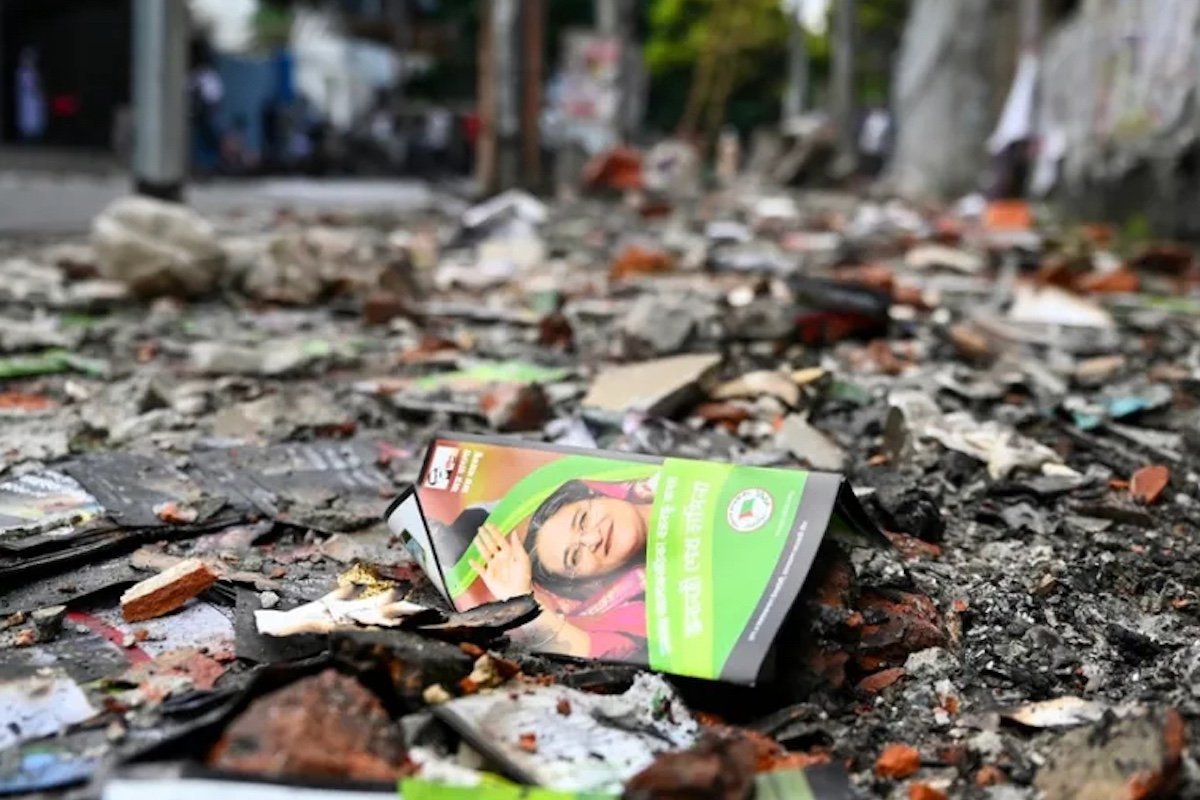
On November 17, armed assailants set fire to the residence of SM Zilany, a lawmaker from Bangladesh's ruling party, in Tungipara, Gopalganj—the ancestral political base of ousted Prime Minister Sheikh Hasina. The attackers also stormed the local police station, vandalized the premises, and set it ablaze. The violence followed a police checkpoint operation that led to several detentions and motorcycle seizures. Videos circulating online showed men smashing property while chanting “Joy Bangla” and “Joy Bangabandhu,” the traditional slogans of Hasina's Awami League. The footage has not been independently verified.
Home Minister Salahuddin Ahmed accused the banned Awami League of orchestrating the violence from abroad, vowing to identify and prosecute those responsible. Earlier incidents in Gopalganj had already seen attacks on police vehicles and local businesses.
The attacks highlight a fundamental contradiction in the Awami League's comeback strategy. A party banned under Bangladesh's anti-terrorism law is seeking to restore its political standing through mobilization accompanied by violence. Such tactics are counterproductive. A political organization seeking rehabilitation must convince the public that the conduct that led to its exclusion is a thing of the past. Instead, the Awami League's recent actions—or those attributed to its supporters—are reinforcing the arguments of those who want the restrictions maintained.
Violence beyond Bangladesh's borders
The problem extends well beyond Gopalganj. On November 16, Awami League supporters gathered outside the Mayfair Venue in Romford, east London, where Nahid Islam, leader of the National Citizen Party and parliamentary opposition chief whip, was attending a reception. Nahid accused Awami League activists of attacking expatriate Bangladeshis and university students at the event. Five people were reportedly injured and taken to hospital.
More revealing was the account given by UK-based Awami League figure Akhtar Hossain during a talk show with suspended former ambassador Harun Al Rashid. According to a Daily Waadaa report, Akhtar described how party supporters had assembled before Nahid arrived, positioned themselves around the venue, and entered the gathering. He acknowledged the use of eggs and did not deny that sticks had been used. “Our intention was to create a scandal, cause disorder and spread panic,” he said. He also indicated that the campaign would continue until Hasina, now exiled in India, returned to power. That statement suggests that disruption was not merely an unintended consequence of political protest; at least one participant described it as the objective.
The Romford incident was one of many. In September 2025, Awami League supporters protested outside the School of Oriental and African Studies in London during a visit by Mahfuj Alam, then an adviser to Bangladesh's interim government. Protesters threw eggs at Bangladesh High Commission vehicles, prompting police intervention. Mahfuj had previously faced harassment outside Bangladesh's consulate in New York. Later that month, members of a delegation accompanying Muhammad Yunus to the United Nations General Assembly faced hostile protesters at John F. Kennedy International Airport. NCP leader Akhter Hossen was pelted with eggs, while Tasnim Jara and BNP leader Mirza Fakhrul Islam Alamgir were also targeted. Similar incidents subsequently involved NCP leader Hasnat Abdullah in London and actress Azmeri Haque Badhon in Italy, where she reported being assaulted and harassed by people identifying themselves as Awami League or Chhatra League supporters.
The incidents differ in seriousness and circumstances, but together they suggest a political culture in which intimidating opponents remains an accepted form of mobilization among sections of the Awami League's supporters. The timing is important. In July, Hasina told Reuters that she and senior Awami League colleagues planned to return from exile in India around December and surrender to the courts. She acknowledged the possibility of arrest and said she intended to challenge the legal proceedings against her. Hasina, who fled Bangladesh on August 5, 2024, faces a death sentence imposed in absentia over her government's crackdown on that year's uprising. She denies the charges and maintains that the ban on her party is unjustified.
The announced return has given Awami League supporters a political deadline. Demonstrations and efforts to reopen party offices have accompanied renewed mobilization in Gopalganj, where the party retains historical and organizational roots. But violent mobilization will make that recovery harder. The Awami League's history helps explain why. On October 28, 2006, Bangladesh witnessed one of its most notorious episodes of partisan street violence during the political confrontation surrounding the end of the BNP-led government's tenure. The Awami League-led movement became associated with the logi-boitha—the use of boat hooks and oars as weapons. Political activists were beaten in public, and the violence became part of the country's enduring record of partisan confrontation. The episode showed how political parties could mobilize supporters carrying improvised weapons and present street confrontation as an acceptable means of advancing political demands.
The Awami League subsequently returned to office in 2009. Over the next 15 years, the party's rule was marked by authoritarian drift, culminating in the 2024 uprising that forced Hasina to flee. The current violent tactics, both at home and abroad, are a stark reminder of the party's past and a warning about its future. For a party seeking to shed its terrorist label, the path to rehabilitation lies in renouncing violence and embracing democratic norms. So far, the Awami League shows little sign of doing so.