For decades, Chinese investment has underpinned development across Southeast Asia, funding infrastructure from highways to green energy projects that help nations meet global environmental standards. Yet this economic partnership has also offered a lifeline to governments seeking to consolidate power while mitigating the costs of Western sanctions. Now, a new dimension is emerging: artificial intelligence (AI) and digital surveillance.
At the World AI Conference in Shanghai earlier this year, President Xi Jinping warned of “new historical injustices” stemming from unequal access to AI, signaling Beijing's ambition to shape global norms for the technology. As Xi prepared for his visit to the United States, the pace at which China is extending its technological reach across Southeast Asia warrants closer attention. Cambodia, where long-standing dependence on Beijing is increasingly intertwined with new surveillance capabilities, offers a telling preview.
Economic ties deepen, political space narrows
Cambodia's relationship with China has often been framed as one of economic necessity, a common narrative across the Global South. When Prime Minister Hun Manet succeeded his father three years ago, many Cambodians and foreign diplomats hoped for a shift toward greater openness and a reduced reliance on Beijing. Manet, educated in the United States and the United Kingdom, seemed poised to reopen democratic space that had eroded under his father's rule.
Instead, Phnom Penh has doubled down on its partnership with China. Beijing is now Cambodia's largest foreign direct investor, deeply involved in flagship projects like the Funan Techo Canal and the expansion of Ream Naval Base on the Gulf of Thailand. China's growing role in Cambodia's security apparatus has fueled concerns about long-term strategic influence and raised questions about where the country's geopolitical loyalties truly lie.
Economic dependence, military cooperation, and political alignment reinforce one another. The deeper these ties become, the harder it will be for any future Cambodian government to change course without confronting powerful interests at home and abroad. Technology could make that entanglement even more difficult to unwind.
AI surveillance as a new lever of control
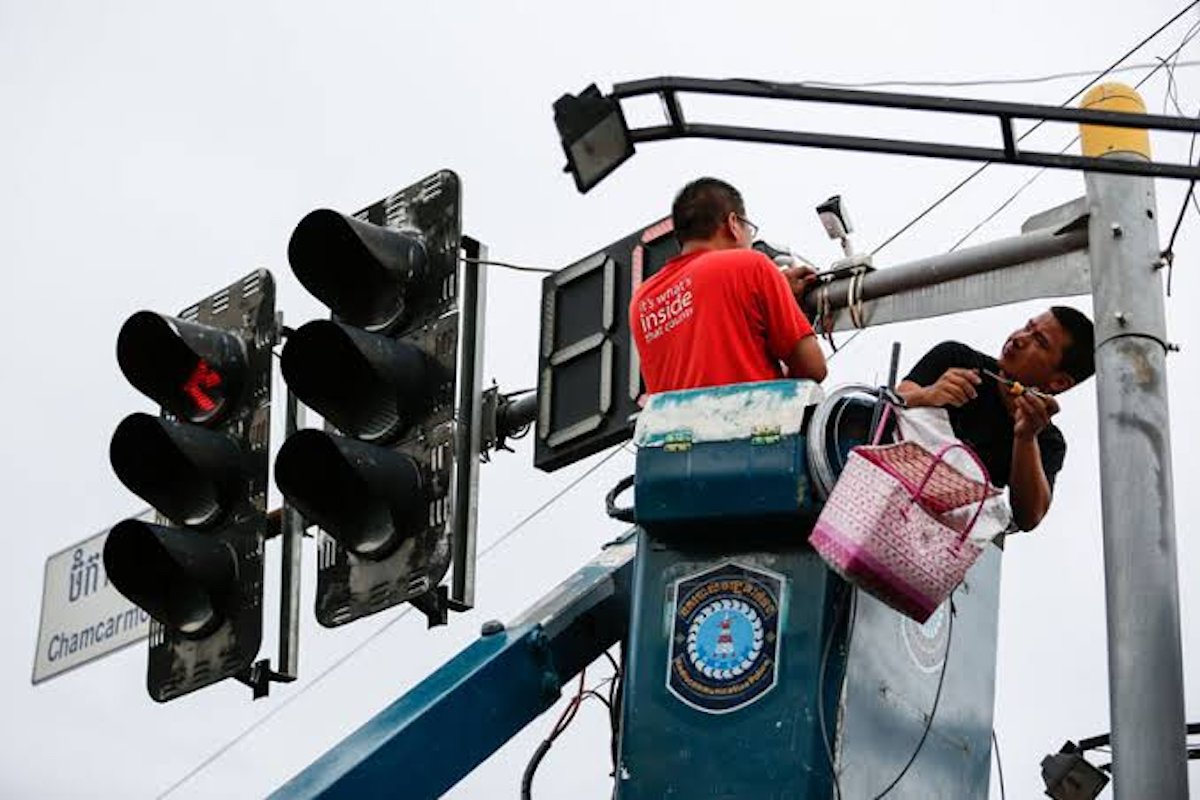
Artificial intelligence and digital surveillance tools offer governments unprecedented capabilities to track, identify, and intimidate populations. China is already deploying AI-enabled surveillance technologies globally, and Cambodia is building comparable infrastructure through its China-backed “Smart Police” initiative, which has been used to crack down on dissenting voices.
Activists have long warned of this trend. Experts at the Carnegie Endowment for International Peace noted as far back as 2022 that Chinese surveillance technology had been exported to more than 50 countries. Through the so-called Digital Silk Road, China has not only exported hardware but also helped shape cyber laws and internet infrastructure abroad, extending its influence over how information is managed and controlled.
For Cambodians, the danger is not abstract. Attacks on opposition figures and regime critics are already common, even beyond the country's borders. Expanding the state's ability to identify, track, and monitor individuals could give Phnom Penh powerful new tools to target those already vulnerable to intimidation and repression.
As technological cooperation between China and other authoritarian governments deepens, such repression could become more systematic, less visible, and harder to challenge. In Cambodia, where democratic institutions have been steadily weakened and meaningful oversight is limited, there are few safeguards to prevent technologies presented as tools of public security from being turned against the government's critics.
A generational disappointment
For Cambodia's younger generation, this trajectory is deeply frustrating. Many hoped Hun Manet represented a chance for a different future—a younger leader who might embrace political openness, strengthen independent institutions, and build a more balanced relationship with China and democratic partners. Instead, political space remains restricted, and Cambodia's international partnerships increasingly reinforce the authoritarian model established under his father.
This should serve as a warning to Southeast Asia. Chinese influence is no longer confined to diplomacy, investment, and military cooperation; it is increasingly reinforced through technology and the exchange of governance models that reach deeper into state institutions and, potentially, the daily lives of ordinary citizens.
With AI surveillance infrastructure still being scaled across much of the world, there is time to establish meaningful safeguards around its export and use. That means protecting journalists, activists, and political opponents, increasing transparency over data collection and surveillance, and setting clear rules for cross-border intelligence sharing before authoritarian practices become embedded in digital infrastructure.
Washington has a particular responsibility to push for such safeguards, not simply because of its position in the global AI race, but because its negotiations with Beijing will help shape the norms governing the technology's international use. This week's talks should look beyond strategic competition and confront a more immediate question: how to prevent AI from becoming another instrument of authoritarian influence, particularly across the Global South.
But the United States cannot do this alone. The European Union, the United Kingdom, ASEAN, South Korea, Australia, and other like-minded partners must coordinate their efforts. For instance, the recent US-China AI hotline is a step toward managing risks, but it must be accompanied by concrete measures to protect human rights. Similarly, Cambodia's anti-scam summit has drawn criticism for overlooking the government's own role in enabling such abuses. The international community must press for accountability and transparency in the deployment of AI surveillance, ensuring that technology serves public safety without undermining fundamental freedoms.