This week, Phnom Penh plays host to the “International Conference on Combating Online Scams,” drawing diplomats, law-enforcement officials, and financial regulators from around the world. Prime Minister Hun Manet’s government is presenting the gathering as evidence of its commitment to tackling a criminal industry that has devastated lives across the globe.
Yet the official messaging also reveals a more immediate concern. When the conference was announced, Cambodia’s state news agency said it was intended in part to help “restore the country’s reputation on the international stage.”
There is nothing unreasonable about wanting that reputation repaired, but it cannot be bought with handshakes and photo opportunities. Cambodia has spent years at the center of Southeast Asia’s scam economy, while reporters, volunteers, and human rights monitors documented forced labor, beatings, and industrial fraud inside guarded compounds, including properties connected to figures close to the ruling elite.
Now that international pressure has forced a reaction, Phnom Penh is asking governments whose citizens it has defrauded to treat it not as a culprit, but as a leader in solving the problem.
The scale of the scam economy
The sheer scale of the industry makes it impossible to argue convincingly that Cambodia was merely a helpless bystander overrun by foreign syndicates. US agencies estimate annual scam revenues between $12.5 billion and $19 billion, equivalent to as much as 60% of Cambodia’s formal GDP.
A new National Democratic Institute (NDI) study also notes that the government itself has stated that nearly 300,000 people tied to the trade left the country during its 2026 crackdown. If that tally is anywhere near accurate, earlier estimates were almost certainly too conservative.
More troubling is how an underworld of this size put down such deep roots. The NDI report argues that foreign criminal money did not simply slip through the cracks of a fragile state. It became absorbed into Cambodia’s economy and political order through land, construction, casinos, payment infrastructure, patronage networks, and elite-linked businesses.
Layers of political protection, the report argues, helped insulate key actors from scrutiny while the industry expanded. This was never simply a failure of state capacity; it was a choice born of a system in which private wealth, political protection, and public authority have long been difficult to separate.
Elite connections exposed
Foreign governments have increasingly followed those connections. In 2024, the US Treasury sanctioned Cambodian ruling-party senator and tycoon Ly Yong Phat, his business group, and associated properties over serious human rights abuses linked to trafficked workers forced to conduct online scams.
In April, Washington sanctioned another sitting senator, Kok An, along with 28 associated individuals and firms, alleging that scam operators worked “under the protection of Kok An and his political connections.” These are US administrative actions, not findings by a Cambodian court, but the lack of comparable domestic legal action against either man tells its own story.
In July, independent reporting described another businessman as the only prominent local tycoon to have been prosecuted in the domestic crackdown, while Ly Yong Phat remained sufficiently close to the Manet administration to appear and be named as the leading donor to Cambodia’s new Senate building the following month.
The criminal indictment of Prince Group chairman Chen Zhi exposed that domestic silence still further. In October 2025, American federal prosecutors accused his conglomerate of operating forced-labor scam compounds across Cambodia and charged Chen with wire fraud and money laundering conspiracy. The Justice Department also sought the forfeiture of roughly $15 billion in bitcoin, calling it the largest forfeiture action in its history. Chen, now in Chinese custody, is presumed innocent unless proved guilty.
Even so, how could a business empire accused of running forced-labor compounds on this scale have become so deeply established without the active blessing, or deliberate blindness, of the state?
Reform theater
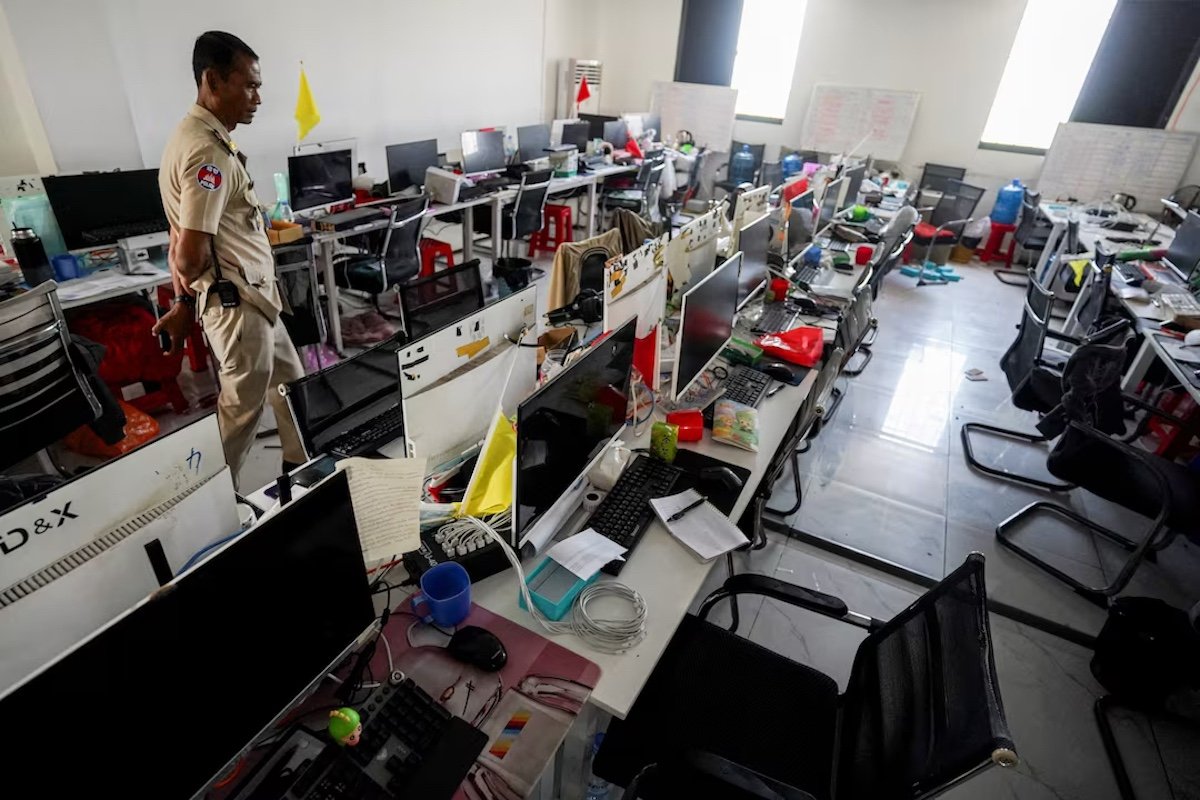
It is true that Phnom Penh has moved aggressively since international pressure intensified, and many notorious compounds, particularly in Kampot and Sihanoukville, now sit empty. But claims that the operations have been exorcised from Cambodia are patently false, when evidence suggests they have become more dispersed.
And, tellingly, even when larger premises have been shuttered, we have learned nothing about the owners of the buildings, and who moved the money or guaranteed protection. Foreign workers, detained in highly-publicized raids, have been swiftly deported, while the owners, financiers, and political patrons remained untouched.
That gives this week’s conference significance beyond the speeches and communiques. The presence of foreign governments and agencies such as the FBI and Interpol gives Manet and his administration something it badly craves: legitimacy as a serious anti-scam partner.
Cooperation with a country that stands as the epicenter of a global criminal network is, of course, necessary, but it should not become an endorsement of Phnom Penh’s preferred narrative in which the Cambodian state is chiefly another victim of foreign criminals, in need of training, resources, and international technical assistance.
The NDI report has a useful term for this danger: “reform theater.” Visible cooperation can allow an entrenched political system to absorb outside pressure while protected networks survive. The danger delegations face this week is judging progress by speeches, deportations, and shuttered compounds rather than by accountability.
I urge attendees to be strict in their demands of Phnom Penh. They should press for credible investigations of politically connected figures, tougher scrutiny of money moving through casinos, companies, and financial channels, and independent monitoring. As Cambodia shuts scam hubs, the world must ensure that the crackdown is not just a public relations exercise. The victims deserve no less.