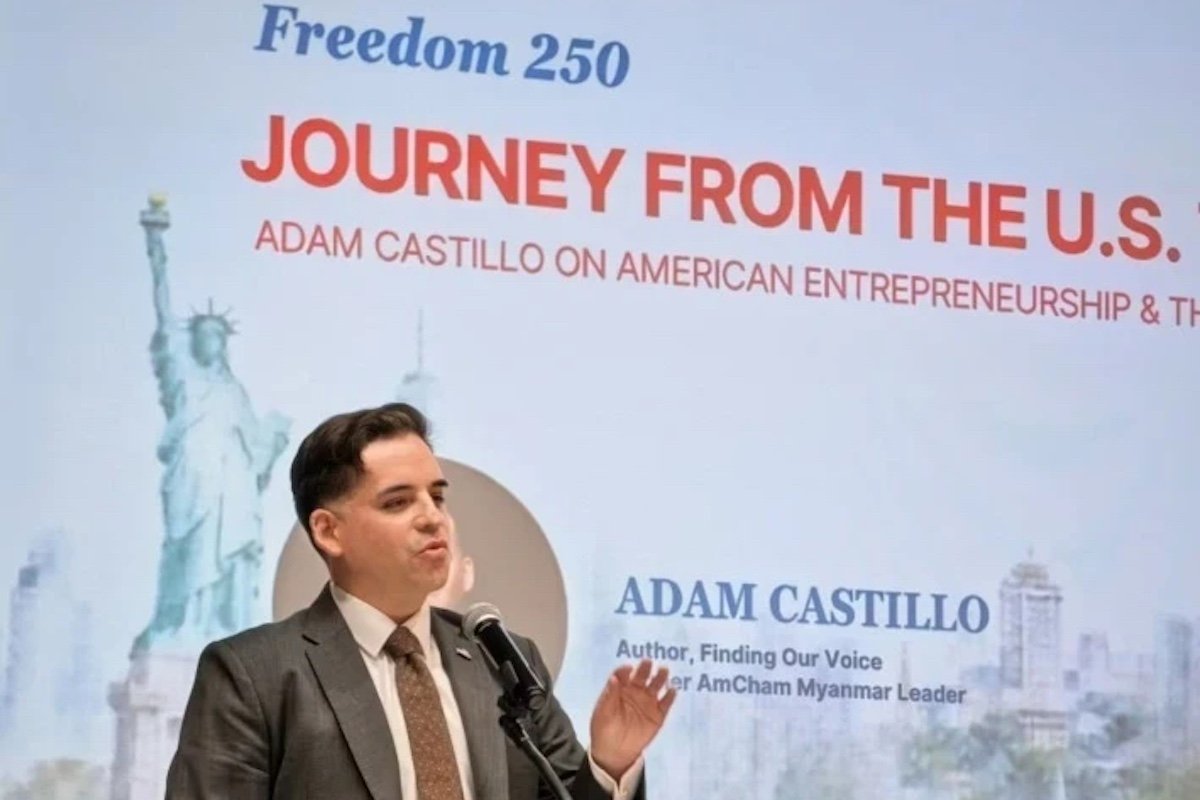
The release of Adam Castillo, a former US Marine and ex-president of the American Chamber of Commerce in Myanmar, is a diplomatic win for Washington. But turning that win into a case for trusting the country's coup-making, rights-abusing generals would be a serious mistake.
Castillo was freed and deported on September 16 after roughly three months in military custody. Global Reach, the organization assisting his family, credited the Trump administration's efforts. His release is welcome news, but Castillo's proposals for American engagement with Myanmar need tough scrutiny.
Myanmar's military-backed authorities framed his departure as a gesture of bilateral friendship. Yet Washington should not let that gesture become evidence that the generals are reliable partners for stabilizing Myanmar's civil war or opening its mineral wealth, including rare earth elements, to US investors.
Reports of Castillo's release disclose no sanctions relief-for-freedom agreement or minerals bargain. No credible leaks have emerged about the US delegation of unnamed officials that arrived in Naypyitaw from Bangkok on the evening of September 15, 2026, and left the following day aboard a US Air Force C-12D Huron aircraft.
The immediate danger isn't a secret deal between the US and the generals. Rather, it's that a narrow US consular success is spun into an argument for political rehabilitation the military hasn't remotely earned—certainly not by releasing a prominent US citizen it detained for months on flimsy grounds.
Washington's own assessment undercuts the generals
Washington's own assessment of Myanmar's situation provides a useful counterweight. A presidential determination sent to Congress on September 15 and released by the State Department the next day found that Myanmar, referred to as Burma in the text, had "failed demonstrably" over the previous year to make substantial counternarcotics efforts, saying, "the military regime has made little discernible effort to crack down on its drug economy."
The same determination found US assistance to Myanmar "currently vital to the national interests of the United States," without naming recipients. Under Section 706, the finding permits covered assistance despite the adverse designation, though it doesn't itself allocate any funds. Disaster relief, food, medicine and refugee assistance already carry statutory exceptions. Nowhere in the assessment are the generals given a clean bill of health.
Castillo's detention followed an AMCHAM complaint focused on his role in establishing the US-Burma Economic Forum as a lobbying organization for the chamber while he was president from 2023 to 2025. In 2024, he reportedly signed a $300,000 contract with Washington-based public relations firm Mercury LLC to arrange meetings and events.
News reports say AMCHAM's complaint claims he "illegally collected the funds using the association's name" but "did not deposit these funds into the association's bank accounts"—charges Castillo has denied. Castillo told the BBC that neither he nor his company had lobbied on behalf of Myanmar's government and that he had not approached US officials seeking sanctions relief for the regime or its associates. His release neither resolves this dispute nor provides new clarity on it.
Limits of transactional diplomacy
Reuters reported that Castillo met with advisers in Vice President JD Vance's office in July 2025 and pitched an American peace-broker role—including a self-governance arrangement between the military and the Kachin Independence Army, and mineral processing routed through India. Vance himself was not present, and the talks were exploratory rather than adopted policy, the report said.
The issue isn't whether US-brokered peace talks or US mineral deals with Myanmar are objectionable in principle—it's whether a narrow natural resource bargain would crown the military as Myanmar's accepted gatekeeper while leaving the underlying armed conflict unresolved. A bilateral accommodation could benefit specific communities if it genuinely reduced violence and respected their choices, and the Kachin and others should not be denied that agency in the name of a broader democratic cause.
But a local agreement is not, by itself, a nationwide federal democratic settlement. Neither a foreign businessman nor a foreign government can supply the consent of the people whose political future and resources are on the table.
Research from the Stimson Center think tank, published in July 2026, found mining control fragmented among ethnic armed organizations. The Kachin Independence Army (KIA) seized most rare-earth mines in late 2024, new mines have emerged in territory held by the Ta'ang National Liberation Army (TNLA), and nearly all of Myanmar's heavy rare earths still move overland to China. An agreement signed in Naypyitaw thus cannot manufacture control over mines, community consent, transport access or alternative processing capacity. America's desire to reduce dependence on China's rare earth dominance doesn't make a deal with the generals any more feasible.
The test is a working supply chain, not access to a minister's office in Naypyitaw. Castillo's case shows at least partly why engagement proposals built around resources and territory the junta doesn't control are likely futile. To be sure, the junta wants improved relations with Washington. A July 2025 agreement between the lobbying firm DCI Group and Myanmar's Ministry of Information specified a $3 million annual fee to rebuild relations with the US, focused on trade, natural resources and humanitarian relief. That contract shows a paid lobbying arrangement, and nothing more. It has no established link to Castillo's detention or release.
A better opposition response
Myanmar's democratic forces should welcome Castillo's freedom without treating his ordeal as vindication. They should also resist declaring that Washington has already betrayed them, since the terms of his release remain undisclosed. Several questions remain unanswered, and the junta's record—from its sanctions-busting axis with Russia to its failure to meet ASEAN's test—offers no reason for trust. The release of one American, however welcome, does not change that.