BANGKOK — Thai authorities exhumed four bodies from an unlicensed Jewish cemetery on September 16, part of a widening investigation into Israeli nationals accused of illegal property deals and business practices. The move comes as anti-Israel sentiment, stoked by a popular rock star's song and a protest outside the Israeli embassy, has taken on an anti-Semitic tone that worries diplomats and community leaders.
Investigations and nationalist backlash
The exhumation took place in Chachoengsao province, about 60 kilometers east of Bangkok, where the cemetery had operated without a valid license since 2023. Officials said the dead included three Israeli men and a British woman, whose identities were based on paperwork and await forensic confirmation. The cemetery's license expired in 2023, and authorities are also examining its financial links to Chabad Houses across Thailand.
Thai security forces have been focusing on tourist-heavy areas such as Bangkok, Phuket, Pattaya, Koh Samui, Koh Phangan, and Pai, where Israeli-run hotels, restaurants, and tour companies have become conspicuous. Arrests, property seizures, and deportations of foreigners—especially Israelis—have struck a nationalist nerve in this Buddhist-majority nation.
Popular rock star Aed Carabao, whose real name is Yuenyong Opakul, released a song in September titled “Where Do Jewish People Come From?” (Thai: “Kon Yiw Ma Jak”). The lyrics warn: “Zionist, Zionist, Zionist / Israel is not Thai / Thai soil is not Canaan / Thai soil is not Israel.” Carabao has voiced support for rallies against what he calls an Israeli takeover of destinations like Koh Phangan and Pai.
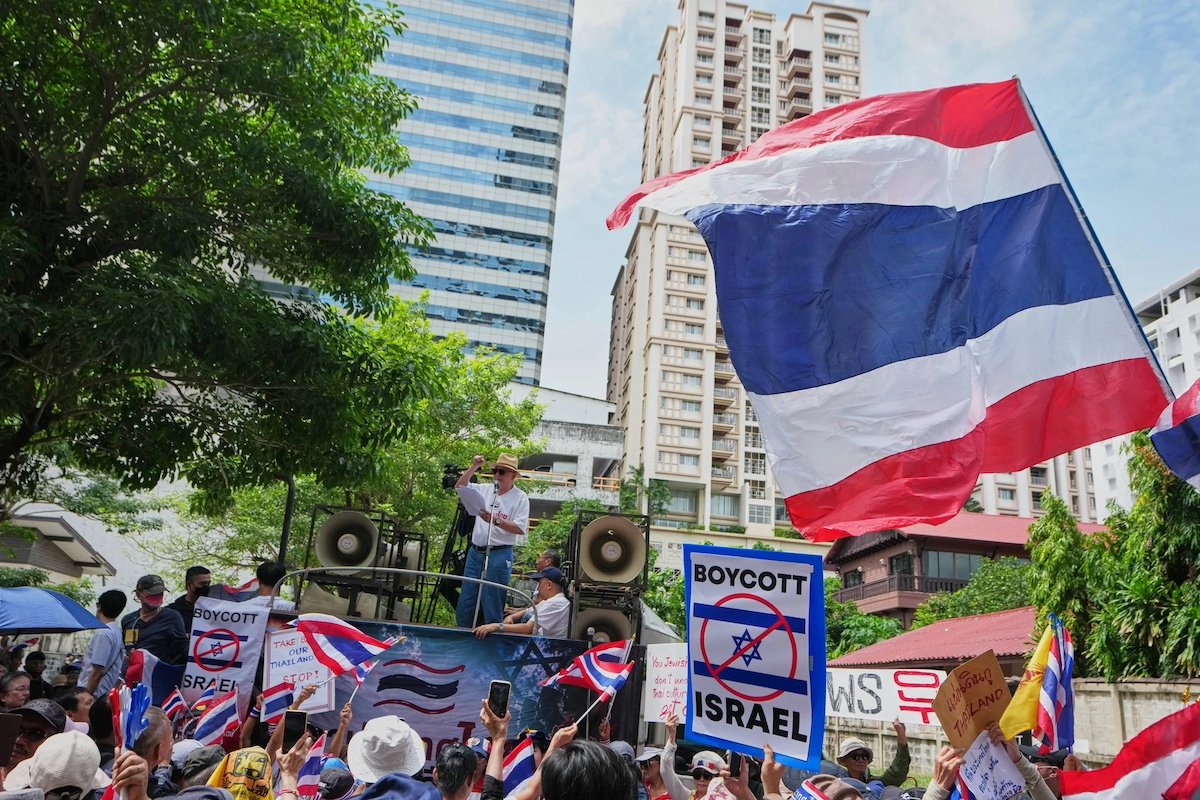
On September 10, about 300 conservative and royalist protesters gathered outside the Israeli embassy in Bangkok, with some displaying signs reading “Jews Out” and “Keep Zionist Expansion Out of Thailand.” The protest was spearheaded by media owner Sondhi Limthongkul, and among the speakers was Siranudh “Psi” Scott, an heir to the Singha beer fortune, who told the ambassador: “Get the f*ck out! We don’t want you here.”
Israel’s Ambassador to Thailand, Alona Fisher-Kamm, condemned the rhetoric, noting that chants of “Free Palestine” and insults against Jews went beyond legitimate grievances. “There are areas where the numbers show significant Israeli involvement, such as illegal land purchases, and there are serious cases,” she told Israel’s Ynet news. “But insulting people, shouting, arguments, music and noise in the middle of the night—there is a feeling that Israelis think everything is allowed.”
Thai media have framed the issue as a mix of xenophobia, economic stagnation, and genuine complaints about Israeli conduct, both in Thailand and in the Gaza conflict. The Khao Sod English news described it as “a combination of xenophobia, a nation facing economic stagnation, genuine grievances, plus some people’s opposition to how Israel has conducted itself mercilessly in Gaza, the occupied West Bank, and recently, in Iran.”
The US State Department’s Special Envoy to Monitor and Combat Antisemitism, Yehuda Kaploun, an Israeli-American Chabad-Lubavitch rabbi, expressed concern on X (formerly Twitter) on September 11, saying he was “deeply concerned by rising antisemitic rhetoric in Thailand” and that the State Department was in close contact with Thai authorities to ensure the Jewish community’s protection.
The Chabad-Lubavitch movement, which operates over 3,000 houses worldwide, has a presence in Thailand, offering kosher food, religious services, and community support. The cemetery in question was operated by Kan Chabad Co. Ltd, and officials are investigating whether its finances are linked to the Chabad network.
This episode reflects broader regional tensions. India's evolving arms relationship with Israel shows how the conflict reverberates across Asia, while recent European bans on settlement imports highlight the international dimension. For Thailand, the challenge is balancing legitimate law enforcement with avoiding the spread of anti-Semitic stereotypes that could damage its reputation as a welcoming destination.
As the investigation continues, Thai authorities face the delicate task of addressing real grievances without allowing nationalist fervor to veer into hatred. The coming weeks will test whether Bangkok can manage this crisis with the “land of smiles” spirit intact.