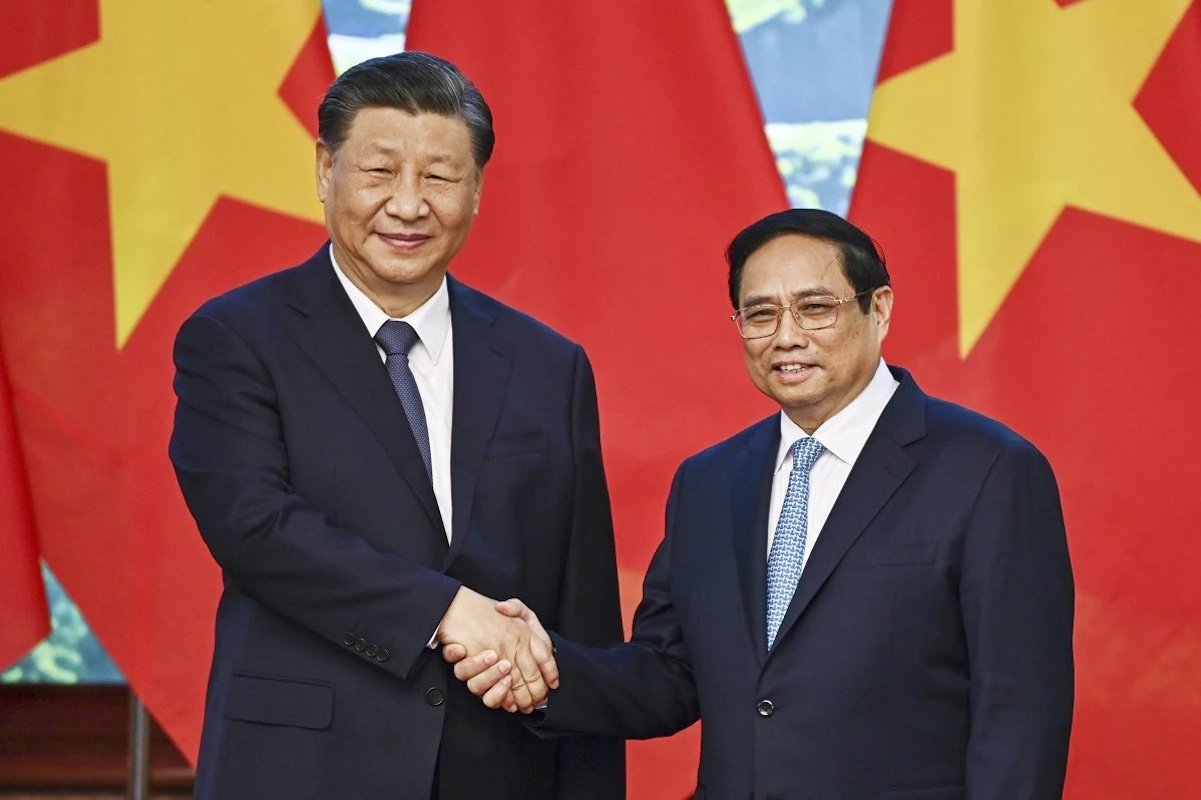
When Vietnam’s Prime Minister Le Minh Hung landed in New Delhi for the 18th BRICS Summit, the visit was framed at home as a diplomatic milestone. He met bilaterally with Indian Prime Minister Narendra Modi and outlined Hanoi’s vision for international cooperation. But beneath the headlines, the trip underscored a quieter reality: BRICS remains a peripheral thread in Vietnam’s diversification strategy, not a pivot point.
The BRICS partner-country category, created at the Kazan summit in October 2024, was designed for states that want a seat at the table without the full commitments of membership. Vietnam took eight months to formally accept the invitation, finally doing so in June 2025. The delay was telling. Indonesia, by contrast, moved straight to full membership, while Vietnam chose the outer ring—a track that signals engagement without the signaling costs that full membership entails.
A bloc with concentrated weight
BRICS now counts 11 full members and accounts for roughly 41% of global GDP at purchasing power parity. But that heft is heavily concentrated: China alone generates about half of the bloc’s output. Excluding China, the remaining members’ combined share of world goods exports has actually declined since 2011. For Vietnam, the question is whether BRICS offers anything it doesn’t already have.
On trade, the answer starts with the Comprehensive and Progressive Agreement for Trans-Pacific Partnership (CPTPP), which binds Vietnam to enforceable rules eliminating tariffs on 95% of goods, alongside investment protections and digital trade provisions. The World Bank estimates the CPTPP alone will lift Vietnam’s GDP by at least 1.1% by 2030 under conservative assumptions—with larger gains when paired with the Regional Comprehensive Economic Partnership (RCEP), whose simplified rules of origin cover a market spanning China, Japan, South Korea and Australia. Add the EU-Vietnam Free Trade Agreement, and Vietnam has already institutionalized trade ties across every major market. BRICS offers no equivalent: no enforceable tariff schedules, no dispute-settlement mechanism, no binding commitments.
Bilaterally, Vietnam has built 15 comprehensive strategic partnerships, including with China, Russia, India, the United States, Japan, South Korea and the EU. Since To Lam became general secretary, that number has roughly doubled, with 12 more countries added across lower partnership tiers. The relationship with India was upgraded to an Enhanced Comprehensive Strategic Partnership during To Lam’s state visit in May, encompassing defense, rare earths and a $25 billion trade target by 2030. In other words, Vietnam already conducts its most consequential business with BRICS members through these bilateral channels—not through the BRICS forum itself.
The trade figures bear this out. China-Vietnam trade reached about $153 billion in the first half of 2026; Russia-Vietnam trade totaled $4.77 billion in 2025; India-Vietnam trade has crossed $16 billion—all managed through bilateral channels, with the China relationship additionally supported by RCEP and the ASEAN-China Free Trade Agreement. Exports to India, Russia and South Africa still make up less than 3% of Vietnam’s total trade, and whatever marginal diversification BRICS might offer simply hasn’t materialized in the numbers.
Institutional finance: a similar story
The BRICS New Development Bank has approved roughly $42.9 billion across 139 projects, and the $100 billion Contingent Reserve Arrangement offers a liquidity backstop—both potentially useful, except that partner status confers access to neither. Vietnam isn’t an NDB member, and the Asian Development Bank and Asian Infrastructure Investment Bank already perform the same functions, with deeper institutional roots in the country.
What partner status delivers is diplomatic positioning, not economic substance: a seat in the Global South reform conversation outside ASEAN-centered mechanisms, and optionality on the alternative payment and settlement systems BRICS is developing, should the dollar-denominated order come under further strain. India, notably, has been moderating the bloc’s ambitions on that front, framing the agenda as de-risking rather than de-dollarization. It also functions as a venue for advancing bilateral ties: the Modi-Le Minh Hung meeting on the summit’s sidelines covered defense, energy, critical minerals and the proposed 2+2 mechanism. None of that required a BRICS summit—but the summit made for an efficient occasion to get it done.
That calculus could shift. If the CPTPP loses enforcement credibility, if RCEP’s rollout stalls, or if U.S. tariff actions intensify, alternative frameworks gain relative value. China’s 2027 BRICS chairmanship adds another variable: India’s tenure suited Vietnam well, staying economics-focused and steering clear of anti-Western posturing, but Beijing is likely to push a more assertive agenda on payment systems and institutional expansion—leaving partner countries under pressure to engage. As Asia's weight quietly redefines BRICS, Hanoi will watch closely.
For now, Vietnam’s engagement with BRICS is supplementary, not a strategic realignment. The serious institutional work still runs through trade agreements with enforceable rules and bilateral partnerships with real operational weight. BRICS simply adds a forum where Vietnam can be present without being bound. As multilateral forums multiply, one challenge facing middle and smaller states is sorting out which ones carry real weight and which are merely supplementary. Vietnam’s choice of the partner tier—and its use of the summit’s margins to conduct bilateral business—suggests Hanoi has already drawn that distinction with some clarity.