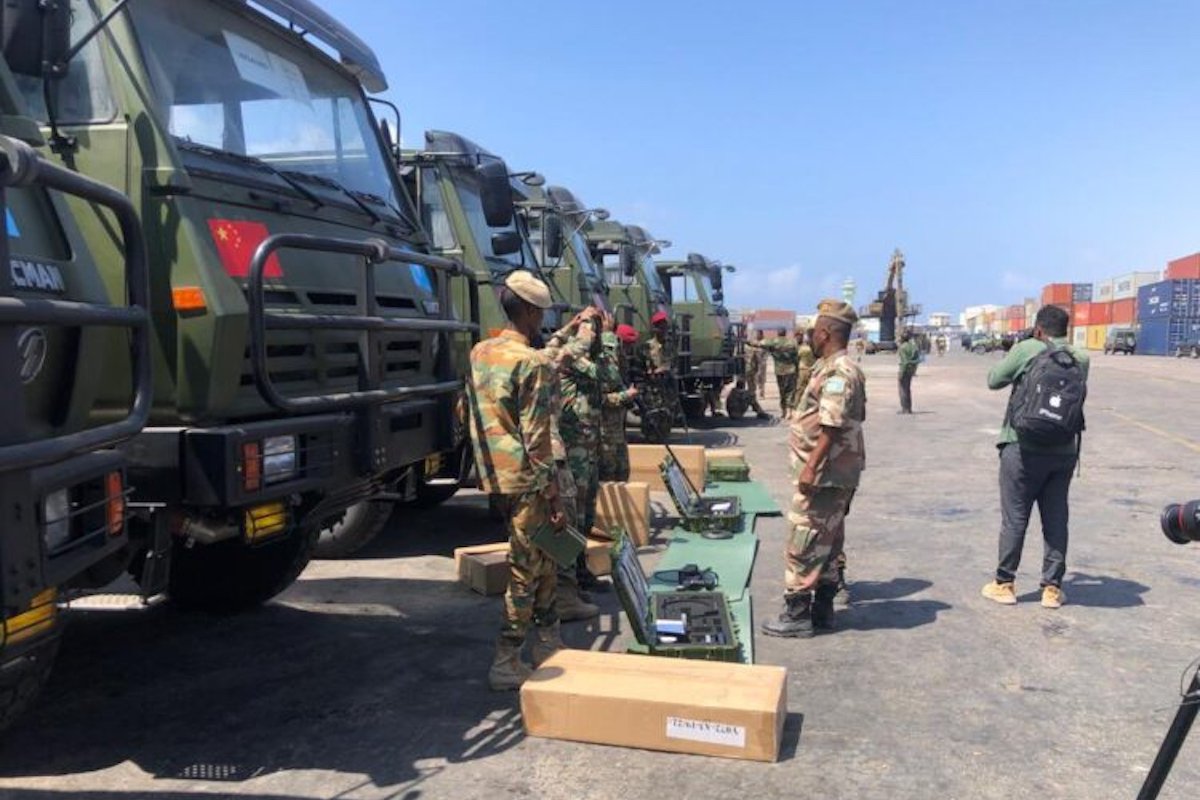
China has pledged to significantly increase military assistance to Somalia, promising equipment, training, and closer security cooperation with Mogadishu in its fight against the al-Shabaab militant group. The announcement marks a notable escalation in Beijing's engagement in the Horn of Africa, a region where it has traditionally maintained a cautious and limited footprint.
According to Brendon J Cannon, a researcher who studies external powers in sub-Saharan Africa, China's interests in Somalia are twofold. The first is geopolitical: the Horn of Africa, linking the Indian Ocean to the Red Sea and Mediterranean, is a strategic crossroads. Beijing already maintains a military base in Djibouti and has invested heavily in infrastructure across Ethiopia, Kenya, Uganda, and South Sudan. The second, more specific driver is China's domestic politics and its stance on Taiwan.
Beijing considers Taiwan a breakaway province and is alarmed by Somaliland's diplomatic recognition of Taipei in 2020. Somaliland, a de facto independent state that broke away from Somalia in 1991, has pursued international recognition, and its ties with Taiwan threaten China's efforts to isolate the island diplomatically. As of 2026, only Eswatini and Somaliland in Africa maintain formal relations with Taiwan.
China's support to Somalia includes diplomatic backing, development assistance, and now security cooperation framed around counterterrorism. However, its economic footprint remains modest compared to neighboring Ethiopia, which has received large-scale Belt and Road infrastructure projects. Chinese engagement in Somalia is selective and strategic rather than transformative.
Strategic Interests and Diplomatic Calculations
Beijing's growing involvement in Somalia is directly linked to Somaliland's diplomatic progress. In December 2025, Israel became the first state to formally recognize Somaliland's independence, prompting China to reaffirm its support for Somalia's sovereignty and territorial integrity. US policymakers are also pushing for recognition of Somaliland.
China and Somalia's leaders frequently affirm their support for "One Somalia" and "One China," respectively. From their perspective, both Somaliland and Taiwan must submit to central rule. Neither entity wishes to be part of what they view as failed political experiments, and both face pressure from larger, more powerful neighbors. China has wealth, economic power, a growing navy, and a military tailored for a potential invasion of Taiwan, yet Taiwan continues to resist, backed by the United States, Japan, and Australia. Mogadishu, meanwhile, cannot control much of its own territory; its military remains weak, entangled in clan politics, and unable to defeat al-Shabaab despite decades of external assistance.
This shared failure to shift the status quo unites China and Somalia against smaller, weaker entities. Beijing's approach in the Horn of Africa differs from Western actors, who emphasize counterterrorism operations, governance reforms, and security sector training. Turkey and the United Arab Emirates have combined military engagement with infrastructure investment and commercial interests, often embedding themselves in Somalia's internal politics. China, by contrast, focuses on regime support to reinforce territorial integrity, building technological and institutional dependencies in telecommunications, technology, and surveillance.
Greater Chinese involvement risks adding another layer of geopolitical competition in an already fragile region. Rather than acting as a stabilizing force, Beijing may find itself drawn into the same local dynamics that have frustrated other external actors. Somaliland, in comparison, has developed a relatively functional security sector and strong domestic political legitimacy. There is little reason to expect China's military assistance to succeed where others have failed.
This development also intersects with broader trends in the Indo-Pacific. For instance, China's truck-mounted drone launcher blurs military and civilian lines, reflecting its expanding defense capabilities. Meanwhile, India's nuclear buildup sharpens deterrence as Pakistan and China probe below the threshold, highlighting the region's security complexities. Additionally, China blacklists 40 Japanese firms, accusing Tokyo of militarization, signaling its aggressive posture on multiple fronts.