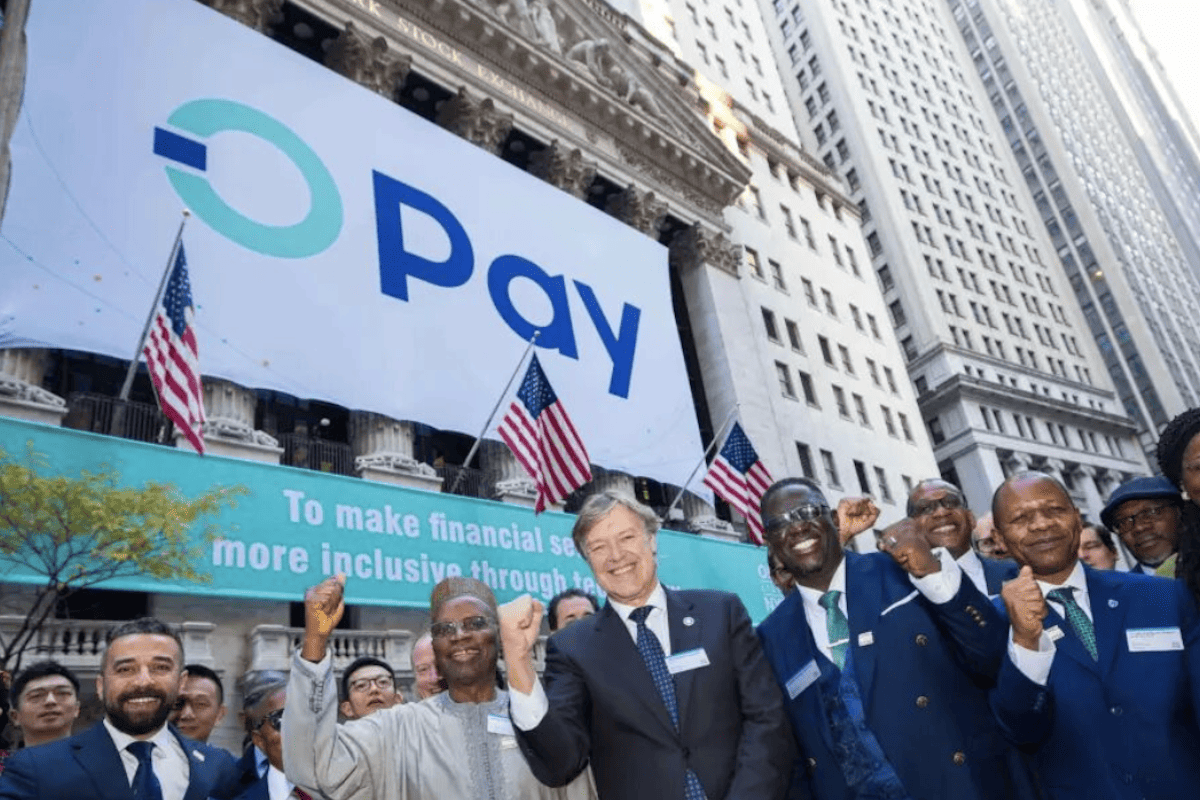
On October 30, executives of OPay, a Nigeria-focused payments company, rang the opening bell at the New York Stock Exchange. Within hours, their $304 million initial public offering was suspended before a single share traded. The company had priced 16 million American depositary shares at $19 the previous evening, implying a valuation of roughly $4 billion.
OPay's terse statement cited a regulatory inquiry in a jurisdiction it deemed immaterial to its business, without naming the country or authority. Reports, citing people familiar with the matter, pointed to a Chinese regulator. OPay has not confirmed this, and an inquiry does not imply wrongdoing.
A company with multiple homes
OPay's corporate structure reflects the globalized nature of fintech. Its headquarters are in Singapore, its holding company is incorporated in the Cayman Islands, and its founder, Zhou Yahui, is a Chinese national. Yet Nigeria generated 89.5% of its first-half revenue in 2026. The company's operations are deeply embedded in the Nigerian economy: 50.1 million monthly users, $558 billion in transaction volume over the twelve months to June, and $467.1 million in first-half revenue with net income of $90.9 million.
For many Nigerians, OPay is a lifeline. Its agents facilitate money transfers and merchant payments without the need for bank branches, and the company is expanding into credit. OPay insists none of this is affected, and most users are unlikely to notice the New York setback.
The regulatory shadow
China's rules on overseas listings, in effect since March 2023, require companies deemed Chinese to file with regulators before certain offshore share offerings. OPay's prospectus noted that Chinese legal advisers saw no need to file, given the group's lack of mainland revenue in 2025 and its offshore operating assets and management. But the rules also instruct regulators to judge by substance over form, leaving room for broader interpretations.
The 2023 test has two limbs, both of which must be met: at least half of the issuer's revenue, profit, assets, or net assets must come from mainland companies, and its business must be conducted mainly in China or run by managers who are mostly Chinese citizens or residents. Zhou, who held 21.3% of OPay's shares before the offering, is non-executive chairman, but his passport alone does not satisfy the test. Still, the discretion inherent in the rules means Chinese regulators could apply their own criteria of control and operations to companies they regard as Chinese, regardless of where customers and revenue reside.
This episode underscores a broader tension: a Chinese entrepreneur who builds a business in Africa may find the regulatory tie to home outlasting the customers and revenue that settle elsewhere. The address of an offshore holding company offers little protection.
Ripple effects for African listings
OPay's aborted IPO also had implications for South Africa's Standard Bank Group. Stanbic Africa Holdings, a subsidiary, had agreed to buy up to $200 million in OPay shares, subject to the flotation and regulatory approvals. The two groups were also discussing cooperation in payments and lending. A South African bank's stake in a Nigerian company thus hinged on an offering in North America and, if reports are accurate, on an unresolved regulatory question in China—an authority over which no African investor, exchange, or supervisor has any say.
OPay had planned a secondary listing in Lagos, which would have allowed Nigerian investors to own part of a company whose strongest market is their own. That plan is now on hold with no confirmed date. Even if both listings had proceeded, OPay warned that shares traded in Nigeria might not be freely exchangeable with the American depositary shares, potentially causing price divergence and split liquidity.
African exchanges face similar challenges as more of the continent's successful tech companies consider listing at home. On October 20, MNT-Halan, an Egyptian fintech, began trading on the Egyptian Exchange after floating a fifth of its Egyptian business for about $150 million. The Cairo debut valued that business at around $750 million—a fraction of the $4 billion OPay was seeking.
The sequence of OPay's plan is telling: New York first, Lagos only after a price had been set abroad. Its venture backers, including SoftBank, would have gained a dollar-denominated exit route. But the collapse highlights the fragility of such arrangements when a regulator elsewhere takes an interest.
Funding for African startups is thinning. In the first ten months of 2026, only 343 companies raised at least $100,000, down from 438 a year earlier, and total funding fell 12% to $2.4 billion, although equity funding rose 5%. Exits are critical for venture funds to return cash to their own backers, and African startups have seen relatively few. OPay, profitable and valued in the billions, looked ready to supply one.
OPay's preferred shareholders have a date to watch: if no qualifying IPO occurs by December 31, 2027, they can seek redemption on agreed terms, returning the original investment plus 8% annual simple interest. A long delay would thus carry a cost even if the payments business keeps growing. OPay says it expects the inquiry to conclude without material impact, but the episode has already exposed the limits of offshore structures in an era of heightened regulatory scrutiny.