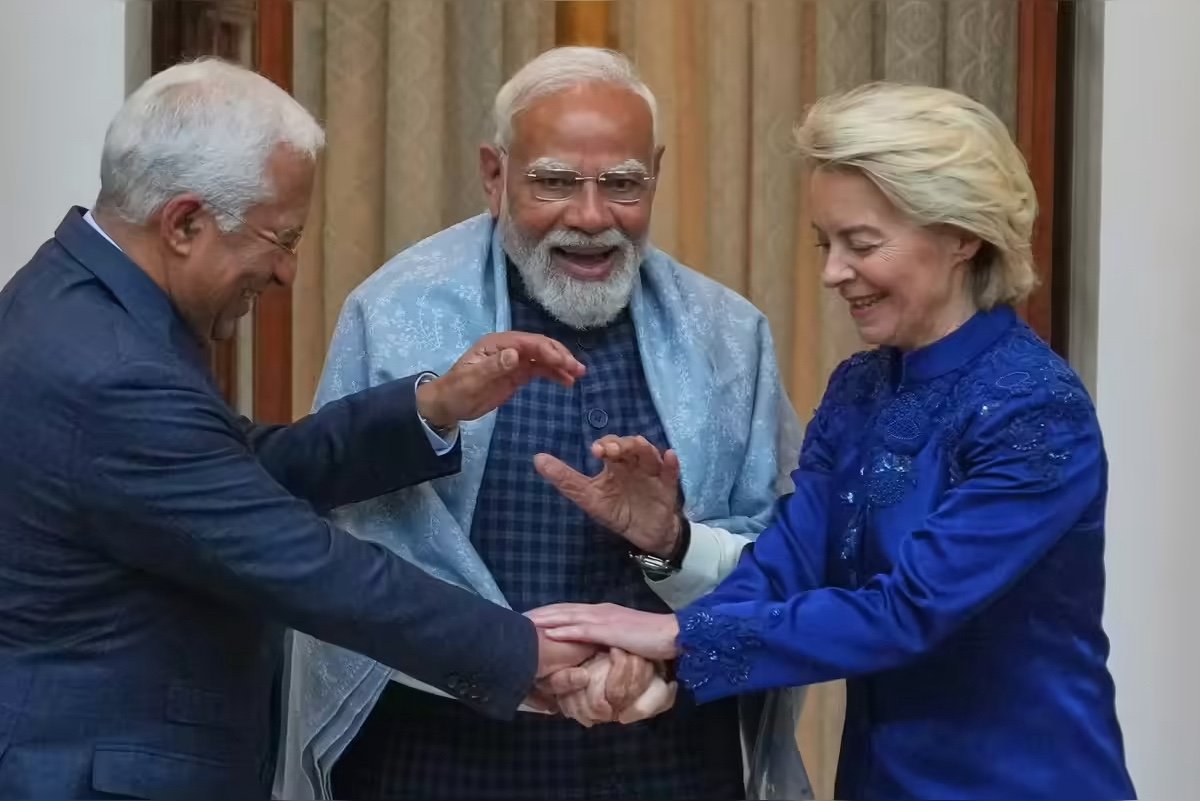
The European Union and India concluded their long-awaited trade agreement in early 2026, a deal that stands as one of the most complex and politically revealing negotiations in the EU's modern history. Formally known as the EU–India Broad-based Trade and Investment Agreement, the pact demonstrates that free trade can still advance even in an era defined by geopolitical fragmentation, supply-chain disruption, and competing development models.
The roots of this agreement stretch back to the early 2000s, when Brussels and New Delhi—already significant commercial partners—began exploring a more structured economic relationship. In 2004, they elevated ties to a "strategic partnership," signaling shared interests in trade, technology, and global governance. Formal negotiations launched in 2007, envisioning a comprehensive framework covering goods, services, investment protection, public procurement, intellectual property, and regulatory cooperation.
Yet progress stalled. Between 2007 and 2013, talks advanced unevenly as fundamental differences emerged. The EU pushed for deeper market access in automobiles, wine and spirits, pharmaceuticals, and public procurement, alongside stringent IP and investment standards. India prioritized mobility for its skilled professionals under Mode 4 of services trade and insisted on policy space for its development priorities. Europe's financial crisis and shifting political priorities in New Delhi after 2014 led to a de facto suspension in 2013.
A Decade of Stalemate and Strategic Recalibration
For nearly a decade, the agreement remained frozen, mirroring broader shifts in global trade politics. The EU adopted an increasingly values-driven approach, embedding sustainability, labor rights, and environmental standards into its external economic relations. India grew skeptical of comprehensive deals, emphasizing domestic manufacturing, strategic autonomy, and economic resilience. It was only in the late 2010s and early 2020s—amid supply-chain disruptions, intensifying US-China rivalry, and Europe's search for dependable partners—that momentum returned. In 2021 and 2022, negotiations were relaunched through a modular approach that separated trade, investment, and geographical indications into parallel tracks.
The prolonged gestation reflected not diplomatic inertia but the challenge of reconciling two large, diverse economies with distinct regulatory philosophies and global ambitions. Its conclusion in early 2026 marked not merely a bilateral breakthrough but a broader recalibration of trade strategy in an era of geopolitical uncertainty.
That uncertainty intensified dramatically after Russia's full-scale invasion of Ukraine in February 2022. India's continued economic engagement with Russia—particularly its imports of discounted crude oil—became a point of contention with Washington. In mid-2025, the United States announced a 25% tariff on selected Indian exports, explicitly linked to India's purchases of Russian oil. From New Delhi's perspective, such measures appeared disproportionate: with a population of roughly 1.46 billion and one of the world's fastest-growing major economies, energy security is a development imperative. Since the war began, India's crude oil imports from Russia surged from marginal levels to an estimated 35–40% of its total crude mix by mid-2025, making Russia one of its principal suppliers. Bilateral trade surpassed US$68 billion in 2024–25.
Indian officials have pointed to what they view as inconsistencies in Western policy. The European Union continued substantial trade with Russia in 2024, with bilateral goods trade valued at approximately 67.5 billion euros, alongside record imports of Russian liquefied natural gas (16.5 million metric tons). The US also maintained imports of selected Russian commodities, such as uranium for civilian nuclear use and palladium critical to electric vehicle manufacturing, even while criticizing India's energy purchases. From New Delhi's vantage point, these patterns reveal a double standard.
Europe's response, by contrast, has been marked by pragmatism rather than overt coercion. While firmly condemning Russia's actions and maintaining an extensive sanctions regime, European policymakers have acknowledged that trade and energy flows remain essential to economic stability. This calibrated approach informed Europe's renewed engagement with India, culminating in the 2026 trade agreement. The pact's modular structure allows both sides to manage their differences while deepening cooperation in areas of mutual interest, such as digital trade, green technology, and supply-chain resilience.
The EU-India deal also carries implications for the broader Indo-Pacific. As the US and China compete for influence, the agreement offers an alternative model of economic integration—one that is rules-based but flexible enough to accommodate strategic autonomy. For India, it reinforces its position as a bridge between the West and the Global South. For the EU, it provides a foothold in a region where China's industrial overcapacity and Japan's yen volatility are reshaping trade dynamics. The pact's success will depend on implementation, but its very existence signals that free trade still has a future—even in a fractured world.